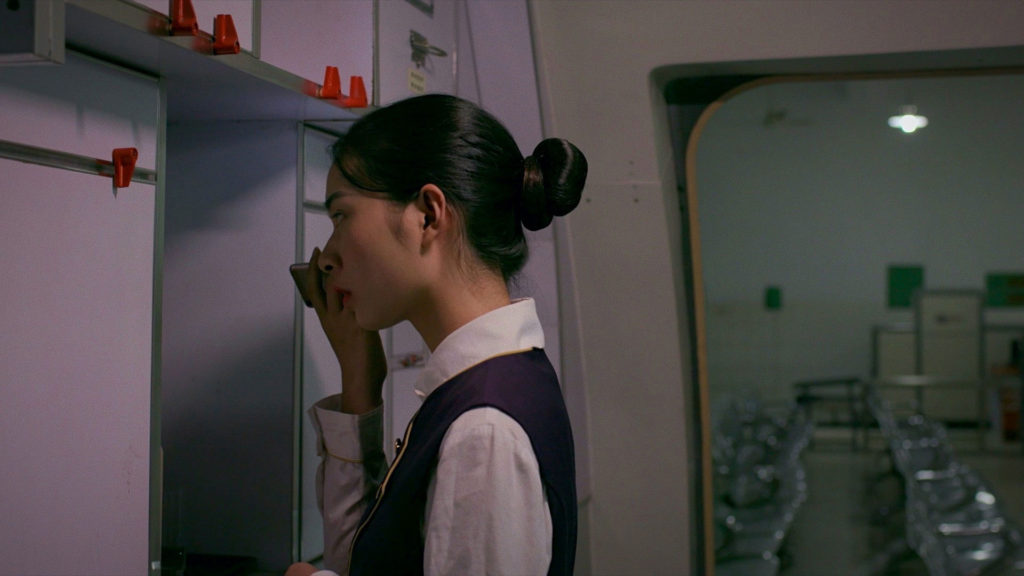
Before the Flood [STONEWALLING]

Stonewalling/石门/Shímén

Rating *** A must-see

Directed by Huang Ji & Otsuka Ryuji

In an early scene from Stonewalling, co-directed by wife-husband duo Huang Ji & Otsuka Ryuji, the main character Lynn (Yao Honggui), who works in various modeling and hostess gigs while studying to become a flight attendant, recites the phrases “forty is forty,” “fourteen is fourteen,” “forty isn’t fourteen” to herself over and over. In Mandarin, these words (sì shí shì sì shí, shí sì shì shí sì, sì shí bú shì shí sì), while foundational in and of themselves, combine to form a rather potent tongue-twister, one that Lynn, who grew up speaking Hunanese, uses to improve her grasp of the dominant Mandarin dialect, any extra asset to assist in her hireability, though she declines to practice her English.

Stonewalling is suffused with such delicate balances of identity that reflect wider socioeconomic concerns. It is the third part of a trilogy with Egg and Stone (2012) and The Foolish Bird (2017) — the first directed by Huang solo, while all three are lensed by the Japanese-born Otsuka — a triptych following Yao’s character from the age of 14 to 20 and her parents (played by Huang’s own father and mother). I haven’t seen the first two films, whose narrative linkages seems fairly secondary to Stonewalling‘s concerns, but they all deal with the particular struggles faced by young women in a rapidly changing China. And those struggles are especially particular here: the film takes place over the course of Lynn’s unexpected pregnancy; first intending to get an abortion, she instead decides to carry her child to term so that her mother (who runs a woman’s clinic) can offer it as compensation to a patient who lost her own child.

This set-up gestures towards Stonewalling‘s most pressing interest: the commodification of the body, how one’s personal being is turned into just another item for the market, objectified in multiple senses of the word and evaluated according to strict parameters. Much of the film thus unfolds as almost a series of vignettes, as Lynn passes from gig to gig, crossing back and forth from her parents’ home in the suburbs of Changsha to the big city, continually trying to sustain herself amidst a climate of uncertainty and fraud, most clearly typified by her mother’s participation in a multi-level marketing scam involving a healing cream. The effect is in many ways akin to an ambitious cross-section of a certain aspect of the Chinese marketplace, continually finding new manifestations and outgrowths of a fundamental imbalance in society.

But what makes Huang and Otsuka’s approach much greater than a simple exposé of the dire state of modern China and/or capitalism in general is the middle ground they find. Mostly shooting in static long shots, the pace of their scenes unfurls with a great sense of consideration, refusing to lean into the outrageousness of any moments and instead letting it emanate from the material. This especially comes to pass during a crucial job that finds Lynn supervising a group of women potentially slated to donate their eggs to wealthy clients; all young, attractive, and told to behave in certain ways, their job interviews take place with exactly the level of discomfort one might expect without ever becoming overbearing. (It’s also worth noting that there are a few Uyghur women in this group, though it’s not a thread that is this film’s place to explore further).

Throughout this, Lynn’s sense of drift and displacement remains pronounced, not the least because of her fraught, distant relationship with her parents and her boyfriend, the latter of whom disappears for most of the film because of her concealment of her decision to carry her child. And this all reaches full tilt with a shockingly vivid recreation of the early days of the pandemic, something which is evoked as a disruption to the rhythms of life, a further elaboration on Stonewalling‘s interest in the body’s role amidst the masses blown up to national and then global scales. Without saying too much further, the ending suddenly hammers home the sadness and personal ties that bind, only hinted at before and which suddenly come home to roost. The elegance of its conceit, the suddenly bursting emotions that swell amidst immense loneliness, feels so attuned to its character’s journey, something which makes the quotidian rhythms all the more potent.

Preliminary Sight & Sound 2022 Thoughts

Initial thoughts on the 2022 Sight & Sound Poll initially written for Seattle Screen Scene.

For all the prattling I’ve done on Twitter about this iteration of The List, which I do agree is pleasingly vibrant, I find it hard to really get my thoughts settled about it. Part of the idiosyncrasy of such an endeavor is of course how arbitrary it can feel, a taste purposefully unrepresentative of all but whatever might be considered the “average” critic in the year 2022. But there’s also the way in which highly diverse films — directed by Keaton, Sembène, Apichatpong, Leone, Bresson, just to name the first names on the list alongside the incongruous Peele — are lumped together, a “baseline” of tradition that’s largely neglected in favor of the discussion of all the new films that have sprung to the surface and the old ones that have drowned.

This is of course how the discourse works; change is — ironically, given the new #1 — much more interesting than what’s already known. And despite everyone talking about how films made the list or not, we really only have about half of the most important data: not only the individual ballots, but also what lies just beyond the top 100. For some reason, I always thought that as long as something was in the top 250 it was roughly as prestigious as the top 100, whereas the current attitude of many seems to be that if a film is not in the top 100 then it’s been ejected from The Canon (as opposed to the canon). Certainly I’m guilty of this, and I have my own lamented favorites, stalwarts (The Mother and the Whore, The Magnificent Ambersons, Gertrud, the aforementioned Rio Bravo) and new combatants (Twin Peaks: The Return, Goodbye, Dragon Inn) alike that might have ended up in the top 150.

Sean, I like your phrasing about “established young critics” (I guess I’m one, though I don’t try to think of myself that way) having their own Wild Strawberries and Chinatown, even as I struggle to figure out what those might be. As I’ve made clear elsewhere, I do think the inclusion of Portrait of a Lady on Fire in the top 100, let alone at #30, is (despite being an okay film) a travesty, a kowtowing to mediocre middlebrow aesthetics dressed up in gestures to representation that do little to ameliorate its great faults. I do quite like the other 2010s films, especially Parasite, but it’s not so much their newness that troubles as it is the magnitude of hype that accompanies them, while vastly more totemic films in our circles (Twin Peaks, Toni Erdmann, Zama) get left in the dust; I agree (and hope) that none of them stay in the top 100. (Perhaps unfairly, I’d also lump in Daisies as a massively overinflated inclusion, and probably The Piano and Daughters of the Dust as well.)

None of these qualms really apply to some of the other enormous jumps: Wanda, Killer of Sheep, Do the Right Thing, all deserving and cemented in film history long before their breakthroughs here. They certainly don’t apply to Beau Travail and “Meshes of the Afternoon,” two films which I had no inkling would make it as high as they deservingly did, alongside my beloved Mulholland Dr. and In the Mood for Love. And most of all they don’t apply to Jeanne Dielman, as deserving a #1 as any film out there. On the one hand, I don’t think it’s absolutely sunk in for me how incredible a result this is, given its almost inevitable rise amid a general renewed love for Akerman’s work. Despite The Discourse that has resulted, it truly is a challenging film in all the best senses, one which demands an engagement rare for films that generally make it to the uppermost echelons of this kind of evaluation.

But it also has me weirdly reflecting back on Vertigo, and how weirdly out of place its 10-year reign was. The other three #1s — Jeanne Dielman, the perennial winner Citizen Kane, the one-time Bicycle Thieves — were all effectively nuclear bombs in the film landscape of their time, radical films which had an immense effect on the many films that followed in their footsteps. This has been obscured in large part by, as Jonathan Rosenbaum put it, his polemical (and to my mind true) reading of Citizen Kane as “the first feature of an independent, avant-garde filmmaker” being downplayed by the traditional reading as a flash-in-the-pan triumph of the Hollywood system by a director who never bettered it.

Vertigo, on the other hand, though it had a slow rise and seemed likely to best Kane in 2012, is in many ways the opposite of these other #1s, entirely befitting its status as a dark mirror. It is still likely cinema’s greatest nightmare, a reflection of all the forbidden pleasures we cinephiles indulge in. Of course none of the other three are exactly heartwarmers, but there is nothing of the plain humanism of Bicycle Thieves, the astonishing jubilation of Citizen Kane, the uncompromising feminism of Jeanne Dielman, only a swooning pain. Vertigo has many imitators to be sure, but it took much longer to reach that level of recognition. Maybe we can only appreciate how strange it is that it was ever at the very top in hindsight.