Trenque Lauquen

Trenque Lauquen continues and, in many ways, elaborates on the ascendancy of the Argentine production company El Pampero Cine as one of the greatest forces in cinema today. Directed by Laura Citarella, who produced Mariano Llinás’s modern landmark La flor, it functions as a loose sequel to her 2011 film Ostende, with the principal linkage courtesy of its heroine Laura (Laura Paredes, one of the leads of Llinás’s film, who also co-wrote the screenplay), a botanist who disappears at the beginning of the film, leaving her boyfriend and her coworker to fruitlessly search for her, developing their own uneasy relationship along the way. What ensues is a four-hour, eight-chapter opus that constantly hops between the trio’s perspectives, and in the process serves as almost something of a response film to its spiritual predecessor: while La flor‘s quartet of female leads existed as pure fantasy, icons who came to embody entire axioms of cinema, Trenque Lauquen‘s approach is more grounded, yet in some ways even more elusive. Its shapeshifting journey — spanning epistolary detective-work, eerie quasi-science fiction, landscape observation, and so much more — is far less delineated, and thus the genres become a backdrop to this portrait of a woman and the small city she roams. Patient but always surprising, blending El Pampero Cine’s simple point-and-shoot style with overt cinematic devices (above all voiceover), the ultimate elegance of the film is overwhelming.

I Contain Multitudes [SHOWING UP]

Showing Up

Rating **** Masterpiece

Directed by Kelly Reichardt

Inherent in the process of artmaking is the imperfection, the unexpected detour that can radically change the overall trajectory of the artist’s intent and execution. Mark Toscano once wrote about an occurrence in his restoration of Stan Brakhage’s films, where the legendary avant-garde filmmaker stated that, for a particular short, he had initially failed to spot the hair in the camera gate; upon doing so, he decided to orient his entire visual conceit around that unintended intrusion. Such an approach can be found across media and along the entire continuum of resources and styles: whether it be classical or experimental, a mega-blockbuster or a no-budget picture, a piece of music or a film or a play, the essential humanity of art means that nothing “perfect” exists, which is something to be cherished and upheld as indicative of a personality, or a coterie of personalities, behind pieces both imposing and modest.

The best films about art accept this idea on its own terms and incorporate it into their forms; the miracle of Kelly Reichardt’s Showing Up lies in its ability to do so while creating a vivid world of its own, filled with quotidian frustrations, mysteries, and liberations. In her portrait of Lizzy (Michelle Williams), a sculptor who does administrative work at a Portland art college for a living, Reichardt does this task almost literally: the film takes place at the Oregon College of Art and Craft, which closed just before the pandemic. Temporarily resurrected during filming, the space conjures an effect not so dissimilar from Tsai Ming-liang’s Goodbye Dragon Inn, though there is no looming closure that threatens to destroy an entire way of life.

Instead, Showing Up takes place over the course of a week, as Lizzy attempts to create enough pieces for her first solo show while dealing with sundry personal problems: her contentious relationship with her friend and landlord Jo (Hong Chau), who is dragging her heels on fixing her fellow artist’s hot water due to her own impending shows; her tedious days at the college under the watchful eye of her boss, who happens to be her mom (Maryann Plunkett); and her house calls to her eccentric father (Judd Hirsch) and troubled brother (John Magaro). An additional wrench is thrown into the proceedings when her cat mauls a pigeon, breaking its wing; almost by accident, she ends up taking care of it for large stretches of time, forcing her to alter her art-making routine. Crucially, however, Lizzy is not the sole protagonist. Jo takes center stage at numerous moments, with her relatively carefree nature — she is introduced excitedly rolling a tire down the street to a tree so she can swing from it — acting as a source of equal parts hilarity, resentment, and serenity, something which Chau inhabits with exquisite good grace. Even more importantly, the film is strewn with shots of students and teachers creating their own art in wildly different media — light installations, artifice-forward films, wool-work, dyeing, painting, and much more — usually without Lizzy or any named character in the shot, frequently featuring bold tracking shots to convey the scope of this institute.

While Showing Up is probably funnier than all of Reichardt’s previous films put together — the withering glares Williams flashes at certain points are especially choice — it generously refuses to look down on any of the art its characters make, not even a landscaping piece that Lizzy’s brother claims to be crafting near the climax of the film. Its view is humble yet expansive, often using uncharacteristic jerky small pans and zooms which could be called be called, not unlike the more apparent zooms of Hong Sang-soo — whose recent films, particularly The Novelist’s Film, feel like kindred spirits in their approach to the artist — amateurish.

Of course, the entire nature of what it means to be an amateur, especially in this milieu, where a relative star like Jo still has to deal with possibly not getting a catalogue for her work, has no bearing on the quality of art or its maker’s level of dedication. While plenty of artmaking is seen, including from Lizzy, the most extended view of her practice comes in a static long take, where she breaks off the arm of one of her sculptures so she can carefully attach a different, extended set of arms in its place. That concept, subtraction in the service of addition, can be found all over Showing Up, especially its climax at Lizzy’s opening, which evolves into a litany of anxiety and passive-aggression that then unspools into a fitting equanimity. The key in that modus operandi is the back-and-forth: the blindspots and irritation must exist alongside the camaraderie and rapprochement, often coming from the most unexpected of sources. In that balance, in her leads’ abilities to carry both emotions, Reichardt finds her brilliant muse.

Bob Dylan’s Bootleg Series Ranked

I can’t think of a series of physical media releases that I currently adore more, both conceptually and in execution, than the ongoing Bootleg Series issued by Bob Dylan and Columbia Records. Despite the ultimately large differences in my personal love for each, all of them are wonderful and probably essential listens for any Dylan lover. Somehow, they take his inextricable relationship with the genesis and continuing influence of the “illegal” bootleg and Great White Wonder and take them far further, all while feeling like not shameless cash grabs/commercial co-option but rather true labors of love.

These rankings, and even the categorization around the boundaries of each tier, aren’t terribly precise, but it’s worth noting that they’re graded along dual criteria: listening enjoyment and historical significance. My own tastes are different than many others, of course (Shot of Love is in my top 5 Dylan albums after all), but I do think this general order feels right; all the Curios — the name is meant as a compliment, and not a backhanded one either — are extremely fascinating and lovely works in and of themselves. These are all evaluated based on my first (give or take a couple) listens of the standard editions, typically composed of two CDs, and don’t take into account any ancillary material like the booklets.

MASTERPIECES

Vol. 13: Trouble No More, 1979-1981

Vol. 16: Springtime in New York, 1980-1985

Vol. 11: The Basement Tapes Raw

Vol. 8: Tell Tale Signs: Rare and Unreleased, 1989-2006

Vol. 10: Another Self Portrait (1969-1971)

Volumes 1-3: (Rare & Unreleased), 1961-1991

TREASURE TROVES

Vol. 17: Fragments: Time Out of Mind Sessions (1996-1997)

Vol. 5: Live 1975: The Rolling Thunder Revue

Vol. 4: Live 1966: The “Royal Albert Hall” Concert

Vol. 14: More Blood, More Tracks

CURIOS

Vol. 15: Travelin’ Thru, 1967-1969

Vol. 9: The Witmark Demos: 1962-1964

Vol. 12: 1965-1966: The Best of the Cutting Edge

Vol. 6: Live 1964: Concert at Philharmonic Hall

Vol. 7: No Direction Home: The Soundtrack

Volumes 1-3: (Rare & Unreleased), 1961-1991

Realistically speaking, if these were considered as individual volumes, their placement in these rankings would be wildly different: Vol. 1 would be towards the bottom, Vol. 2 likely wouldn’t still leave the Curios tier, and Vol. 3 would be a healthy Treasure Trove. But taken together, this is a completely remarkable achievement, a full summary of Dylan’s entire oeuvre thus far and nearly indefatigable in its search for tracks both expected and unexpected. The inclusion of “Blind Willie McTell” and “Series of Dreams” alongside stuff like “I Shall Be Released” and the 3/4 “Like a Rolling Stone” acts as a validation of then-late Dylan; even if the amount of tracks is a little smaller, the straight run-through of Infidels outtakes lands like a sledgehammer. And there’s even room for surprises to a Dylan fan of like myself among the first two volumes, “Last Thoughts on Woody Guthrie” most of all. Really just a total triumph, with an impact and breadth even greater than the sum of its parts.

Vol. 4: Live 1966: The “Royal Albert Hall” Concert

This and its successor (and that volume’s successor to a much lesser extent) are a little difficult for me to evaluate, considering that I listened to them a number of times many years ago, when my Dylan interest was strictly limited to the ’60s and 1975-76. Still, this really is a great live album, well balanced along the acoustic and electric halves, and engrossing as a clearly audible evolution of energy and tension until the enormous release of “Like a Rolling Stone.” For historical value alone this must place in at least mid-tier, the true apex of the electric period controversy, but Dylan is inspired, clearly headed for a crash under the intense spotlight that dogged him throughout the tour but giving it his all. The Hawks/Band are great as well, “Tell Me, Momma” was probably the first non-studio Dylan song I ever heard and is a perfect way to start disc 2, and I love the little blast of “God Save the Queen” after he’s already left too, a reminder of where we are and a sudden calm reckoning after the storm.

<p
Vol. 5: Live 1975: The Rolling Thunder Revue

The gulf between this and Hard Rain, at least quality-wise, really isn’t as different as many say, but there’s something infectious about the exuberance displayed throughout here, and for all the complaints about this not being taken from a single concert like the surrounding volumes, the hodgepodge nature works to its benefit as a reflection of the ragtag brilliance that typified the Rolling Thunder Revue. “Tonight I’ll Be Staying Here With You” is so electrifying that I often forget it was originally on Nashville Skyline, and in many ways my enormous cooling on Desire actually helps me love the openness and unrestrained fun here. Again, the relative familiarity makes it hard to rate this, and the historical significance is a little tempered considering the existence of other documents of the RTV and its prominence in Dylan’s legend, but as a collection of music it’s never not transporting.

(I’m not counting the DVD that originally came with this; cool to see Dylan playing “Tangled Up in Blue” and to have the Biograph version of “Isis,” though it’s annoying “Romance in Durango” isn’t here, but it’s fairly inessential after everything else on this set.)

Vol. 6: Live 1964: Concert at Philharmonic Hall

I’m probably underrating this one, and it’s really a testament to the strength of the other volumes that this has to settle for second-to-last. The thing that totally escaped me before is how much this is a document of Dylan essentially on top of the folk music world. Consequently, he spends much of it in quite welcome goof-off mode, forgetting the first verse of “I Don’t Believe You,” bantering with the audience (the “Mary Had a Little Lamb” quip is especially choice). His incorporations of Bringing It All Back Home material adds several layers of historical significance; on the other end of that spectrum, the duets with Joan Baez are just lovely, to the point where he simply provides accompaniment on one song. Not as varied as the other releases, but on pure mood alone, this is a great time.

Vol. 7: No Direction Home: The Soundtrack

This is the release that I really don’t know what to do with. I haven’t yet seen Scorsese’s documentary, but as is this exists in a weird space, quite nearly superseded by not one but two volumes: 1-3 in its attempt to tell the story of Dylan, which is a much narrower portrait that only runs to the motorcycle crash; and 12, in its extensive reliance in disc 2 on 1965-66 studio outtakes. I listened to it a second time and think it flows a bit better, but the inclusion of “Song to Woody,” an honest-to-God studio album track, takes up space on what’s supposed to be a bootleg (even if it is the perennially underrated debut), a decision which rubs me the wrong way, as does the usage of 4’s closer to a lesser degree (surely there was some other final performance that would have worked as well). Not a misfire, and listening to Dylan’s evolution even in micro form is still fun, but this is the one that I don’t think has quite the same clear-cut raison d’être that every other volume has.

Vol. 8: Tell Tale Signs: Rare and Unreleased, 1989-2006

Quite conceivably the most important release to the identity of the Bootleg Series aside from 1-3; not only does this introduce the deluxe edition concept that every release from 10 on embraced, but it also redirects the focus of the series from live records or career overviews to a laser focus on a specific period of his creativity. That period here, while still larger than the others, is just chock-full of great songs, and especially coming after the familiarity of 7, the pure blast of energy of “Mississippi” and expert flow makes this a total joy to listen to. The inclusion of multiple versions of the same song also highlights the mutability and constant experimentation that truly comes to the fore with this installment going forward, as does the canny incorporation of fantastic live cuts. The reintroduction of track-by-track notes is more than welcome (though sadly not universally adopted); “‘Cross the Green Mountain” is the exact right slightly odd way to end too. As a realignment in multiple ways and a collection dedicated to such different eras that nevertheless feels so concentrated, this is a total success.

Vol. 9: The Witmark Demos: 1962-1964

Notwithstanding its clear historical significance, I initially had this solidly in second-to-last place, thinking that the comprehensiveness made for something of a slog, but a relisten really helped me love this more. The collection, similar to something like the Basement Tapes, benefits from simultaneously seeing the demos as embryonic forms that would be elaborated on further and as a vibe in and of themselves, the chronological flow across songs signaling a development in songwriting that’s become rather palatable for me to track anew. There’s also just a charm in hearing such a young Dylan interacting with the producers, his eagerness breaking up the songs without interrupting the mood. Much stronger as a unit than I had previously given it credit for.

Vol. 10: Another Self Portrait (1969-1971)

For me, Self Portrait isn’t an album in any need of improvement, but what’s so great about this collection is that all the removal of overdubs and so on and so forth only helps emphasize the brilliance of the original. Dylan’s voice comes to the fore, as does his clear passion for his varied material, and the little bits of contextualization — a Nashville Skyline outtake here, a Basement Tapes cut there — work beautifully to frame the sessions that produced both one of Dylan’s best albums and one of his worst. The latter’s alternate takes are near-uniformly better than their approved counterparts; this even manages to redeem “If Dogs Run Free” for God’s sake. I don’t know if this is quite as revelatory as many of its tier fellows, but ending with maybe my favorite Dylan recordings, the “When I Paint My Masterpiece” demo, is such a bold and perfect move. “Masterpiece” on a masterpiece about a masterpiece: couldn’t be more fitting.

(I still wonder why the deluxe edition only includes the invaluable Isle of Wight concert and the baffling choice to throw in a remastered Self Portrait, though I haven’t listened to it yet and it may be markedly different; wish it didn’t seem so lean but that’s not included in the evaluation.)

Vol. 11: The Basement Tapes Raw

This selection carries with it an enormous asterisk; it can be convincingly argued that this is the sole bootleg whose canonical/standard edition is The Basement Tapes Complete; it’s not given a Deluxe classification, it’s the name of the article/listing on both Wikipedia and Discogs, and arguably the entire reason for this release is the completeness. I haven’t listened to the six discs yet, which could either be a bit wearying or #1 by a mile (I’m banking on the latter), but Raw is totally essential in and of itself, not just because it has the track-by-track notes that Complete understandably lacks. The decision to include outtakes, alternate tracks, restored tracks, and tracks without overdubs all in one basket is inspired, not least because it encourages the listener to constantly look back and reconsider these tracks built upon their underground status. I’ve talked about my enormous issues with the ahistoricity and futzing of the original The Basement Tapes, and even Raw makes enormous strides towards correcting them, bringing these songs and recordings back into the light where they ought to have been forty years earlier. While I wouldn’t want to just own this one (and don’t), the standard and deluxe make for a great pair that reinforce each other, and this one has immaculate vibes, a dream to listen to and savor.

Vol. 12: 1965-1966: The Best of the Cutting Edge

This also poses some of the same categorization problems as its predecessor; I don’t expect I’ll ever listen to the Collector’s Edition and it’s safe to discount that, but the Deluxe Edition doesn’t have the awkward “The Best of” specification. There are reasons to put down this collection: the weird contrivance of three separate editions, a slightly redundant return to the electric period well, my insanely petty gripe that it’s the only one where the booklet is so thick (without track-by-track notes I might add) that it and the jewel case have to swap places in the cardboard slipcase. All that being said, this is still a terrific collection of music, albeit with more inessential outtakes and a little less focus and dynamism than most others post-8. It might be that these songs are *too* iconic for the differences in alternate takes to truly register, notwithstanding the real frisson of “Bob Dylan’s 115th Dream” proceeding in acoustic after the false start that’s on the real album. Even on second listen, I have a lot more fun with the more varied Blonde on Blonde recordings (that chugging “Visions of Johanna”!) well into disc 2, and that’s taking into account that it’s one of my very favorite Dylans. But this isn’t a hard listen at all, and I’m in the presence of some of the greatest songs ever recorded, so this can’t be all that low; breaking the continuity with the last giggle-fit track is a pleasingly playful touch.

Vol. 13: Trouble No More, 1979-1981
An astonishingly big swing in all ways: an album of nothing but live performances for the first time since the early bootlegs, a focus on the infamous Christian period, all coming off of the bootleg dedicated to his most beloved era. This is my favorite, with only 16 as a close rival, in large part because the Christian period genuinely might be my favorite at this point. But this is also among the most historically significant releases, with as radical rearrangements as 8, as complete a reconceiving of a period as 10, a band on as much fire as 5. The very fact that the songs that get two versions are the expected “Slow Train” and “Gotta Serve Somebody” and the totally unexpected (to me) “Solid Rock” just demonstrates how intelligent this is as a collection of music. Even the exclusion of a few Shot of Love songs is more than made up for by a number of amazing unreleased songs, especially the immortal “Ain’t Gonna Go to Hell for Anybody.” That this represents the fullest depiction yet of how Dylan’s songs will evolve across a tour is just icing on the cake; the existence of numerous releases of studio outtakes from this era, especially on 1-3, makes this live swerve all the more appropriate. He’s never sounded more fiery or surprising than this, and I couldn’t be more grateful for such a labor of love.

Vol. 14: More Blood, More Tracks

It’s both annoying and entirely reasonable that this is the only Bootleg thus far (hopefully the only one) that only has one disc in the standard edition. On one hand, it messes up the cardboard slipcase aesthetic continuity and it’s much more annoying to take the booklet out of the jewel case. On the other, while this runs into the same problem as 12 — the songs are too iconic, coupled with the inclusion of acoustic tracks already on 1-3 — there’s still the fact that I’m listening to some of the greatest and most penetrating music ever recorded. With just one take for each song — really wish “Call Letter Blues” was thrown on to complete the collection — this still achieves the same consistent mood that, say, 12 and 9 have without ever getting monotonous; the full New York sessions can stay on the deluxe edition, while these represent something of the cream of the crop, a setup akin to my beloved 11. Maybe I don’t have the best idea of how to rate this (it really is short after all, perhaps too much so to be a true treasure trove) but it’s just great music that doesn’t overstay its welcome at all, each take ringing with possibility.

Vol. 15: Travelin’ Thru, 1967-1969

Conversely, I have no clue why this of all bootlegs needed to be three discs, given that there’s actually less music all together than some of its two-disc brethren, though ultimately that doesn’t mess with the continuity nearly as much as 14; it is strange that there’s no deluxe edition though, especially since there’s so many takes that aren’t on here. Regardless, while this probably has a similar relative lack of dynamism as 12, the comparative strangeness of the music here helps elevate it, as does the canny segmentation. This entire period has some of the most pleasant vibes of Dylan’s entire career (alongside of course 11), and this bootleg is a great representation of that, floating along through the unexpectedly great and fascinating Dylan/Cash sessions, all the way to the surprisingly engaging Earl Scruggs cappers.

Vol. 16: Springtime in New York, 1980-1985

Among other things, this is just utterly brilliant as almost a direct rejoinder to 1-3, acting as a remake and embellishment on all those Infidels outtakes. Performing the incredibly valuable duties of establishing both Infidels and Empire Burlesque as two great albums that could have been masterpieces, it also finds one of the most cogent justifications for the entire series, each of the seven common tracks between it and 1-3 chosen to provide an alternate picture of an alternate picture, fully capable of standing on its own but also encouraging the listener to go back and forth, finding a synthesis of Dylan in this incredibly fertile but also compromised period. In that sense, it’s as full a reinvention of a reviled period as 10 and 13, doing so with both those works’ predilection for new arrangements (so much Empire) and by including substantial outtakes, “Too Late” being the crown jewel (a similar approach that 11 applied to a much more popular time). The decision to end with first “New Danville Girl” and then the other take of “Dark Eyes” is primo Dylan sequencing as well. This is as joyous and revelatory as any edition; on some days it might as well be my favorite.

Vol. 17: Fragments: Time Out of Mind Sessions (1996-1997)

First things first: the new remix of Time Out of Mind is as valuable a service as any the Bootleg Series has ever offered. I go back and forth on the original album (though it’s always been great), but drained of the Lanois swamp this version just sparkles. The inclusion of a full studio album on a bootleg, however, kind of unbalances it, or at least makes it a strange object when compared to the semi-hodgepodge concept of all the preceding entries. It almost feels too polished in a way, too obviously great when compared to the relative modesty of the series as a whole; if there’s a mammoth quality to 11 Complete or 14 Deluxe, that’s created by historical reputation rather than an artist’s canon. More pertinently, it means just one disc of outtakes/alternate takes, though it functions almost akin to 14’s single disc; once again I wish “Dreamin’ of You” and “Marchin’ to the City” were on it to complete the set (intriguingly there’s no alternate studio “Million Miles” even in the Deluxe). But the alternate versions here are vastly different and stripped down, there’s yet another version of “Mississippi,” and listening to them just after a more official version adds another valuable lens. Definitely a fascinating experience, and its revision’s brazen lack of precedence is something to be treasured; a real blast to listen to.

Some Thoughts on Getting Over It With Bennett Foddy

My favorite video game that isn’t a first-person shooter (which I’m arbitrarily grouping Portal 2 under), the only one I’ve paid money for in the past five or so years, is one that I don’t know if I’ll ever finish, or even get more than a quarter through. Mostly this is because I’m simply not very good at it, and I don’t know if I’ll ever take the time to dedicate myself to mastering its single control and mechanics. But it’s also because there’s a certain purity in my mind that I’ve built up around the game, a deliberately contrary view of it to the various videos I’ve seen of those who have tried and failed and saw it as something to be mastered, even conquered, rather than savored.

That game is Getting Over It With Bennett Foddy, the masterpiece from the eponymous creator of the even more infamous/reviled QWOP. On first glance, the incomprehensible simplicity of that game seems equally applicable here: once again, the player controls a person who can only move towards an unknown objective through absurd means; there, the individual control of leg muscles, here, by being propelled with a rock-climbing hammer while seated inside a pot. The construction of the game, ascending a tall mountain while constantly in danger of falling off and losing all of one’s progress, has been the central bugbear of any streamer or YouTuber who has attempted it, focusing on gameplay and accomplishment above all else.

But to look at this game this way seems to miss the entire point, to me. For the other half of the game (leaving aside the actual mountain/objects the player is scaling, which I’ll get to in a moment) is its audio component. Most of this comes in the form of Foddy’s narration, which is scripted to a certain degree — in the form of something akin to a developer’s commentary, though the musings are too wide-ranging *and* too intimate to be limited to that categorization — but also incorporates music cues and quotes from such varied sources as Friedrich Nietzsche, Emily Dickinson, Andrei Tarkovsky, and Ice-T, triggered when the player inevitably falls from a great height.

It’s absolutely hyperbolic to say this, but I truly believe the only possible way to adapt this game would have been directed by Godard and starring Buster Keaton. I fully acknowledge that my experience with games is intensely limited, but there’s something so singular about Getting Over It With Bennett Foddy‘s perfect unity of form and content and its ties to its status as an indie game with limited resources. The idea of repurposing digital assets into a weird amalgam hodgepodge, and having that be a tribute to one’s artistic forebears, is a brilliant way of having one’s cake and eating it too, of making a work of art that’s almost designed to be taken the wrong way and introducing varied ideas about consumption and outsider art into the Internet mainstream.

Last week, I loaded up Getting Over It With Bennett Foddy for the first time probably since I had bought the game. My grasp of the controls still isn’t great, I haven’t made it past the “first” screen. But when I fell, after initial frustration, I felt that calm satisfaction once again, at basking in the simple brilliance that this game continues to be an exemplar of.

Rewind & Play

The pre-title sequence of Alain Gomis’s revelatory archival documentary Rewind & Play is, fittingly, a series of shots that will be recapitulated later in the slender 65-minute running time: Thelonious Monk sweating under the hot lights of a television studio in 1969 while his interviewer blathers on. The film is formed entirely from the footage shot for a shelved French TV documentary about the legendary jazz pianist and operates in three semi-discrete parts: Monk’s arrival, as he ambles around the streets of Paris; a contentious interview, where his brusque responses are brushed aside or ordered to be reshot; and a series of performances, whose brilliance is contextualized and offset by the preceding uneasiness. While Gomis doesn’t opt to directly mimic the inimitable, loping hammering of Monk’s music in formal terms, the inclusion of analog video artifacts and microphone bumps, along with some very canny layering of video and stripping-down of audio, pushes the viewer into something of the discomfort the notoriously private icon must have been feeling. The unusual decision to place the explanatory title card right before the end credits only cements the totally successful experiment at play here: only by looking back and considering, rather than trying and failing to impose a narrative, can one truly begin to grasp the essence of genius.

Before the Flood [STONEWALLING]

Stonewalling/石门/Shímén

Rating *** A must-see

Directed by Huang Ji & Otsuka Ryuji

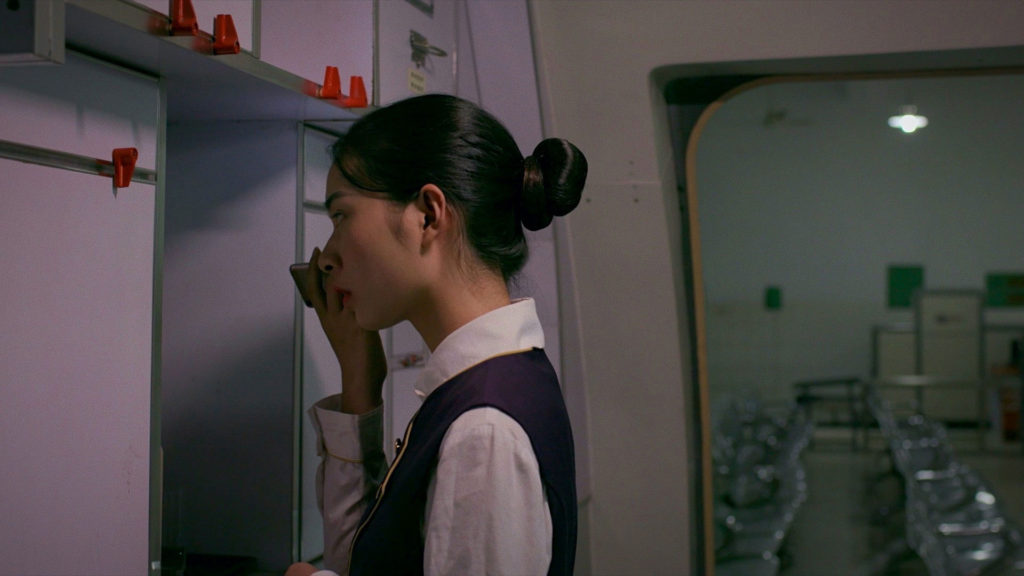
In an early scene from Stonewalling, co-directed by wife-husband duo Huang Ji & Otsuka Ryuji, the main character Lynn (Yao Honggui), who works in various modeling and hostess gigs while studying to become a flight attendant, recites the phrases “forty is forty,” “fourteen is fourteen,” “forty isn’t fourteen” to herself over and over. In Mandarin, these words (sì shí shì sì shí, shí sì shì shí sì, sì shí bú shì shí sì), while foundational in and of themselves, combine to form a rather potent tongue-twister, one that Lynn, who grew up speaking Hunanese, uses to improve her grasp of the dominant Mandarin dialect, any extra asset to assist in her hireability, though she declines to practice her English.

Stonewalling is suffused with such delicate balances of identity that reflect wider socioeconomic concerns. It is the third part of a trilogy with Egg and Stone (2012) and The Foolish Bird (2017) — the first directed by Huang solo, while all three are lensed by the Japanese-born Otsuka — a triptych following Yao’s character from the age of 14 to 20 and her parents (played by Huang’s own father and mother). I haven’t seen the first two films, whose narrative linkages seems fairly secondary to Stonewalling‘s concerns, but they all deal with the particular struggles faced by young women in a rapidly changing China. And those struggles are especially particular here: the film takes place over the course of Lynn’s unexpected pregnancy; first intending to get an abortion, she instead decides to carry her child to term so that her mother (who runs a woman’s clinic) can offer it as compensation to a patient who lost her own child.

This set-up gestures towards Stonewalling‘s most pressing interest: the commodification of the body, how one’s personal being is turned into just another item for the market, objectified in multiple senses of the word and evaluated according to strict parameters. Much of the film thus unfolds as almost a series of vignettes, as Lynn passes from gig to gig, crossing back and forth from her parents’ home in the suburbs of Changsha to the big city, continually trying to sustain herself amidst a climate of uncertainty and fraud, most clearly typified by her mother’s participation in a multi-level marketing scam involving a healing cream. The effect is in many ways akin to an ambitious cross-section of a certain aspect of the Chinese marketplace, continually finding new manifestations and outgrowths of a fundamental imbalance in society.

But what makes Huang and Otsuka’s approach much greater than a simple exposé of the dire state of modern China and/or capitalism in general is the middle ground they find. Mostly shooting in static long shots, the pace of their scenes unfurls with a great sense of consideration, refusing to lean into the outrageousness of any moments and instead letting it emanate from the material. This especially comes to pass during a crucial job that finds Lynn supervising a group of women potentially slated to donate their eggs to wealthy clients; all young, attractive, and told to behave in certain ways, their job interviews take place with exactly the level of discomfort one might expect without ever becoming overbearing. (It’s also worth noting that there are a few Uyghur women in this group, though it’s not a thread that is this film’s place to explore further).

Throughout this, Lynn’s sense of drift and displacement remains pronounced, not the least because of her fraught, distant relationship with her parents and her boyfriend, the latter of whom disappears for most of the film because of her concealment of her decision to carry her child. And this all reaches full tilt with a shockingly vivid recreation of the early days of the pandemic, something which is evoked as a disruption to the rhythms of life, a further elaboration on Stonewalling‘s interest in the body’s role amidst the masses blown up to national and then global scales. Without saying too much further, the ending suddenly hammers home the sadness and personal ties that bind, only hinted at before and which suddenly come home to roost. The elegance of its conceit, the suddenly bursting emotions that swell amidst immense loneliness, feels so attuned to its character’s journey, something which makes the quotidian rhythms all the more potent.

Preliminary Sight & Sound 2022 Thoughts

Initial thoughts on the 2022 Sight & Sound Poll initially written for Seattle Screen Scene.

For all the prattling I’ve done on Twitter about this iteration of The List, which I do agree is pleasingly vibrant, I find it hard to really get my thoughts settled about it. Part of the idiosyncrasy of such an endeavor is of course how arbitrary it can feel, a taste purposefully unrepresentative of all but whatever might be considered the “average” critic in the year 2022. But there’s also the way in which highly diverse films — directed by Keaton, Sembène, Apichatpong, Leone, Bresson, just to name the first names on the list alongside the incongruous Peele — are lumped together, a “baseline” of tradition that’s largely neglected in favor of the discussion of all the new films that have sprung to the surface and the old ones that have drowned.

This is of course how the discourse works; change is — ironically, given the new #1 — much more interesting than what’s already known. And despite everyone talking about how films made the list or not, we really only have about half of the most important data: not only the individual ballots, but also what lies just beyond the top 100. For some reason, I always thought that as long as something was in the top 250 it was roughly as prestigious as the top 100, whereas the current attitude of many seems to be that if a film is not in the top 100 then it’s been ejected from The Canon (as opposed to the canon). Certainly I’m guilty of this, and I have my own lamented favorites, stalwarts (The Mother and the Whore, The Magnificent Ambersons, Gertrud, the aforementioned Rio Bravo) and new combatants (Twin Peaks: The Return, Goodbye, Dragon Inn) alike that might have ended up in the top 150.

Sean, I like your phrasing about “established young critics” (I guess I’m one, though I don’t try to think of myself that way) having their own Wild Strawberries and Chinatown, even as I struggle to figure out what those might be. As I’ve made clear elsewhere, I do think the inclusion of Portrait of a Lady on Fire in the top 100, let alone at #30, is (despite being an okay film) a travesty, a kowtowing to mediocre middlebrow aesthetics dressed up in gestures to representation that do little to ameliorate its great faults. I do quite like the other 2010s films, especially Parasite, but it’s not so much their newness that troubles as it is the magnitude of hype that accompanies them, while vastly more totemic films in our circles (Twin Peaks, Toni Erdmann, Zama) get left in the dust; I agree (and hope) that none of them stay in the top 100. (Perhaps unfairly, I’d also lump in Daisies as a massively overinflated inclusion, and probably The Piano and Daughters of the Dust as well.)

None of these qualms really apply to some of the other enormous jumps: Wanda, Killer of Sheep, Do the Right Thing, all deserving and cemented in film history long before their breakthroughs here. They certainly don’t apply to Beau Travail and “Meshes of the Afternoon,” two films which I had no inkling would make it as high as they deservingly did, alongside my beloved Mulholland Dr. and In the Mood for Love. And most of all they don’t apply to Jeanne Dielman, as deserving a #1 as any film out there. On the one hand, I don’t think it’s absolutely sunk in for me how incredible a result this is, given its almost inevitable rise amid a general renewed love for Akerman’s work. Despite The Discourse that has resulted, it truly is a challenging film in all the best senses, one which demands an engagement rare for films that generally make it to the uppermost echelons of this kind of evaluation.

But it also has me weirdly reflecting back on Vertigo, and how weirdly out of place its 10-year reign was. The other three #1s — Jeanne Dielman, the perennial winner Citizen Kane, the one-time Bicycle Thieves — were all effectively nuclear bombs in the film landscape of their time, radical films which had an immense effect on the many films that followed in their footsteps. This has been obscured in large part by, as Jonathan Rosenbaum put it, his polemical (and to my mind true) reading of Citizen Kane as “the first feature of an independent, avant-garde filmmaker” being downplayed by the traditional reading as a flash-in-the-pan triumph of the Hollywood system by a director who never bettered it.

Vertigo, on the other hand, though it had a slow rise and seemed likely to best Kane in 2012, is in many ways the opposite of these other #1s, entirely befitting its status as a dark mirror. It is still likely cinema’s greatest nightmare, a reflection of all the forbidden pleasures we cinephiles indulge in. Of course none of the other three are exactly heartwarmers, but there is nothing of the plain humanism of Bicycle Thieves, the astonishing jubilation of Citizen Kane, the uncompromising feminism of Jeanne Dielman, only a swooning pain. Vertigo has many imitators to be sure, but it took much longer to reach that level of recognition. Maybe we can only appreciate how strange it is that it was ever at the very top in hindsight.

2022 End-of-Year Catch-Up Capsules

Athena (Romain Gavras)

I feel on the other side for once of the style vs. substance debate, though just as much is probably attributable to just how off-putting its grandstanding seemed to me. Even the lauded opening shot that lasts something like ten minutes and moves from a police station to the sprawling housing complex where the rest of the film takes place acts more as a demonstration of literal fireworks than anything else. I’ve thought before about why two distinct styles of long takes — let’s call them the Cuarón and Bi Gan schools as shorthand — work on me while this one — or, to invoke a much more common and much less technically skilled variant, the kind seen in the likes of Hustlers — don’t, and it has a lot to do with they way they do or don’t support their stories. Both of the really long takes in Children of Men encourage chaos while Bi’s go for maximum dreaminess, but each feel closely tied to the mindset of the character (or characters) they are following. Without such a compelling anchor, there’s nothing to justify (for me) the swooping drones.

It definitely doesn’t help that I found the substance so reprehensible and unbelievable: the zealot’s vehemence overriding any sort of common sense whatsoever, the sneering portrayal of the criminals, the total about-face of the cop on the death of his brother. No one here is given any sort of depth, least of all Athena itself; I have no clue whether it’s a massive set or an actual place where people live, but it’s little more than a playground for Gavras to move his camera and hordes of people; the only thing worse than the nigh-nihilistic ending is the coda which more or less lets the police off the hook entirely.

TÁR (Todd Field)

Note: All other capsules were written today except for this one, which was originally intended as the beginning to a standalone standard-length review.

For all the fascinating and deserved discourse that has sprung up around TÁR, I still think it holds one of the year’s loveliest gestures: the reverse end credits. All except the actors and music credits are featured, playing out over a black screen for about five minutes, accompanied by the sounds of what, according to information only divulged later, is presumably an ethnographic audio recording gathered by Tár in South America. The music being sung, a series of identical lyrics in the round, is as seemingly repetitive as the list of crew members; one wonders whether the first image was included as a reassurance to the viewer that there wasn’t a technical issue that skipped to the end of the film. But the function that these credits serve speaks as loudly as anything in the film; it can be read as almost a rebuke to the now standardized practice of post-credits screens, where people are actually expected to look at the names on screen, instead of scrolling through their phones or chatting while waiting to get to what’s “actually” important. It also serves as a truly noble intent: by the nature of extended repetition, the viewer’s ear is trained to listen to the music, as spare and shaky as it might be, to become attuned to the minute differences and the emotion poured into each note. In essence, before she even speaks one of her many words, the viewer comes to inhabit the mind of the brilliant, mercurial conductor at its core.

I also love, if not the full intent of the final act, then specifically the almost speculative, contemplative mood that it adopts; the boat ride and swim under the waterfall that Tár takes opens up the film to new possibilities, shedding Field’s cloistered halls of culture for something less burdened.

Bones and All (Luca Guadagnino)

I generally like Guadagnino, so it’s difficult for me to express exactly why I found this so anemic and so immediately; something about the recurring use of voiceover to explain the history of cannibalism over the bus travels felt prefab, lazy work that extended to the many feeble attempts to impose an atmosphere of spooky tension. The Stuhlbarg scene was a bust for me, but strangely I do actually like the already legendarily decried work of Rylance in it, if only because it does come across as so inexplicable and in poor Southern dandy mimicry that it lent an air of perversity of proceedings that it desperately needed.

The central relationship lies limp like much of the film, even though Russell and Timothée Chalamet are decent in it; it always feels tentative, on the edge of committing but never becoming either erotic or passionate. I also found the scene with the gay young man egregious, lengthened and winking at matters of sexuality in thoroughly unproductive ways, and the “twist” of the ending is as much of a put-on of bleakness as the rest of the film.

All the Beauty and the Bloodshed (Laura Poitras)

This really is an example of great structuring more than anything else, of trusting the decision to interweave artistry and activism into a portrait of a life well-lived many times over, but it did a number on me. I hadn’t really experienced any of Goldin’s work (also true of Poitras) and so I really appreciated their skillful layering here: combining The Ballad of Sexual Dependency slideshow with her contemplative interviews with Poitras (presented without the questions to heighten the mood) in voiceover creates an air of intimacy that only increases the investments, the personal connections that make the stakes of the film’s strident nature all the more vital. It’s difficult for me to point to specifics much more than that, but the decision to title the film after something Goldin’s sister said says volumes about the sensitivity to the most important details that pervades this.

EO (Jerzy Skolimowski)

I still don’t know if I have much more to say about my favorite film in this round-up (and second of the year as a whole) than just listing the non-stop roundelay of dazzling images and moments: a massive crane presiding over a junk heap like the First Reformed floating sequence, the Night of the Hunter forest venture, the red hellscape of wind farms, the dance of hunters’ lasers at night, and so on and so forth. Despite the Balthazar inspiration, this played to me in many ways like the inverse of that film, whose constant return to recurring human figures struck me on rewatch as much deeper and more considered than I had remembered, less a monolithic story about a suffering donkey than I remembered. Skolimowski takes a different tack, focusing more on the amusing grotesquerie that humanity offers; in that reading the Huppert divergence makes much more sense to me, and it’s more instructive to see Eo as a vessel rather than a specific point of view; it’s notable also that the Wiazemsky analogue doesn’t reappear after all after she abandons him for her biker boyfriend. Skolimowski’s message is carried out to the hilt in that robot donkey, a method of showing a hurt Eo that eschews actually trying to simulate (or actually maim) in favor of a cost-effective method that registers as something human, furthering the beautifully alien nature of this film. Few things better sum up this film’s dizzying brilliance; like others have noted this is late style par excellence yet carried out with the energy of a young man. And the ending reminded me more than a little of A Hidden Life.

Bardo: False Chronicle of a Handful of Truths (Alejandro González Iñárritu)

It didn’t escape my attention that, in this film intended at least a little as González Iñárritu’s grand return to Mexico, his first film predominately in Spanish since his debut Amores perros, he once again adopted the credit Alejandro G. Iñárritu, in the process erasing part of his last name in some kind of attempt to Americanize himself and become even more palatable to the Academy’s tastes. Of course, Bardo is at least partly about this divide, with bookend scenes in its hero’s part-time city of residence of Los Angeles; it really did crack me up to see Giménez Cacho taking the Expo Line, literally riding past my church St. John’s Cathedral.

Calling this self-indulgent and all of the other traditional epithets thrown at González Iñárritu is maybe beside the point, and make no mistake Bardo is that, but the main things that really rankled me are, ironically, those less present than in the other two of his films I’ve seen, both of which I dislike more: political satire. There’s a terribly labored nature to many of his overt breaks with reality and their : a sudden conflict breaking out, Giménez Cacho climbing a pile of corpses to speak with Cortés in a sequence revealed to be some kind of commercial filming (this, like much of the film, is foreshadowed in a long and tedious single-take sequence in a Mexican television studio that’s probably a dream), and most egregious of all a confrontation with a non-White TSA agent at LAX that turned me against the film once and for all.

But Giménez Cacho (and to some degree the always confident lensing of Khondji) comes much closer to salvaging this than any person should, lending many of González Iñarritu’s more irritating tricks — a Woody Allen-esque muting of an irritating conversation partner, a conversation of his father literally rendered in Big Head Mode — a genuine pathos. And I actually do quite like the showy centerpiece where everyone gets down to a slow-motion “Let’s Dance”; as obvious as it is the simple sight of Zama leaping in the middle of a large crowd is pretty fun. Not a truly terrible time, but González Iñárritu never found an interaction he couldn’t turn into bad-faith rancor, and there’s way too much of that strewn through this.

The Whale (Darren Aronofsky)

This might be an even worse film than I already thought; Aronofsky somehow outdid his bating of my Christianity with mother! I don’t think it’s too much to say that this has one of the worst scripts, characters (the daughter), and scores I’ve ever seen. The fatphobia is certainly present, and Aronofsky clearly means for us to see his self-destructiveness as grotesque first and foremost, before such things as empathy and context can enter into the picture. But really everything with both the daughter and the fake missionary are just as if not worse, leaving zero nuance in showing how hateful the former is and squirrelly the latter is. Everything is either telegraphed (the days of the week, with everyone hammering in the point that Fraser won’t see another Monday) or completely arbitrary, like the use of Academy ratio; it is very funny to see Aronofsky decide to switch to digital with this film, a literal stage play (with thudding and obvious period dressing) that could maybe have used a little grain dancing. The less said about the absolutely abhorrent approach to teaching and notions of good critical writing better; I was even able to predict almost down to the second exactly when the film was going to cut outside of the apartment for the first time. Chau emerges from this largely unscathed, and it helps she’s given a nice showcase in her tough love conversation (I didn’t anticipate the full extent of her connection to Fraser), and Fraser does exactly what the script asks of him; it’s just so saccharine at times, and so inexplicably hateful at others.

Close (Lukas Dhont)

I certainly didn’t like this film, but I’m honestly a little surprised I didn’t hate it, given how thoroughly people castigated Girl. More than anything this really just struck me as a flat Dardennes knock-off, and the ostensible hinge on which the film operates, the sudden dispatching of one of its two young boys, failed for the very simple reason that the “other” boy is given absolutely nothing to work with. Nothing is expressed at all except his perhaps platonic, likely romantic interest in his friend, and consequently much of the first half was spent waiting for the other shoe to fall, as obliviousness on the main character’s part and catastrophic inability to communicate on the friend’s part get run through in successively enervating iterations. I don’t remember much of the second half, other than that moments that people praised (especially the scene in which the news is partly broken) seemed like entirely standard ways of dealing with such subject matter.

White Noise (Noah Baumbach)

It’s entirely possible that I might be overrating this, but few films gave me as much fun last year. For a while I counted White Noise as my favorite book, in the same sort of holding pattern that Blade Runner occupied before I started reading/watching for pleasure, but I haven’t read it since and haven’t explored DeLillo’s work at all. Baumbach remains a great American favorite for me though, and this really does function in part like a novelty film par excellence, seeing e.g. the shot of hundreds of cars stuck on the highway that probably cost as much as Baumbach’s first couple of films put together. The 35mm grain and color gels remain consistently captivating, and the overt goofiness of stuff like the car chase is well-balanced with, for instance, the overlapping lectures scene, one of my favorite things he’s ever done, a perfect match of actors with Driver (genuinely one of his best performances to date) and Cheadle; the cut to Driver in his black cloak perched like a bird is just choice.

In general that command of people talking over each other, each voice remaining crystal clear even as the cumulative effect is one of incoherence, is inherently funny to me, and I remember it waxing and waning in fascinating ways. The shot of the fog passing over the Shell sign is as memorable to me as almost anything from last year, the extended dialogue between Driver and a terrific Gerwig in their bedroom is blocked with that same deliberate care Baumbach captured in Marriage Story, and the reconfiguration of the ending into a black comedy of remarriage is wonderful. And my adoration of LCD Soundsystem only makes how distended the credits sequence is all the more delightful.

The Banshees of Inisherin (Martin McDonagh)

This was the first film I saw in my final day and night sprint before LAFCA voting, and it’s only worsened in my mind, so much so that I wonder if I was out of my mind for being mildly mixed-positive on this. For one, I only laughed once, at Farrell’s incredulity at being labeled dull; for another, there’s just such a poor grasp of character strewn throughout all of this. For a film supposedly so defined by its acute perception of the human condition, I didn’t feel like there was any thought given to what these characters are like outside of their admittedly decisive actions. McDonagh’s remedial at best grasp of how to craft a film certainly hurts things, aside from the nice picturesque setting of Ireland, though Farrell does very solid work. I’d have more nice to say about Gleeson if he didn’t feel so obviously second fiddle (Condon is something like fourth or fifth fiddle and even less remarkable), while Keoghan’s character is so blatantly misconceived, a caricature that feels like horrible dead weight, that it cancels anything good he might be doing. The ending is as much of a nothing-burger shrug as the film itself.

One Fine Morning (Mia Hansen-Løve)

I might just be in a particular mood to appreciate Hansen-Løve’s work, but after the relatively bland Bergman Island this really just hit the spot in waves of acute bittersweetness, almost immediately with that carefully measured interaction between Seydoux — rarely better even with the astounding hot streak she’s been on — and an absolutely heartbreaking Greggory. The balance between that, her delightful relationship with her daughter (her dismissing the film that her daughter loved is priceless), and the extraordinarily erotic and touching dalliance with Poupaud is exquisite, in no small part because the film is so willing to embrace both irresolution and the genuine depth of feeling that each moment can and does engender. The juggling act is carried with such ease, such luminosity courtesy of her typically strong use of 35mm; it certainly didn’t hurt that I carried Nick Newman’s quote (paraphrase) that it’s the kind of film that understands how the same street you walk down can feel totally different in a different month; even the obligatory mess-up in Seydoux’s job as translator (a perfect metaphor for her relationship with her father) comes not as a climactic moment but instead as the natural result of accumulation.

In general I love how, as I recall, there isn’t a trace of contempt for any person; even the proliferation of nursing homes that Greggory has to move through is regarded as more a complication of life and the difficulties of a system than any specific person’s failings. This becomes doubly clear in the amazing pair of closing scenes, where the residents of a nursing home and the distant buildings of Paris provide the perfect ballast for all that has been internalized.

Return to Seoul (Chou Davy)

It’s probably a fool’s errand for me to try to write “objectively” about this film, considering I went drinking with Chou and Park Ji-min and got the opportunity to observe their interactions (so loving yet prickly), but it really has risen greatly in my already appreciative esteem. Part of it is just in seeing how much of a genuine performance the first-timer Park gives; in person she’s incredibly sweet, which set the devil-may-care brusqueness of her role into relief. I still think that all of the scenes with her father a little bit rote for my taste, but there’s such an energy coursing through this film, beginning with that drum-based score and moving onto the genuine spontaneity that comes out of Freddie’s decision to begin drinking with others, to dance. It helps that there’s almost a daring nature to much of her actions throughout, something which gets pointedly counterbalanced by the stasis of her reunions with her parents. The time jumps too, slowly letting the viewer in on the amount of time that has passed, her growing facility with Korean, her new living situations, feel brazen in the best ways, necessary resets that also have the nice effect of continually reframing what the title actually means. And the ending opens up the film in fascinating ways; one of those films where any issues I have with it fade much faster than its delights.

Aftersun (Charlotte Wells)

Like with I assume many people, Aftersun has grown for me a good deal the further I’ve gotten away from it, even while its essential character has been preserved. I think I first read this maybe a bit more literally than it should be taken: the club flashbacks/present-day moments felt obvious at first but there’s an abstract quality to them, especially in the “Under Pressure” moment where they become explicitly symbolic, that registers more forcefully for me now, and I don’t know if I was totally on the wavelength of this film except in certain moments — the flurry of images during the first VHS play and some of the more durational shots — until Sophie’s new parent status has been revealed. It’s easy to accuse this of being too studiously lowkey for its own good, holding its cards close to the chest, but there’s enough fine detail, especially in how tacky the resort is, and strength of character in the performances that it makes me constantly question my thoughts anew. Definitely becoming fond of this one more and more, though how much remains an open question.

Saint Omer (Alice Diop)

Can’t remember the last time I talked myself into loving a film with quite the same force as I did with this. Of all things, I was reminded most of Straub-Huillet once the trial sequence started, where the extended manner of speech vividly imprinted on me the central emphasis on listening: I have to assume this is a vastly more convincing rendering of the same impulse behind, say, Women Talking. In some ways I do wish that the entire film was just the trial, or that there was a little bit less dedicated to the journalist, but there’s something potent in how willing Diop is to bring her perspective in. From the introduction of the shooting style in the courtroom, it was easy to predict that the two women would lock eyes at some moment, but there’s still a certain frisson, all the moreso since it’s the only instance in the entire film.

I also want to stridently defend the final speech, which I’ve been shocked to see so many people taking as gospel just because it’s being conveyed directly to the jury/camera/viewer. Throughout the film, the defense lawyer has been well-intentioned but largely uncomprehending of her client’s perspective, and there’s nothing to indicate that her speech isn’t just another attempt to understand that which fundamentally cannot be grasped. Diop, for her own part, seems to recognize that; it’s impossible to imagine a version of this film as strong that offered a conclusive verdict, and if that’s something that a documentary would have had to include, all the better for this to be its own brilliant hybrid.

Both Sides of the Blade (Claire Denis)

I watched this and its sister film much after the rest of these, the day of the LAFCA banquet, since I knew I’d feel weird if I met Claire Denis without watching the rest of her feature films. Perhaps most surprising to me was just how much of the film passes before an affair actually happens; instead there’s a great emphasis on the business relationship between Lindon and Colin that goes a ways in clarifying the more holistic interests of the film, as do Lindon’s relationship with his son and the cavalcade of Denis repertory actors (wish there was room for Descas somewhere in here). Both this and its successor handle the pandemic so well in particular because it becomes just another source of annoyance, another item thrown into the pressure cooker. This remains just constantly dynamic; if my memory’s failing me this deep into this compendium of films and thoughts it’s only because the succession of scenes felt oddly intuitive, a tentative dance between those just on the edge of communication that falls to pieces in a great, unexpected touch.

Stars at Noon (Claire Denis)

So compulsively gripping in its mood that I felt that I would love it as much as those who totally adore it; instead I merely loved it. I still can’t tell if it helped or hurt that I thought so much of my beloved Pacifiction while watching it, purple nightclub and white suit and all; while they communicate somewhat similar themes about the spectres of colonialism, this leaves much more room for disruptions, lots of which are funny and foreboding in equal measure (especially the recurring presence of Safdie).

I do think that Alwyn is ideally cast in this, a handsome and vaguely gruff image that Qualley can put all of her vain hopes into. The film doesn’t necessarily surprise — the internal logic of how its characters interact with their surroundings and a hostile environment feels coherent — but in particular how much Denis pares down the options left to her characters, corralling them into more and more dire straits, is extremely effective. Incredibly seductive score too, even more than its predecessor.

Sniffling Out of the Cold: Sundance 2023

Going on about the dispiriting nature of my predicament during this most recent Sundance — technically being able to attend due to my press pass and a robust online platform but losing out on the in-person experience (through both the Press Inclusion Initiative and a visit as part of the USC Gould Entertainment Law Society) that I had planned until literally the day I was supposed to leave — almost would seem to defeat the point of a festival dispatch, but I think some context is in order. In some ways, Sundance was ideal for the at-home viewer who had just suffered a shock at the start of the festival: all the films, and correspondingly most of the buzz, had premiered by the time I was more than half a week into my quarantine, and the presence of almost every film online (save for the notable exception of e.g. Past Lives, the narrative film I was most looking forward to catching up with) could have enabled an even broader viewing schedule than last year, where I was successful in watching all of the films from the NEXT section. But, whether it be the COVID brain fog or an ever-greater disconnect from the festival atmosphere because of the knowledge of all that I was missing, I only caught up with a handful of films in the final weekend of the festival, partly racing, partly strolling against the clock, all from an even more tightly curated selection than before. (I am also obviously writing this long after the end of the festival, so these reviews will unfortunately be much sparser than I had planned.)

The bulk of this viewing came from the resurrected New Frontier section, and I began with Gush, the feature debut of Fox Maxy, whose shorts have rapidly gained recognition over the past few years (which I have not had the pleasure of seeing). Running a slim 71-minute film, it incorporates enough footage to fill several much longer films, drawn from Maxy’s personal archive of a decade of constantly shooting many of her day-to-day interactions. The footage comes fast, often not providing enough to create a context, though several scenes to recur, including a car-bound conversation with two of Maxy’s nieces about a somewhat predatory older man which was apparently filmed two weeks(!) before the festival began.

Coupled with the fast blur of footage is the use of deliberately intrusive animations, especially skeletons shadowboxing, an experimental theater performance that contextualizes some of the more outré images, and specific meta-film devices, including a nifty use of anonymous stock footage with Maxy’s videos playing on the monitor. Though this is the official world premiere of Gush, it has apparently shown before, including at a public work-in-progress screening at the Museum of Modern Art last Halloween, and will continue to be revised in each of its future showings. In this present incarnation and likely all others, there’s a certain shapelessness that the pell-mell, go-for-broke chaos of the haphazard images and editing encourages. This is of course built into the film and remains compelling on a moment-to-moment basis, but the overall experience grows monotonous, and the deliberate placement of the final scene, in which an emcee at a party thanks Maxy for the use of her footage playing on monitors, feels a tad self-satisfied for something ostensibly so communal.

Another selection from New Frontier, Last Things by the section’s most tenured member Deborah Stratman, is the director’s first feature since her landmark The Illinois Parables, and falls into the mid-length category at just 50 minutes. Unlike that film, which from my memory deals with fairly specific instances of folklore, this largely follows intersecting strands centered around the literal evolution of rocks, featuring a heavy use of voiceover by the French filmmaker Valérie Massadian; comparisons have been made with “La jetée” but the science fiction/nature dichotomy made me think much more of the work of Ben Rivers, which has always toed a border between hypnotic and didactic. While the scientific aspect here is more foregrounded, with footage of laboratories, the play between the question of whether the narrated events are the beginning of this world or the next characterizes the pleasingly diffuse nature of the film.

Probably the film’s greatest asset is Stratman’s photography; for whatever reason her 16mm images, which form one of the crucial components of Thom Andersen’s masterpiece Los Angeles Plays Itself, have always held a certain grain density for me that automatically enliven whatever they capture. It’s especially interesting to see the way she films Petra (footage not shot for the project, it should be noted), revivifying the old stomping grounds of Henry Jones, Senior and Junior. I can’t say much else really stuck with me, but I look forward to revisiting this sometime down the line.

Stratman’s film also played with the Filipino short film “It’s Raining Frogs Outside” by Maria Estela Paiso that premiered in Berlin all the way back in 2021; its title provides the literal backdrop. It begins in enormously promising territory, using stop-motion and voiceover to sketch out its main character’s backstory, but then becomes an interesting yet viscerally unappealing (thanks to some icky CGI) story about evolution in a semi-apocalyptic milieu. One animated moment, which features a very upsetting encounter with a cockroach, came up in my memory when I watched the following film that night and made me think that that feature and this short had been paired, a quirk of film festival viewing happenstance.

That film (whose cockroach scene is thankfully much less graphic) was the first I caught up with in my much-less comprehensive survey of the NEXT section: Fremont, the fourth feature by Babak Jalali. I haven’t seen any of his past work, but it sounds like something of a departure, both in its subject matter — a portrait of an Afghan translator who has moved to the Bay Area city — and its aesthetic, which features a frankly gorgeous deployment of Academy digital black-and-white. Donya (Anaita Wali Zada) lives in a housing complex populated by other immigrants from her native country, many of whom regard her suspicion due to her past work with the government. She instead finds some measure of solace in various denizens of the area, including her coworkers at a fortune cookie factory in Chinatown and a psychiatrist, played in a wonderful supporting turn by Gregg Turkington.

In general, there’s a generosity to Jalali’s approach to his characters, almost always keeping things lightly humorous and leaving him free to pursue tangents powered by the more bit characters. Some of these, especially centering around the affable factory owner, are much more effective than others, including a montage of people receiving Donya’s fortune cookie messages that inexplicably includes Boots Riley in a cameo. But this coasts along well, and if the final passage — following Donya as she drives long-distance for a possible date, encountering a mechanic played by Jeremy Allen White along the way — succumbs to some of Jalali’s weaker/laxer narrative and conversational tendencies, the final punchline is appropriately bittersweet.

The best film I saw at Sundance, Passages directed by Ira Sachs, has its own narrative issues, but largely overcomes them thanks to the powerhouse presence of Franz Rogowski, further cementing his place as one of the best actors around. As Tomas, a film director who — despite being married to Martin (Ben Whishaw) — begins having an affair with Agathe (Adèle Exarchopoulos), he largely defines the roiling rhythms of a fundamentally classical story, that of a man whose capricious and wandering eye destroys his relationships. At only 91 minutes, its fundamental issue is its length, moving possibly too swiftly between partners even as Rogowski does his best to sell his seesawing, self-involved ardor for one or the other.

Despite his long career, I haven’t seen any of Sachs’s films before, which only makes me more inclined to see this as a banner entry in the Saïd Ben Saïd catalogue, whose résumé as producer (Verhoeven, Lapid, Garrel, Mendonça Filho etc.) forms one of the most essential auteurist studies of the past decade. Aside from the forthrightly Parisian setting, which makes the presence of both the German Rogowski and the English Whishaw amusingly incongruous, Passages fits in well with the peculiar recurrence of quietly domineering protagonists, people whose force of personality comes out more in pointed barbs than in raised voices. The sensuality and heartbreak emitted helps carry this through the awkward narrative structure, as do a number of quite erotic sex scenes (though Sachs’s disinterest in Exarchopoulos could scarcely be more palpable).

The third and last film in New Frontier was A Common Sequence, co-directed by Mary Helena Clark and Mike Gibisser in their feature debuts; I had seen the former’s short “Figure Minus Fact” but otherwise wasn’t familiar with either’s work. This takes something of a loose triptych structure, all examining the intersection of nature, work, and science: the regenerative potential of the achoque salamander in Pátzcuaro, Mexico; the use of mechanized apple pickers in the Yakima Valley in Washington, the study of DNA in South Dakota. In large part, this adopts a fairly traditional verite documentary form for better or worse, plenty of handheld observation with some interviews laid in via voiceover, but the transitions between parts can be fascinating: in particular, a Mexican worker’s mention of his friend trying to find work in America, specifically Washington, triggers the leap to the apple orchards a few scenes later.

But every so often, A Common Sequence will throw in a wildly abstract image, especially of machines and interfaces, that considerably enlivens the circumstances. The first and last significant shots arguably make the film an overall success all by themselves: they both capture a group of Mexican fisherman in distinct ways. In the first, they are coming back to a lake’s shores in darkness, illuminating the frame with only their headlamps, as snatches of conversations and dogs barking are heard. The latter features the opposite motion, and as the shot stretches out, the slow fade to night and the emergence is stars is so odd on camera that I genuinely thought the background might be computer generated or even some kind of faux-matte painting; I can’t tell if it was just my state of mind at that particular moment, but it was perhaps the single most compelling thing I saw “at” Sundance.

My final film at the festival was in the NEXT section, and a film I prioritized specifically because of positive notices: The Tuba Thieves, the debut feature by Deaf filmmaker Alison O’Daniel. It is difficult to describe the film, other than to point out its structure of stories loosely related by the preeminence of sound: a group of people affected by the theft of tubas from Los Angeles high schools from 2011-13, people living in neighborhood under the roar of jumbo jets flying in and out of LAX, the first performance of “4’33”,” the last performance at the Deaf Club in San Francisco presided over by Bruce Baillie, and so on and so forth.

The highlight is, by design, the open captions, which are exceedingly delightful in their wit: providing humorous descriptions of even the most routine sounds, giving actual decibel measurements, stretching out words as they get longer and longer, and so on and so forth. Indeed, I feel a bit churlish for liking this less than I wish I did; O’Daniel provides a great deal of invention from scene to scene, and I’m not usually one to fault a film for its narrative incoherency. But there’s too much packed into here, and the ending in particular feels like an especially arbitrary note, a return to an already extraneous storyline that sheds little further light. That summed up my abbreviated Sundance in a nutshell: all the films I saw were good and interesting, but none felt free from compromise.

Pacifiction

Much of the discussion around Albert Serra’s monumental new film has centered around its incongruity: an uncommonly “accessible” film for the notoriously abstruse filmmaker of grotesque and minimal narratives, one embraced by even many of his usual detractors. Indeed, its late-breaking addition to an otherwise fairly anemic Cannes competition line-up felt entirely fitting, a bomb (nuclear or not) thrown into the traditional order. But what makes Pacifiction such an enrapturing experience is the mysterious ways it emerges as both hypnotic — maintaining the same mood and undercurrents of paranoia surrounding the possible resumption of French nuclear testing in Tahiti — and disruptive, marked by indelible scenes of sudden impressionism: a boat and jet-ski ride on enormous crashing waves, a visit to a decaying house at sunset, a nightclub that becomes almost monochrome in its deep hues. It wouldn’t be too much to say that there has never been a film that looks like this, somehow shot with Blackmagic Pocket cameras that yield a kind of lush, alien glow, where even the many lackadaisical scenes of petty interactions thrum with an unidentifiable anxiety. And at the center is Benoît Magimel, a performance as galvanizing an anchor as Léaud in The Death of Louis XIV, where the soft sleaze of his voice and his imposing white suit-clad presence lend the exact kind of empty swagger that guides the film along. In its invocation of colonialism’s past and present by way of nothing except suggestion and sheer style, it is nigh impossible to imagine a more fully assured, a more tantalizing film this year.