Trenque Lauquen continues and, in many ways, elaborates on the ascendancy of the Argentine production company El Pampero Cine as one of the greatest forces in cinema today. Directed by Laura Citarella, who produced Mariano Llinás’s modern landmark La flor, it functions as a loose sequel to her 2011 film Ostende, with the principal linkage courtesy of its heroine Laura (Laura Paredes, one of the leads of Llinás’s film, who also co-wrote the screenplay), a botanist who disappears at the beginning of the film, leaving her boyfriend and her coworker to fruitlessly search for her, developing their own uneasy relationship along the way. What ensues is a four-hour, eight-chapter opus that constantly hops between the trio’s perspectives, and in the process serves as almost something of a response film to its spiritual predecessor: while La flor‘s quartet of female leads existed as pure fantasy, icons who came to embody entire axioms of cinema, Trenque Lauquen‘s approach is more grounded, yet in some ways even more elusive. Its shapeshifting journey — spanning epistolary detective-work, eerie quasi-science fiction, landscape observation, and so much more — is far less delineated, and thus the genres become a backdrop to this portrait of a woman and the small city she roams. Patient but always surprising, blending El Pampero Cine’s simple point-and-shoot style with overt cinematic devices (above all voiceover), the ultimate elegance of the film is overwhelming.
Reviews
I Contain Multitudes [SHOWING UP]

Showing Up
Rating **** Masterpiece
Directed by Kelly Reichardt
Inherent in the process of artmaking is the imperfection, the unexpected detour that can radically change the overall trajectory of the artist’s intent and execution. Mark Toscano once wrote about an occurrence in his restoration of Stan Brakhage’s films, where the legendary avant-garde filmmaker stated that, for a particular short, he had initially failed to spot the hair in the camera gate; upon doing so, he decided to orient his entire visual conceit around that unintended intrusion. Such an approach can be found across media and along the entire continuum of resources and styles: whether it be classical or experimental, a mega-blockbuster or a no-budget picture, a piece of music or a film or a play, the essential humanity of art means that nothing “perfect” exists, which is something to be cherished and upheld as indicative of a personality, or a coterie of personalities, behind pieces both imposing and modest.
The best films about art accept this idea on its own terms and incorporate it into their forms; the miracle of Kelly Reichardt’s Showing Up lies in its ability to do so while creating a vivid world of its own, filled with quotidian frustrations, mysteries, and liberations. In her portrait of Lizzy (Michelle Williams), a sculptor who does administrative work at a Portland art college for a living, Reichardt does this task almost literally: the film takes place at the Oregon College of Art and Craft, which closed just before the pandemic. Temporarily resurrected during filming, the space conjures an effect not so dissimilar from Tsai Ming-liang’s Goodbye Dragon Inn, though there is no looming closure that threatens to destroy an entire way of life.
Instead, Showing Up takes place over the course of a week, as Lizzy attempts to create enough pieces for her first solo show while dealing with sundry personal problems: her contentious relationship with her friend and landlord Jo (Hong Chau), who is dragging her heels on fixing her fellow artist’s hot water due to her own impending shows; her tedious days at the college under the watchful eye of her boss, who happens to be her mom (Maryann Plunkett); and her house calls to her eccentric father (Judd Hirsch) and troubled brother (John Magaro). An additional wrench is thrown into the proceedings when her cat mauls a pigeon, breaking its wing; almost by accident, she ends up taking care of it for large stretches of time, forcing her to alter her art-making routine. Crucially, however, Lizzy is not the sole protagonist. Jo takes center stage at numerous moments, with her relatively carefree nature — she is introduced excitedly rolling a tire down the street to a tree so she can swing from it — acting as a source of equal parts hilarity, resentment, and serenity, something which Chau inhabits with exquisite good grace. Even more importantly, the film is strewn with shots of students and teachers creating their own art in wildly different media — light installations, artifice-forward films, wool-work, dyeing, painting, and much more — usually without Lizzy or any named character in the shot, frequently featuring bold tracking shots to convey the scope of this institute.
While Showing Up is probably funnier than all of Reichardt’s previous films put together — the withering glares Williams flashes at certain points are especially choice — it generously refuses to look down on any of the art its characters make, not even a landscaping piece that Lizzy’s brother claims to be crafting near the climax of the film. Its view is humble yet expansive, often using uncharacteristic jerky small pans and zooms which could be called be called, not unlike the more apparent zooms of Hong Sang-soo — whose recent films, particularly The Novelist’s Film, feel like kindred spirits in their approach to the artist — amateurish.
Of course, the entire nature of what it means to be an amateur, especially in this milieu, where a relative star like Jo still has to deal with possibly not getting a catalogue for her work, has no bearing on the quality of art or its maker’s level of dedication. While plenty of artmaking is seen, including from Lizzy, the most extended view of her practice comes in a static long take, where she breaks off the arm of one of her sculptures so she can carefully attach a different, extended set of arms in its place. That concept, subtraction in the service of addition, can be found all over Showing Up, especially its climax at Lizzy’s opening, which evolves into a litany of anxiety and passive-aggression that then unspools into a fitting equanimity. The key in that modus operandi is the back-and-forth: the blindspots and irritation must exist alongside the camaraderie and rapprochement, often coming from the most unexpected of sources. In that balance, in her leads’ abilities to carry both emotions, Reichardt finds her brilliant muse.
Rewind & Play
The pre-title sequence of Alain Gomis’s revelatory archival documentary Rewind & Play is, fittingly, a series of shots that will be recapitulated later in the slender 65-minute running time: Thelonious Monk sweating under the hot lights of a television studio in 1969 while his interviewer blathers on. The film is formed entirely from the footage shot for a shelved French TV documentary about the legendary jazz pianist and operates in three semi-discrete parts: Monk’s arrival, as he ambles around the streets of Paris; a contentious interview, where his brusque responses are brushed aside or ordered to be reshot; and a series of performances, whose brilliance is contextualized and offset by the preceding uneasiness. While Gomis doesn’t opt to directly mimic the inimitable, loping hammering of Monk’s music in formal terms, the inclusion of analog video artifacts and microphone bumps, along with some very canny layering of video and stripping-down of audio, pushes the viewer into something of the discomfort the notoriously private icon must have been feeling. The unusual decision to place the explanatory title card right before the end credits only cements the totally successful experiment at play here: only by looking back and considering, rather than trying and failing to impose a narrative, can one truly begin to grasp the essence of genius.
Before the Flood [STONEWALLING]
Stonewalling/石门/Shímén
Rating *** A must-see
Directed by Huang Ji & Otsuka Ryuji
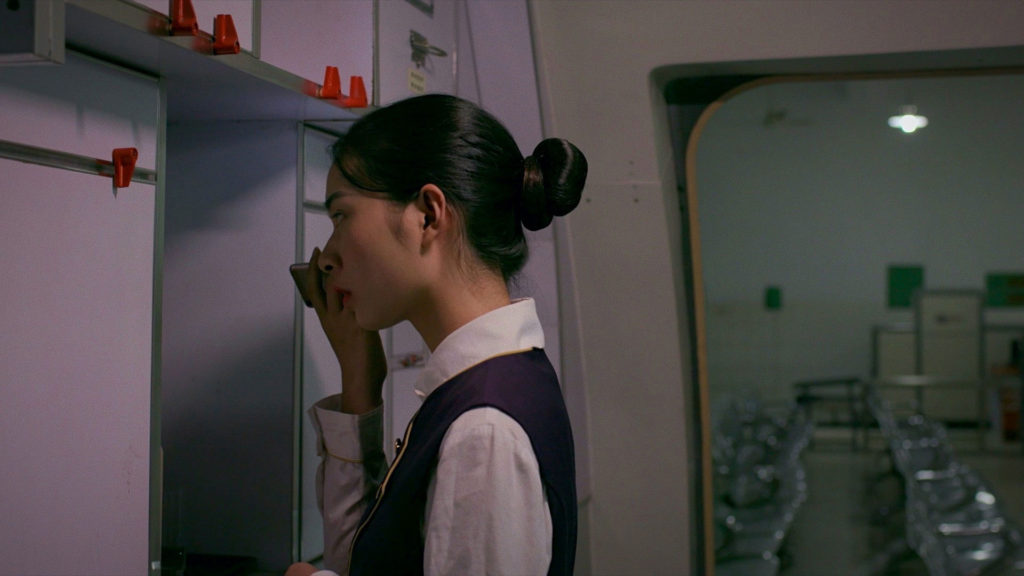
In an early scene from Stonewalling, co-directed by wife-husband duo Huang Ji & Otsuka Ryuji, the main character Lynn (Yao Honggui), who works in various modeling and hostess gigs while studying to become a flight attendant, recites the phrases “forty is forty,” “fourteen is fourteen,” “forty isn’t fourteen” to herself over and over. In Mandarin, these words (sì shí shì sì shí, shí sì shì shí sì, sì shí bú shì shí sì), while foundational in and of themselves, combine to form a rather potent tongue-twister, one that Lynn, who grew up speaking Hunanese, uses to improve her grasp of the dominant Mandarin dialect, any extra asset to assist in her hireability, though she declines to practice her English.
Stonewalling is suffused with such delicate balances of identity that reflect wider socioeconomic concerns. It is the third part of a trilogy with Egg and Stone (2012) and The Foolish Bird (2017) — the first directed by Huang solo, while all three are lensed by the Japanese-born Otsuka — a triptych following Yao’s character from the age of 14 to 20 and her parents (played by Huang’s own father and mother). I haven’t seen the first two films, whose narrative linkages seems fairly secondary to Stonewalling‘s concerns, but they all deal with the particular struggles faced by young women in a rapidly changing China. And those struggles are especially particular here: the film takes place over the course of Lynn’s unexpected pregnancy; first intending to get an abortion, she instead decides to carry her child to term so that her mother (who runs a woman’s clinic) can offer it as compensation to a patient who lost her own child.
This set-up gestures towards Stonewalling‘s most pressing interest: the commodification of the body, how one’s personal being is turned into just another item for the market, objectified in multiple senses of the word and evaluated according to strict parameters. Much of the film thus unfolds as almost a series of vignettes, as Lynn passes from gig to gig, crossing back and forth from her parents’ home in the suburbs of Changsha to the big city, continually trying to sustain herself amidst a climate of uncertainty and fraud, most clearly typified by her mother’s participation in a multi-level marketing scam involving a healing cream. The effect is in many ways akin to an ambitious cross-section of a certain aspect of the Chinese marketplace, continually finding new manifestations and outgrowths of a fundamental imbalance in society.
But what makes Huang and Otsuka’s approach much greater than a simple exposé of the dire state of modern China and/or capitalism in general is the middle ground they find. Mostly shooting in static long shots, the pace of their scenes unfurls with a great sense of consideration, refusing to lean into the outrageousness of any moments and instead letting it emanate from the material. This especially comes to pass during a crucial job that finds Lynn supervising a group of women potentially slated to donate their eggs to wealthy clients; all young, attractive, and told to behave in certain ways, their job interviews take place with exactly the level of discomfort one might expect without ever becoming overbearing. (It’s also worth noting that there are a few Uyghur women in this group, though it’s not a thread that is this film’s place to explore further).
Throughout this, Lynn’s sense of drift and displacement remains pronounced, not the least because of her fraught, distant relationship with her parents and her boyfriend, the latter of whom disappears for most of the film because of her concealment of her decision to carry her child. And this all reaches full tilt with a shockingly vivid recreation of the early days of the pandemic, something which is evoked as a disruption to the rhythms of life, a further elaboration on Stonewalling‘s interest in the body’s role amidst the masses blown up to national and then global scales. Without saying too much further, the ending suddenly hammers home the sadness and personal ties that bind, only hinted at before and which suddenly come home to roost. The elegance of its conceit, the suddenly bursting emotions that swell amidst immense loneliness, feels so attuned to its character’s journey, something which makes the quotidian rhythms all the more potent.
Sniffling Out of the Cold: Sundance 2023

Going on about the dispiriting nature of my predicament during this most recent Sundance — technically being able to attend due to my press pass and a robust online platform but losing out on the in-person experience (through both the Press Inclusion Initiative and a visit as part of the USC Gould Entertainment Law Society) that I had planned until literally the day I was supposed to leave — almost would seem to defeat the point of a festival dispatch, but I think some context is in order. In some ways, Sundance was ideal for the at-home viewer who had just suffered a shock at the start of the festival: all the films, and correspondingly most of the buzz, had premiered by the time I was more than half a week into my quarantine, and the presence of almost every film online (save for the notable exception of e.g. Past Lives, the narrative film I was most looking forward to catching up with) could have enabled an even broader viewing schedule than last year, where I was successful in watching all of the films from the NEXT section. But, whether it be the COVID brain fog or an ever-greater disconnect from the festival atmosphere because of the knowledge of all that I was missing, I only caught up with a handful of films in the final weekend of the festival, partly racing, partly strolling against the clock, all from an even more tightly curated selection than before. (I am also obviously writing this long after the end of the festival, so these reviews will unfortunately be much sparser than I had planned.)
The bulk of this viewing came from the resurrected New Frontier section, and I began with Gush, the feature debut of Fox Maxy, whose shorts have rapidly gained recognition over the past few years (which I have not had the pleasure of seeing). Running a slim 71-minute film, it incorporates enough footage to fill several much longer films, drawn from Maxy’s personal archive of a decade of constantly shooting many of her day-to-day interactions. The footage comes fast, often not providing enough to create a context, though several scenes to recur, including a car-bound conversation with two of Maxy’s nieces about a somewhat predatory older man which was apparently filmed two weeks(!) before the festival began.
Coupled with the fast blur of footage is the use of deliberately intrusive animations, especially skeletons shadowboxing, an experimental theater performance that contextualizes some of the more outré images, and specific meta-film devices, including a nifty use of anonymous stock footage with Maxy’s videos playing on the monitor. Though this is the official world premiere of Gush, it has apparently shown before, including at a public work-in-progress screening at the Museum of Modern Art last Halloween, and will continue to be revised in each of its future showings. In this present incarnation and likely all others, there’s a certain shapelessness that the pell-mell, go-for-broke chaos of the haphazard images and editing encourages. This is of course built into the film and remains compelling on a moment-to-moment basis, but the overall experience grows monotonous, and the deliberate placement of the final scene, in which an emcee at a party thanks Maxy for the use of her footage playing on monitors, feels a tad self-satisfied for something ostensibly so communal.
Another selection from New Frontier, Last Things by the section’s most tenured member Deborah Stratman, is the director’s first feature since her landmark The Illinois Parables, and falls into the mid-length category at just 50 minutes. Unlike that film, which from my memory deals with fairly specific instances of folklore, this largely follows intersecting strands centered around the literal evolution of rocks, featuring a heavy use of voiceover by the French filmmaker Valérie Massadian; comparisons have been made with “La jetée” but the science fiction/nature dichotomy made me think much more of the work of Ben Rivers, which has always toed a border between hypnotic and didactic. While the scientific aspect here is more foregrounded, with footage of laboratories, the play between the question of whether the narrated events are the beginning of this world or the next characterizes the pleasingly diffuse nature of the film.
Probably the film’s greatest asset is Stratman’s photography; for whatever reason her 16mm images, which form one of the crucial components of Thom Andersen’s masterpiece Los Angeles Plays Itself, have always held a certain grain density for me that automatically enliven whatever they capture. It’s especially interesting to see the way she films Petra (footage not shot for the project, it should be noted), revivifying the old stomping grounds of Henry Jones, Senior and Junior. I can’t say much else really stuck with me, but I look forward to revisiting this sometime down the line.
Stratman’s film also played with the Filipino short film “It’s Raining Frogs Outside” by Maria Estela Paiso that premiered in Berlin all the way back in 2021; its title provides the literal backdrop. It begins in enormously promising territory, using stop-motion and voiceover to sketch out its main character’s backstory, but then becomes an interesting yet viscerally unappealing (thanks to some icky CGI) story about evolution in a semi-apocalyptic milieu. One animated moment, which features a very upsetting encounter with a cockroach, came up in my memory when I watched the following film that night and made me think that that feature and this short had been paired, a quirk of film festival viewing happenstance.
That film (whose cockroach scene is thankfully much less graphic) was the first I caught up with in my much-less comprehensive survey of the NEXT section: Fremont, the fourth feature by Babak Jalali. I haven’t seen any of his past work, but it sounds like something of a departure, both in its subject matter — a portrait of an Afghan translator who has moved to the Bay Area city — and its aesthetic, which features a frankly gorgeous deployment of Academy digital black-and-white. Donya (Anaita Wali Zada) lives in a housing complex populated by other immigrants from her native country, many of whom regard her suspicion due to her past work with the government. She instead finds some measure of solace in various denizens of the area, including her coworkers at a fortune cookie factory in Chinatown and a psychiatrist, played in a wonderful supporting turn by Gregg Turkington.
In general, there’s a generosity to Jalali’s approach to his characters, almost always keeping things lightly humorous and leaving him free to pursue tangents powered by the more bit characters. Some of these, especially centering around the affable factory owner, are much more effective than others, including a montage of people receiving Donya’s fortune cookie messages that inexplicably includes Boots Riley in a cameo. But this coasts along well, and if the final passage — following Donya as she drives long-distance for a possible date, encountering a mechanic played by Jeremy Allen White along the way — succumbs to some of Jalali’s weaker/laxer narrative and conversational tendencies, the final punchline is appropriately bittersweet.
The best film I saw at Sundance, Passages directed by Ira Sachs, has its own narrative issues, but largely overcomes them thanks to the powerhouse presence of Franz Rogowski, further cementing his place as one of the best actors around. As Tomas, a film director who — despite being married to Martin (Ben Whishaw) — begins having an affair with Agathe (Adèle Exarchopoulos), he largely defines the roiling rhythms of a fundamentally classical story, that of a man whose capricious and wandering eye destroys his relationships. At only 91 minutes, its fundamental issue is its length, moving possibly too swiftly between partners even as Rogowski does his best to sell his seesawing, self-involved ardor for one or the other.
Despite his long career, I haven’t seen any of Sachs’s films before, which only makes me more inclined to see this as a banner entry in the Saïd Ben Saïd catalogue, whose résumé as producer (Verhoeven, Lapid, Garrel, Mendonça Filho etc.) forms one of the most essential auteurist studies of the past decade. Aside from the forthrightly Parisian setting, which makes the presence of both the German Rogowski and the English Whishaw amusingly incongruous, Passages fits in well with the peculiar recurrence of quietly domineering protagonists, people whose force of personality comes out more in pointed barbs than in raised voices. The sensuality and heartbreak emitted helps carry this through the awkward narrative structure, as do a number of quite erotic sex scenes (though Sachs’s disinterest in Exarchopoulos could scarcely be more palpable).
The third and last film in New Frontier was A Common Sequence, co-directed by Mary Helena Clark and Mike Gibisser in their feature debuts; I had seen the former’s short “Figure Minus Fact” but otherwise wasn’t familiar with either’s work. This takes something of a loose triptych structure, all examining the intersection of nature, work, and science: the regenerative potential of the achoque salamander in Pátzcuaro, Mexico; the use of mechanized apple pickers in the Yakima Valley in Washington, the study of DNA in South Dakota. In large part, this adopts a fairly traditional verite documentary form for better or worse, plenty of handheld observation with some interviews laid in via voiceover, but the transitions between parts can be fascinating: in particular, a Mexican worker’s mention of his friend trying to find work in America, specifically Washington, triggers the leap to the apple orchards a few scenes later.
But every so often, A Common Sequence will throw in a wildly abstract image, especially of machines and interfaces, that considerably enlivens the circumstances. The first and last significant shots arguably make the film an overall success all by themselves: they both capture a group of Mexican fisherman in distinct ways. In the first, they are coming back to a lake’s shores in darkness, illuminating the frame with only their headlamps, as snatches of conversations and dogs barking are heard. The latter features the opposite motion, and as the shot stretches out, the slow fade to night and the emergence is stars is so odd on camera that I genuinely thought the background might be computer generated or even some kind of faux-matte painting; I can’t tell if it was just my state of mind at that particular moment, but it was perhaps the single most compelling thing I saw “at” Sundance.
My final film at the festival was in the NEXT section, and a film I prioritized specifically because of positive notices: The Tuba Thieves, the debut feature by Deaf filmmaker Alison O’Daniel. It is difficult to describe the film, other than to point out its structure of stories loosely related by the preeminence of sound: a group of people affected by the theft of tubas from Los Angeles high schools from 2011-13, people living in neighborhood under the roar of jumbo jets flying in and out of LAX, the first performance of “4’33”,” the last performance at the Deaf Club in San Francisco presided over by Bruce Baillie, and so on and so forth.
The highlight is, by design, the open captions, which are exceedingly delightful in their wit: providing humorous descriptions of even the most routine sounds, giving actual decibel measurements, stretching out words as they get longer and longer, and so on and so forth. Indeed, I feel a bit churlish for liking this less than I wish I did; O’Daniel provides a great deal of invention from scene to scene, and I’m not usually one to fault a film for its narrative incoherency. But there’s too much packed into here, and the ending in particular feels like an especially arbitrary note, a return to an already extraneous storyline that sheds little further light. That summed up my abbreviated Sundance in a nutshell: all the films I saw were good and interesting, but none felt free from compromise.
Pacifiction
Much of the discussion around Albert Serra’s monumental new film has centered around its incongruity: an uncommonly “accessible” film for the notoriously abstruse filmmaker of grotesque and minimal narratives, one embraced by even many of his usual detractors. Indeed, its late-breaking addition to an otherwise fairly anemic Cannes competition line-up felt entirely fitting, a bomb (nuclear or not) thrown into the traditional order. But what makes Pacifiction such an enrapturing experience is the mysterious ways it emerges as both hypnotic — maintaining the same mood and undercurrents of paranoia surrounding the possible resumption of French nuclear testing in Tahiti — and disruptive, marked by indelible scenes of sudden impressionism: a boat and jet-ski ride on enormous crashing waves, a visit to a decaying house at sunset, a nightclub that becomes almost monochrome in its deep hues. It wouldn’t be too much to say that there has never been a film that looks like this, somehow shot with Blackmagic Pocket cameras that yield a kind of lush, alien glow, where even the many lackadaisical scenes of petty interactions thrum with an unidentifiable anxiety. And at the center is Benoît Magimel, a performance as galvanizing an anchor as Léaud in The Death of Louis XIV, where the soft sleaze of his voice and his imposing white suit-clad presence lend the exact kind of empty swagger that guides the film along. In its invocation of colonialism’s past and present by way of nothing except suggestion and sheer style, it is nigh impossible to imagine a more fully assured, a more tantalizing film this year.
Decision to Leave
Decision to Leave finds Park Chan-wook burrowing into, if not entirely new territory for South Korea’s preeminent crime filmmaker, then the foundations of his strongest aspects. The bifurcated telling of a detective’s (Park Hae-il) continuously shifting relationship with the wife (Tang Wei) of his latest investigation’s decedent, it operates almost polyrhythmically, letting the dead ends and often humorous tangents inherent to a bewildering murder case play out while remaining intently precise in its dealings with the beats from shot to shot. The visual schema constantly dazzles, employing bold diagonals, distorted and unexpected POVs, and superimpositions of digital information that playfully carries the film along its deliberately mirroring halves. But the true heart of the film rests in its potent riff on Vertigo, where identity is shaped along more ambiguous lines, and, above all, Tang’s performance, surely among the greatest by an actor not primarily speaking in their native language. Her capacity for simultaneous seeming total transparency and opacity molds the emotional tenors of the film, rendering it a tentative romance where the words — spoken in Korean or Mandarin — take on so many other unintended resonances. The entirely appropriate ending rings with such force because of the care and confidence placed in the proceedings, an exquisitely enigmatic dance which must end in the only way possible.
Triangle of Sadness
Ruben Östlund’s Palme d’Or-winning follow-up to his Palme d’Or winning The Square epitomizes a certain contradiction: he is a director who I wish I didn’t like as much as I do. In its tripartite narrative, which follows the disintegration of a relationship over the course of increasingly absurd circumstances, Triangle of Sadness does, all things considered, have little else on its mind aside from the skewering of the nouveau riche as their environments get turned upside down by machinery, unwelcome workers, and eventually the natural world itself. But while Östlund’s aims are fairly pat, aside from a late-breaking development which productively deepens the complexities of otherwise steadily declining relationships, his skill lies in the actual orchestration of his scenes, and in the touches of comedy that arise from carefully placed running gags. As might be expected from such a scattershot approach, the good and the bad (and the ugly) intermix freely throughout, often in the same scene. Östlund’s spare aesthetic, mostly conveyed in long shot, and his facility with actors as anchoring presences — in The Square Claes Bang; here, Harris Dickinson and Charlbi Dean, with Dolly de Leon coming to the fore in the last, crucially distended third — helps unite many of these sequences. And on some level, I find such devices as a woman who can only speak one German phrase, the elevation of aerosolized water to a necessary part of survival, and the sight of Woody Harrelson (as the Communist captain of the yacht which serves as the setting of the second act) and a Russian manure baron totally soused, reading Marx quotes back at each other over the intercom as the boat is battered by ocean waves irresistibly funny; your mileage will certainly vary.
Three Thousand Years of Longing
George Miller’s return to feature filmmaking after his career’s apotheosis Mad Max: Fury Road (2015) trades that film’s tactility and near-relentless narrative drive for something much more fantastical and circular, with largely mixed results. While Three Thousand Years of Longing takes as its jumping-off point the extended encounter between a narratologist (Tilda Swinton) and the djinn she unwittingly unleashes (Idris Elba), the film moves with uncertainty between their present-day hotel room and the simulacra of ancient times that the genie has experienced. Each of the three stories he tells revolves around the circumstances in which he was imprisoned, feeling free to meander through the massive, beautiful, and uncanny digital structures and the somewhat weaker stories, which vary between the joy of learning and the delight in grotesquerie. It truly is unfortunate that Miller’s worthy but limited effort — by his gleefully maximalist sensibilities that overwhelm the delicate tête-à-tête; by first too little, then too much footage of the present day; by a romance that, while affecting generally and carried out well by the two actors, feels schematic — came out just a year after Memoria. The fear and trembling in the face of the supernatural/extraterrestrial that Swinton conveyed so potently there reappears here in attenuated form; there is even a scene where the djinn acts as a radio receiver for all the noises of the modern world. Three Thousand Years of Longing and Miller himself are best in the moment, in little tricks and teleological progressions, which only inconsistently come to the surface here.
The Novelist’s Film
Something of a culmination of the love-story-as-narrative-arc that Hong Sang-soo has crafted with Kim Min-hee, The Novelist’s Film finds the two paired with Lee Hye-young, the latest major addition to his repertory ensemble. Unfolding mostly over the course of a day, the film tracks the novelist Jun-hee (Lee) as she pays a visit to the small town where her former friend resides. As she accumulates chance encounters with both familiar faces — a poet, a director — and new ones — recently reclusive actress Gil-soo, played by Kim — an idea for a short film comes to mind out of the small interactions she shares as both participant and observer. The film’s dynamic, and indeed that of Hong’s Kim films in general, is perfectly captured in Gil-soo’s introduction, walking briskly around a park in a leather jacket as Jun-hee happens to see her from afar: the character, the director, and the viewer are fortunate to find this remarkable woman at this time of life. She is nothing less than a burst of inspiration, an enrapturing person who in turn comes to absorb all of the incredible coincidences and hurtful memories that forms everyday life. With the coda, one of the most mysterious and moving scenes in Hong’s entire career, The Novelist’s Film enchanting and lovingly earnestness comes to full bloom.

