New York Film Festival 2023 Main Slate Predictions (Round 1)

My annual NYFF main slate predictions will have an additional home on my Patreon from here on out, now with annotations; some of these will be more obvious picks than others, but worth making a comment for each of them. This is the first round, done as per usual after the Cannes jury awards announcements; the annotated version is after the clean version.

Virtual Lock
Anatomy of a Fall (Justine Triet)
La chimera (Alice Rohrwacher)
Close Your Eyes (Víctor Erice)
Eureka (Lisandro Alonso)
Fallen Leaves (Aki Kaurismäki)
In Our Day (Hong Sang-soo)
in water (Hong Sang-soo)
May December (Todd Haynes)
Music (Angela Schanelec)
Youth (Wang Bing)

Strong Chance
The Delinquents (Rodrigo Moreno)
Here (Bas Devos)
Kidnapped (Marco Bellocchio)
Last Summer (Catherine Breillat)
Occupied City (Steve McQueen)
The Pot-au-feu (Trần Anh Hùng)
Samsara (Lois Patiño)
The Zone of Interest (Jonathan Glazer)

Moderate Possibility
About Dry Grasses (Nuri Bilge Ceylan)
About Thirty (Martin Shanly)
Bad Living (João Canijo)
Inside the Yellow Cocoon Shell (Phạm Thiên Ân)
Killers of the Flower Moon (Martin Scorsese)
Kubi (Kitano Takeshi)
Living Bad (João Canijo)
On the Adamant (Nicolas Philibert)
Only the River Flows (Wei Shujun)
Orlando, My Political Biography (Paul B. Preciado)
Perfect Days (Wim Wenders)
A Prince (Pierre Creton)
The Shadowless Tower (Zhang Lu)
Till the End of the Night (Christoph Hochhäusler)

Virtual Lock

Anatomy of a Fall (Justine Triet)
Triet managed to place previously with Sibyl despite its bafflingly tepid reception at Cannes 2019, so its better-received successor should have no problem, and the Palme (no winner has missed since 2015) is just a sweetener.

La chimera (Alice Rohrwacher)
Every single one of Rohrwacher’s features have been in the Main Slate.

Close Your Eyes (Víctor Erice)
Surprisingly neither of Erice’s past two fiction features have placed in the Main Slate, but the triumphant return seems like a no-brainer.

Eureka (Lisandro Alonso)
Maybe a little quick to place this here, given that this doesn’t seem to necessarily provide the same lightning-bolt that Jauja did, but hard to imagine the Main Slate without it.

Fallen Leaves (Aki Kaurismäki)
Kaurismäki’s got a solid track record with NYFF and people are (almost certainly justifiably) loving this one out of Cannes.

In Our Day (Hong Sang-soo)
It’s Hong.

in water (Hong Sang-soo)
It’s Hong.

May December (Todd Haynes)
Unless this somehow gets released before NYFF then the Film Comment interview between Haynes and Dennis Lim confirms it.

Music (Angela Schanelec)
Maybe the highlight of Berlin, might be even more shocking than the Hongs if this didn’t place.

Youth (Wang Bing)
Wang has never been at NYFF before as far as I know (had forgotten Dead Souls New York-premiered at its own retrospective) but a strong new film plus a surprising Cannes competition berth feels like the right time.

Strong Chance

The Delinquents (Rodrigo Moreno)
The clear highlight of Un Certain Regard plus the El Pampero Cine connections all but guarantee this.

Here (Bas Devos)
This will 100% be in NYFF, the only question is if it’s Main Slate or Currents.

Kidnapped (Marco Bellocchio)
One of the riskier propositions on here, but both the personal documentary and the sprawling miniseries after The Traitor have been in a NYFF section so it stands to reason that it’ll make it.

Last Summer (Catherine Breillat)
Breillat’s been in NYFF enough (including with her last film a decade ago) that this seems likely, plus the Saïd Ben Saïd credit.

Occupied City (Steve McQueen)
McQueen’s salvation of the first COVID NYFF plus Lim’s liking for him make this a pretty safe bet, despite the running time; don’t think it’s unconventional enough for Currents.

The Pot-au-feu (Trần Anh Hùng)
Hùng actually hasn’t been in NYFF at all this century, but its Cannes reception has been warm enough, and the Best Director win almost certainly helps; Decision to Leave might not have made it in without that, and aside from the ineligible Annette every winner this past decade has been in the Main Slate.

Samsara (Lois Patiño)
See Here.

The Zone of Interest (Jonathan Glazer)
Might seem crazy to not call this a lock (especially considering my friend and new committee member Justin Chang’s adoration of it) but Under the Skin missed in the mega year of 2013 and Glazer hasn’t appeared at all; will probably make it but not going to be totally shocked if it doesn’t, and the Grand Prix placement only muddies the waters (just one of the four (thanks to a bunch of egregious ties) has made it in, and Stars at Noon was touch and go).

Moderate Possibility

About Dry Grasses (Nuri Bilge Ceylan)
Might be placing this too high, given neither Winter Sleep nor Wild Pear Tree made it, but I’m never inclined to count out a perennially monumental artist.

About Thirty (Martin Shanly)
Out-there Forum pick but there’s been a decent amount of chatter about Shanly.

Bad Living (João Canijo)
Would be very fun to see how NYFF would program it and its sibling if they both got in.

Inside the Yellow Cocoon Shell (Phạm Thiên Ân)
One of the more loved films at Directors’ Fortnight, really could be in any NYFF section or ND/NF.

Killers of the Flower Moon (Martin Scorsese)
Has enough time before its theatrical date to show, but now that Kent Jones is gone I’m not certain about how good Scorese’s chances are (not that he needs them).

Kubi (Kitano Takeshi)
Kitano hasn’t been at NYFF since the turn of the century, but might be part of the Cannes Premiere/late period wave.

Living Bad (João Canijo)
If both it and its sibling got in, would be very fun to see how NYFF would program them.

On the Adamant (Nicolas Philibert)
Philibert’s been at NYFF once before, and the somewhat lukewarmly-received 2022 Golden Bear winner Alcarràs managed to make it in (albeit in a weak year) so seems more likely than not that he’ll make it.

Only the River Flows (Wei Shujun)
Generated enough buzz at Un Certain Regard to merit inclusion.

Orlando, My Political Biography (Paul B. Preciado)
Might be more likely for Currents, but the Sideshow/Janus acquisition makes it quite probable that this will end up in the Main Slate.

Perfect Days (Wim Wenders)
Surprisingly well-received out of Cannes and while the Best Actor award might not be an enormous boost, the prospect of getting Wenders in the Main Slate for the first time in over a decade (and for the first time for a solo-directed fiction film since… Paris, Texas) might be sweet enough.

A Prince (Pierre Creton)
Had honestly never heard of Creton before this Cannes but the press has been strong for it and I know the Main Slate documentary section is looking to be bolstered.

The Shadowless Tower (Zhang Lu)
More a wishful thinking pick than anything else, but Zhang hasn’t had a competition berth anywhere for a while so his profile might be sufficiently high enough for this.

Till the End of the Night (Christoph Hochhäusler)
Got decent reviews out of Berlin and with Petzold’s Afire bafflingly out of contention thanks to a summer release and Graf’s Melting Ink documentary unlikely, the Berlin School/Dreileben slack has to be picked up, right?

Thoughts on the Screen International Cannes Jury Grid (2009-2022)

It’s nothing new to say that the Cannes Film Festival is one of the most influential forces in cinema, for better and for worse. Like its eviler twin, the Oscars, it is almost choked by its glamor and prestige: its putative brethren Berlin and even, to a certain degree, Venice, are able to escape an over-abundance of notice, with off years or low-key line-ups largely going unnoticed (at least among the trades and the Hollywood industry). No such recourse is available to Cannes, who always stands as a bellwether for the health of the festival landscape, despite its well-established reliance on pet auteurs and a reluctance to stray too far out of its comfort zone.

I actually don’t mind this tendency too much, and to unpack that more would take something much longer/more formal, but I wanted to focus in on something much less consequential but equally fascinating: the Screen International Cannes Jury Grid. One of the best pieces of film festival ephemera, it is run by the British film magazine and prompts typically 10 or 11 critics from different publications around the world to rate each film in the Official Competition from zero to four stars. What appeals to me about this concept — aside from giving me access to the thoughts of some of my favorite critics, Dennis Lim and Justin Chang chief among them — is the snapshot nature of it, the way it embodies the in-the-moment feeling about a film in the same way that any ratings scale or list does. Obviously, the makeup of names from year to year varies a great deal, and I may not put an enormous amount of truck in a good number of people involved, but it is as good a portrait of the thoughts of a certain semi-mainstream stripe of critic as there is in any place. People can hedge or try to make themselves look better in retrospective reviews, top-ten lists, and the like, but with such iron-clad parameters (five points with no decimals) and limited options — the aggregate ranking of only about 20 films is entirely dependent on the votes of a few people, which leads to both consensus and chaos, as one dissenter in either direction can tip the scales wildly — leads to some lovely, often infuriating, always surprising results. It’d be great, for instance, if films in other sections, even in the functionally separate Directors’ Fortnight, where many of the best films have premiered, were included, or if something similar was consistently established for even just Berlin and Venice, but there’s a perverse purity to the grid, as there is to the competition, that truly compels me.

Cannes 2023 is currently underway, and this lovely Screen Daily piece by Nikki Baughan that my friend/presumed grid contributor this year (one of the few enormous gripes I have is the refusal to name the Screen International respondent for the year) Tim Grierson tweeted out made me want to go back and look at how the ad hoc rankings formed by each of the grids have shaken out; it’s easy and fun to rag on the often dunderheaded choices by the Cannes juries, for Palme d’Or winners and other jury awards alike, but what about the on-the-ground opinions of (hopefully) well-meaning critics?

From a very quick look online, I’ve been able to find the full grids from 2009-2022 — the article’s inclusion of the highest and lowest rated titles from almost every edition is fascinating in its own right but doesn’t offer enough information; I might do a second edition if I can find some others and/or if I decide to delve into some of these grids a bit deeper — and sorted each film by their rating, with alphabetical order controlling for ties. I’ve then sought to rank the films by a very loose but still considered series of criteria, including my own personal liking of the film and/or director (when applicable), the thoughts on both of my own circles, and, for a lack of a better descriptor, the enduring appeal, renown, and importance of the film. These should not be taken as strict rankings, and the former will often outweigh the latter (which is subjective in and of itself), but it’s a start to considering just how these odd (in multiple senses of the word) opinions have evolved over the years.

* will indicate a film I have seen.

2009

1. A Prophet (Jacques Audiard) – 3.4
2. Bright Star (Jane Campion) – 3.3
The White Ribbon (Michael Haneke) – 3.3
4. Broken Embraces (Pedro Almodóvar) – 3.2
5. Looking for Eric (Ken Loach) – 2.9
Vincere (Marco Bellocchio) – 2.9
7. The Time That Remains (Elia Suleiman) – 2.6
8. Wild Grass (Alain Resnais) – 2.5
9. Inglourious Basterds (Quentin Tarantino) – 2.4
Thirst (Park Chan-wook) – 2.4
11. Fish Tank (Andrea Arnold) – 2.3
12. Vengeance (Johnnie To) – 2.1
13. Taking Woodstock (Ang Lee) – 2
14. In the Beginning (Xavier Giannoli) – 1.9
15. Antichrist (Lars von Trier) – 1.6
Enter the Void (Gaspar Noé) – 1.6
Spring Fever (Lou Ye) – 1.6
18. Face (Tsai Ming-liang) – 1.3
Map of the Sounds of Tokyo (Isabel Coixet) – 1.3
20. Kinatay (Brillante Mendoza) – 1.2

1. *Inglourious Basterds
2. Wild Grass
3. Bright Star
4. Broken Embraces
5. *Face
6. The White Ribbon
7. Vengeance
8. Vincere
9. Thirst
10. Antichrist
11. A Prophet
12. *Fish Tank
13. The Time That Remains
14. Enter the Void
15. Taking Woodstock
16. Looking for Eric
17. Spring Fever
18. Kinatay
19. In the Beginning
20. Map of the Sounds of Tokyo

2010

1. Another Year (Mike Leigh) – 3.4
2. Of Gods and Men (Xavier Beauvois) – 3.1
3. Poetry (Lee Chang-dong) – 2.7
4. Outside the Law (Rachid Bouchareb) – 2.6
5. The Princess of Montpensier (Bertrand Tavernier) – 2.4
Route Irish (Ken Loach) – 2.4
Uncle Boonmee Who Can Recall His Past Lives (Apichatpong Weerasethakul) – 2.4
8. Certified Copy (Abbas Kiarostami) – 2.3
A Screaming Man (Mahamat-Saleh Haroun) – 2.3
10. Chongqing Blues (Wang Xiaoshuai) – 2.2
Fair Game (Doug Liman) – 2.2
The Housemaid (Im Sang-soo) – 2.2
My Joy (Sergei Loznitsa) – 2.2
14. Tender Son: The Frankenstein Project (Mundruczó Kornél) – 2.1
15. Biutiful (Alejandro Gonzalez Iñárritu) – 2
On Tour (Mathieu Amalric) – 2
17. Our Life (Daniele Luchetti) – 1.6
18. Burnt by the Sun 2: Exodus (Nikita Mikhalkov) – 1.3
19. Outrage (Kitano Takeshi) – 0.9

1. *Uncle Boonmee Who Can Recall His Past Lives
2. Poetry
3. *Certified Copy
4. Another Year
5. Of Gods and Men
6. My Joy
7. Outrage
8. The Housemaid
9. A Screaming Man
10. Chongqing Blues
11. Biutiful
12. On Tour
13. The Princess of Montpensier
14. Route Irish
15. Outside the Law
16. Our Life
17. Burnt by the Sun 2: Exodus
18. Fair Game
19. Tender Son: The Frankenstein Project

2011

1. Once Upon a Time in Anatolia (Nuri Bilge Ceylan) – 3.3
2. Le Havre (Aki Kaurismäki) – 3.2
3. The Kid With a Bike (Jean-Pierre & Luc Dardenne) – 3.1
4. The Artist (Michel Hazanavicius) – 2.8
The Skin I Live In (Pedro Almodóvar) – 2.8
This Must Be the Place (Paolo Sorrentino) – 2.8
The Tree of Life (Terrence Malick) – 2.8
8. We Need to Talk About Kevin (Lynne Ramsay) – 2.5
9. Drive (Nicolas Winding Refn) – 2.4
Melancholia (Lars von Trier) – 2.4
11. We Have a Pope (Nanni Moretti) – 2.3
12. Footnote (Joseph Cedar) – 2
Michael (Markus Schleinzer) – 2
14. Father (Alain Cavalier) – 1.9
15. Hara-Kiri: Death of a Samurai (Miike Takashi) – 1.7
Polisse (Maïwenn) – 1.7
The Source (Radu Mihǎileanu) – 1.7
18. Hanezu (Kawase Naomi) – 1.6
19. Sleeping Beauty (Julia Leigh) – 1.5
20. House of Tolerance (Bertrand Bonello) – 1.1

1. *The Tree of Life
2. *The Kid With a Bike
3. *Melancholia
4. *House of Tolerance
5. Once Upon a Time in Anatolia
6. Le Havre
7. The Skin I Live In
8. Hara-Kiri: Death of a Samurai
9. Sleeping Beauty
10. We Have a Pope
11. Footnote
12. Michael
13. Polisse
14. Father
15. *Drive
16. We Need to Talk About Kevin
17. *The Artist
18. Hanezu
19. This Must Be the Place
20. The Source

2012

1. Amour (Michael Haneke) – 3.3
Beyond the Hills (Cristian Mungiu) – 3.3
3. The Hunt (Thomas Vinterberg) – 2.9
In the Fog (Sergei Loznitsa) – 2.9
Killing Them Softly (Andrew Dominik) – 2.9
Rust & Bone (Jacques Audiard) – 2.9
7. The Angels’ Share (Ken Loach) – 2.8
Mud (Jeff Nichols) – 2.8
9. On the Road (Walter Salles) – 2.7
10. Moonrise Kingdom (Wes Anderson) – 2.6
You Ain’t Seen Nothin’ Yet (Alain Resnais) – 2.6
12. Like Someone in Love (Abbas Kiarostami) – 2.4
13. Cosmopolis (David Cronenberg) – 2.2
14. In Another Country (Hong Sang-soo) – 2.1
15. Holy Motors (Leos Carax) – 2
Post Tenebras Lux (Carlos Reygadas) – 2
17. Reality (Matteo Garrone) – 1.9
18. Lawless (John Hillcoat) – 1.7
19. The Paperboy (Lee Daniels) – 1.6
20. After the Battle (Yousry Nasrallah) – 1.5
Paradise: Love (Ulrich Seidl) – 1.5
22. The Taste of Money (Im Sang-soo) – 1.4

1. *Holy Motors
2. *Like Someone in Love
3. *Moonrise Kingdom
4. *You Ain’t Seen Nothin’ Yet
5. *In Another Country
6. *Cosmopolis
7. Amour
8. Post Tenebras Lux
9. Beyond the Hills
10. In the Fog
11. The Hunt
12. Killing Them Softly
13. Paradise: Love
14. Rust & Bone
15. Reality
16. The Angels’ Share
17. Mud
18. On the Road
19. Lawless
20. The Paperboy
21. The Taste of Money
22. After the Battle

2013

1. Blue Is the Warmest Color – Abdellatif Kechiche) – 3.4
2. Inside Llewyn Davis (Joel & Ethan Coen) – 3.3
3. Nebraska (Alexander Payne) – 3.1
4. A Touch of Sin (Jia Zhangke) – 3
5. The Past (Asghar Farhadi) – 2.8
Venus in Fur (Roman Polański) – 2.8
7. The Great Beauty (Paolo Sorrentino) – 2.7
8. Only Lovers Left Alive (Jim Jarmusch) – 2.6
9. Behind the Candelabra (Steven Soderbergh) – 2.5
Like Father, Like Son (Koreeda Hirokazu) – 2.5
11. The Immigrant (James Gray) – 2.4
Young & Beautiful (François Ozon) – 2.4
13. Borgman (Alex Van Warmerdam) – 2.1
Jimmy P: Psychotherapy of a Plains Indian (Arnaud Desplechin) – 2.1
15. Grigris (Mahamat-Saleh Haroun) – 1.8
16. Heli (Amat Escalante) – 1.6
Michael Kohlhaas (Arnaud des Pallières) – 1.6
18. A Castle in Italy (Valeria Bruni Tedeschi) – 1.5
Only God Forgives (Nicolas Winding Refn) – 1.5
20. Shield of Straw (Miike Takashi) – 1.3

1. *Inside Llewyn Davis
2. *The Immigrant
3. *A Touch of Sin
4. Only Lovers Left Alive
5. Blue Is the Warmest Color
6. Behind the Candelabra
7. Nebraska
8. Like Father, Like Son
9. Jimmy P: Psychotherapy of a Plains Indian
10. The Past
11. The Great Beauty
12. Heli
13. Grigris
14. Shield of Straw
15. Young & Beautiful
16. Venus in Fur
17. Borgman
18. Michael Kohlhaas
19. A Castle in Italy
20. *Only God Forgives

2014

1. Mr. Turner (Mike Leigh) – 3.6
2. Leviathan (Andrey Zvyagintsev) – 3.5
3. Winter Sleep (Nuri Bilge Ceylan) – 3.4
4. Two Days, One Night (Jean-Pierre & Luc Dardenne) – 3.1
5. Clouds of Sils Maria (Olivier Assayas) – 2.9
6. Foxcatcher (Bennett Miller) – 2.8
7. Maps to the Stars (David Cronenberg) – 2.7
8. The Homesman (Tommy Lee Jones) – 2.6
Mommy (Xavier Dolan) – 2.6
Timbuktu (Abderrahmane Sissako) – 2.6
The Wonders (Alice Rohrwacher) – 2.6
12. Goodbye to Language (Jean-Luc Godard) – 2.5
Jimmy’s Hall (Ken Loach) – 2.5
14. Still the Water (Kawase Naomi) – 2.2
Wild Tales (Damian Szifron) – 2.2
16. Saint Laurent (Bertrand Bonello) – 1.7
17. The Captive (Atom Egoyan) – 1.6
18. The Search (Michel Hazanavicius) – 1.2

1. *Goodbye to Language
2. *Two Days, One Night
3. *Clouds of Sils Maria
4. Timbuktu
5. Mr. Turner
6. The Wonders
7. *Saint Laurent
8. Winter Sleep
9. Maps to the Stars
10. The Homesman
11. *Foxcatcher
12. Leviathan
13. Wild Tales
14. Jimmy’s Hall
15. Mommy
16. Still the Water
17. The Captive
18. The Search

2015

1. The Assassin (Hou Hsiao-hsien) – 3.5
Carol (Todd Haynes) – 3.5
3. Mountains May Depart (Jia Zhangke) – 2.8
Son of Saul (Nemes László) – 2.8
5. Mia madre (Nanni Moretti) – 2.7
6. Dheepan (Jacques Audiard) – 2.5
Our Little Sister (Koreeda Hirokazu) – 2.5
8. The Lobster (Yorgos Lanthimos) – 2.4
Youth (Paolo Sorrentino) – 2.4
10. The Measure of a Man (Stéphane Brizé) – 2.3
Sicario (Denis Villeneuve) – 2.3
12. Louder Than Bombs (Joachim Trier) – 2.2
13. Chronic (Michel Franco) – 2
Tale of Tales (Matteo Garrone) – 2
15. Macbeth (Justin Kurzel) – 1.8
16. Valley of Love (Guillaume Nicloux) – 1.7
17. Mon roi (Maïwenn) – 1.5
18. Marguerite and Julien (Valérie Donzelli) – 0.9
19. The Sea of Trees (Gus Van Sant) – 0.6

1. *The Assassin
2. *Carol
3. *Mountains May Depart
4. *Sicario
5. *Our Little Sister
6. *The Lobster
7. *Son of Saul
8. Mia madre
9. The Measure of a Man
10. *Valley of Love
11. Dheepan
12. Macbeth
13. Louder Than Bombs
14. Tale of Tales
15. Marguerite and Julien
16. Chronic
17. Youth
18. Mon roi
19. The Sea of Trees

2016

1. Toni Erdmann (Maren Ade) – 3.7
2. Paterson (Jim Jarmusch) – 3.5
3. Elle (Paul Verhoeven) – 3.1
4. Graduation (Cristian Mungiu) – 3
Sieranevada (Cristi Puiu) – 3
6. Aquarius (Kleber Mendonça Filho) – 2.9
7. Loving (Jeff Nichols) – 2.5
The Unknown Girl (Jean-Pierre & Luc Dardenne) – 2.5
9. American Honey (Andrea Arnold) – 2.4
I, Daniel Blake (Ken Loach) – 2.4
Julieta (Pedro Almodóvar) – 2.4
The Salesman (Asghar Farhadi) – 2.4
13. Personal Shopper (Olivier Assayas) – 2.3
Slack Bay (Bruno Dumont) – 2.3
15. Ma’ Rosa (Brillante Mendoza) – 2.2
Staying Vertical (Alain Guiraudie) – 2.2
17. The Handmaiden (Park Chan-wook) – 2.1
18. From the Land of the Moon (Nicole Garcia) – 2
19. The Neon Demon (Nicolas Winding Refn) – 1.5
20. It’s Only the End of the World (Xavier Dolan) – 1.4
21. The Last Face (Sean Penn) – 0.2

1. *Toni Erdmann
2. *Elle
3. *Sieranevada
4. *Personal Shopper
5. *Aquarius
6. *The Handmaiden
7. *Paterson
8. *Julieta
9. *The Unknown Girl
10. *Staying Vertical
11. The Salesman
12. *Graduation
13. Slack Bay
14. *I, Daniel Blake
15. Loving
16. *American Honey
17. *Ma’ Rosa
18. From the Land of the Moon
19. *The Neon Demon
20. It’s Only the End of the World
21. The Last Face

2017

1. Loveless (Andrey Zvyagintsaev) – 3.2
You Were Never Really Here (Lynne Ramsay) – 3.2
3. The Square (Ruben Östlund) – 2.7
Wonderstruck (Todd Haynes) – 2.7
5. The Day After (Hong Sang-soo) – 2.5
Good Time (Josh & Benny Safdie) – 2.5
120 BPM (Beats per Minute) (Robin Campillo) – 2.5
8. The Meyerowitz Stories (New and Selected) (Noah Baumbach) – 2.4
9. The Beguiled (Sofia Coppola) – 2.3
Double Lover (François Ozon) – 2.3
Okja (Bong Joon-ho) – 2.3
12. A Gentle Creature (Sergei Loznitsa) – 2.2
Happy End (Michael Haneke) – 2.2
14. The Killing of a Sacred Deer (Yorgos Lanthimos) – 1.9
15. Jupiter’s Moon (Mundruczó Kornél) – 1.6
Radiance (Kawase Naomi) – 1.6
17. In the Fade (Fatih Akın) – 1.5
Le Redoutable (Michel Hazanavicius) – 1.5
19. Rodin (Jacques Doillon) – 1

1. *The Day After
2. *Good Time
3. *120 BPM (Beats per Minute)
4. *Wonderstruck
5. *The Meyerowitz Stories (New and Selected)
6. A Gentle Creature
7. *The Square
8. *The Beguiled
9. *Okja
10. Happy End
11. Rodin
12. *You Were Never Really Here
13. Loveless
14. *The Killing of a Sacred Deer
15. Double Lover
16. In the Fade
17. Radiance
18. *Le Redoutable
19. Jupiter’s Moon

2018

1. Burning (Lee Chang-dong) – 3.8
2. Shoplifters (Koreeda Hirokazu) – 3.2
3. The Image Book (Jean-Luc Godard) – 3
4. Ash Is Purest White (Jia Zhangke) – 2.9
Cold War (Paweł Pawlikowski) – 2.9
Happy as Lazzaro (Alice Rohrwacher) – 2.9
The Wild Pear Tree (Nuri Bilge Ceylan) – 2.9
8. 3 Faces (Jafar Panahi) – 2.6
9. BlacKkKlansman (Spike Lee) – 2.5
10. Asako I & II (Hamaguchi Ryusuke) – 2.4
Leto (Kirill Serebrennikov) – 2.4
12. Dogman (Matteo Garrone) – 2.3
Sorry Angel (Christophe Honoré) – 2.3
14. At War (Stéphane Brizé) – 2.1
Ayka (Sergei Dvortsevoy) – 2.1
16. Under the Silver Lake (David Robert Mitchell) – 2
17. Capernaum (Nadine Labaki) – 1.9
18. Everybody Knows (Asghar Farhadi) – 1.8
Yomeddine (Abu Bakr Shawky) – 1.8
20. Knife + Heart (Yann Gonzalez) – 1.6
21. Girls of the Sun (Eva Husson) – 1

1. *Burning
2. *The Image Book
3. *Ash Is Purest White
4. *Happy as Lazzaro
5. *Asako I & II
6. *3 Faces
7. *Shoplifters
8. *BlacKkKlansman
9. *Cold War
10. The Wild Pear Tree
11. *Knife + Heart
12. Sorry Angel
13. *Under the Silver Lake
14. Leto
15. Dogman
16. At War
17. Ayka
18. Girls of the Sun
19. Capernaum
20. Everybody Knows
21. Yomeddine

2019

1. Parasite (Bong Joon-ho) – 3.5
2. Pain and Glory (Pedro Almodóvar) – 3.3
Portrait of a Lady on Fire (Céline Sciamma) – 3.3
4. Once Upon a Time…in Hollywood (Quentin Tarantino) – 3
5. Atlantics (Mati Diop) – 2.8
6. The Wild Goose Lake (Diao Yinan) – 2.7
7. Bacurau (Kleber Mendonça Filho & Juliano Dornelles) – 2.6
It Must Be Heaven (Elia Suleiman) – 2.6
The Traitor (Marco Bellocchio) – 2.6
10. A Hidden Life (Terrence Malick) – 2.5
Sorry We Missed You (Ken Loach) – 2.5
The Whistlers (Corneliu Porumboiu) – 2.5
13. Les Misérables (Ladj Ly) – 2.4
Oh Mercy! (Arnaud Desplechin) – 2.4
Young Ahmed (Jean-Pierre & Luc Dardenne) – 2.4
16. Little Joe (Jessica Hausner) – 2.3
17. The Dead Don’t Die (Jim Jarmusch) – 2.2
18. Sibyl (Justine Triet) – 1.8
19. Matthias & Maxime (Xavier Dolan) – 1.7
20. Frankie (Ira Sachs) – 1.6
21. Mektoub, My Love: Intermezzo (Abdellatif Kechiche) – 1.5

1. *Parasite
2. *Once Upon a Time…in Hollywood
3. *Portrait of a Lady on Fire
4. *Bacurau
5. *Pain and Glory
6. *The Traitor
7. *Atlantics
8. *A Hidden Life
9. *Young Ahmed
10. *Sibyl
11. *The Wild Goose Lake
12. *The Whistlers
13. Oh Mercy!
14. Little Joe
15. *The Dead Don’t Die
16. Mektoub, My Love: Intermezzo
17. Les Misérables
18. Frankie
19. Sorry We Missed You
20. Matthias & Maxime
21. It Must Be Heaven

2021

1. Drive My Car (Hamaguchi Ryusuke) – 3.5
2. Memoria (Apichatpong Weerasethakul) – 3.4
3. Annette (Leos Carax) – 3
4. Benedetta (Paul Verhoeven) – 2.7
5. Compartment No. 6 (Juho Kuosmanen) – 2.6
A Hero (Asghar Farhadi) – 2.6
Paris, 13th District (Jacques Audiard) – 2.6
8. The Worst Person in the World (Joachim Trier) – 2.4
9. The French Dispatch of the Liberty, Kansas Evening Sun (Wes Anderson) – 2.3
Petrov’s Flu (Kirill Serebrennikov) – 2.3
11. Bergman Island (Mia Hansen-Løve) – 2.2
Everything Went Fine (François Ozon) – 2.2
Red Rocket (Sean Baker) – 2.2
14. Ahed’s Knee (Nadav Lapid) – 2.1
15. France (Bruno Dumont) – 2
16. The Restless (Joachim Lafosse) – 1.9
17. Lingui, the Sacred Bonds (Mahamat-Saleh Haroun) – 1.8
Nitram (Justin Kurzel) – 1.8
The Story of My Wife (Enyedi Ildikó) – 1.8
20. Casablanca Beats (Nabil Ayouch) – 1.6
Titane (Julia Ducournau) – 1.6
22. Three Floors (Nanni Moretti) – 1.5
23. The Divide (Catherine Corsini) – 1.4
24. Flag Day (Sean Penn) – 1.1

1. *Drive My Car
2. *Memoria
3. *Annette
4. *The Worst Person in the World
5. *France
6. *Benedetta
7. *The French Dispatch of the Liberty, Kansas Evening Sun
8. *Bergman Island
9. *Red Rocket
10. *Ahed’s Knee
11. *Titane
12. A Hero
13. Compartment No. 6
14. Lingui, the Sacred Bonds
15. Petrov’s Flu
16. Nitram
17. Paris, 13th District
18. Three Floors
19. The Restless
20. Everything Went Fine
21. The Divide
22. Casablanca Beats
23. Flag Day
24. The Story of My Wife

2022

1. Decision to Leave (Park Chan-wook) – 3.2
2. Armageddon Time (James Gray) – 2.8
3. EO (Jerzy Skolimowski) – 2.7
Showing Up (Kelly Reichardt) – 2.7
Tori and Lokita (Jean-Pierre & Luc Dardenne) – 2.7
6. Crimes of the Future (David Cronenberg) – 2.6
Pacifiction (Albert Serra) – 2.6
8. Nostalgia (Mario Martone) – 2.5
R.M.N. (Cristian Mungiu) – 2.5
Triangle of Sadness (Ruben Östlund) – 2.5
11. Close (Lukas Dhont) – 2.4
Mother and Son (Léonor Serraille) – 2.4
13. Boy From Heaven (Tarik Saleh) – 2.3
Leila’s Brothers (Saeed Roustaee) – 2.3
Tchaikovsky’s Wife (Kirill Serebrennikov) – 2.3
16. Brother and Sister (Arnaud Desplechin) – 2
The Eight Mountains (Felix van Groeningen & Charlotte Vandermeersch) – 2
Holy Spider (Ali Abbasi) – 2
19. Broker (Koreeda Hirokazu) – 1.9
Stars at Noon (Claire Denis) – 1.9
21. Forever Young (Valeria Bruni Tedeschi) – 1.8

1. *Pacifiction
2. *Showing Up
3. *EO
4. *Crimes of the Future
5. *Stars at Noon
6. *Decision to Leave
7. *Armageddon Time
8. *Triangle of Sadness
9. R.M.N.
10. Tori and Lokita
11. Brother and Sister
12. The Eight Mountains
13. Broker
14. *Close
15. Holy Spider
16. Forever Young
17. Boy From Heaven
18. Nostalgia
19. Mother and Son
20. Leila’s Brothers
21. Tchaikovsky’s Wife

2009-2013

Obviously, during this early stretch of festivals I wasn’t aware of films as all, so there are plenty more films collected at the bottom that I’m ranking more haphazardly, so a few notes from this period should suffice:

– The stars of Loach, Lou, Mundruczó, Ozon, Suleiman, Nichols, and Sorrentino (among numerous others, including perhaps Farhadi) have all fallen at least for now, especially for these films of the former’s that I’ve never heard of before (consistent top 5/10 finishes seems ridiculous from my current vantage) and these are intended to reflect that.

– Controversy at the time of the release matters a lot less than whether the films are controversial now, as the illustrative, well-distributed rankings of Tarantino, Trier, and Noé in 2009 illustrate.

– It is insane that Tsai was third-to-last in 2009.

– So many high films in 2010 that I’ve never heard of before (including a Tavernier?), meanwhile Uncle Boonmee and Certified Copy struggle to remain in the top 10.

– Fair Game might be the most ludicrous selection in this whole era, which includes two Sean Penn films.

– Some of the more revisionist rankings I’m taking on faith, but also there’s no way that Outrage is not more notable than <emBiutiful.

– Fascinating to see The Artist and This Must Be the Place so high in 2011; House of Tolerance in last remains a Colossal Youth-in-last level embarrassment.

– I’ll probably be mildly appreciative of some of these films when I see them but that 2012 run of Killing Them Softly through On the Road when stacked up immediately against the run from Moonrise Kingdom to Holy Motors(???) is… unbelievable.

– Definitely plenty of films that are still plenty talked about that I chose to rank lower because I personally can’t stand them; Refn’s films are prime contenders.

2014

Not the first Cannes I was really conscious of (that’s next year) but somehow I’m at least vaguely familiar with every film here. This is the first year that presents the Zvyagintsev conundrum, wherein his films have done extraordinarily well despite seemingly no one I’m especially aligned with caring for his work, or at least this late output. Plenty of films that I still haven’t seen but have ranked decently high based on their reputations and my appreciation for their directors’ later work, like The Wonders. I remember reading Dennis Lim dissenting with the on-the-ground feeling that this was a weak year for Cannes, and this new top 5 feels like a great argument for his view.

2015

The Screen jury got it *exactly* right, though it can’t have been difficult with just three true standouts. I’m frankly shocked that Mountains May Depart, my second-favorite film of the decade but which has proved enduringly divisive (and a turning point in Jia’s reputation I feel), managed to tie for third. Populating the list below the top three was somewhat difficult, and having Sicario, a film I used to love but have mixed feelings about now, in fourth doesn’t feel great. But displacing Nemes, a once firebrand director that now 90% of new cinephiles probably haven’t even heard of, does.

2016

Maybe the single best edition of Cannes on this list, which makes the fact that the bottom three films in both rankings screened back-to-back-to-back all the funnier. I feel that Paterson‘s gotten lost in the cracks in recent years which accounts for its much lower placing, while slightly more divisive films at the time like Personal Shopper and The Handmaiden have soared. I am surprised that the previously twice-shellacked Mendoza managed to get away with an above-average rating for a truly crummy film.

2017

Speaking of crummy, what a truly awful year for Cannes; it’s a nice coincidence that the three best films all somehow tied for fifth. Kind of a surprise to see 120 BPM so low and Wonderstruck, which I love but has been derided, tied for third. Ramsay gets the Refn treatment, while I know enough people that didn’t mind Rodin to put it up above a bunch of what looks like dreck.

2018

Not totally sure about how to rank the top three here, each has its own very different, summative late-period merits, but they help buttress a Cannes where the gap between great/noteworthy films and ones that everybody does *not* know is vast. Under the Silver Lake has stuck around but I’m not keen on it, so in the bottom half it goes.

2019

Another year so stuffed with both films I love and extremely noteworthy films that the former can be a bit shortchanged (e.g. the mystifyingly disregarded Sibyl and the pleasingly well-received The Wild Goose Lake); my antipathy for Portrait is well known but it’s endured at least for now, though I didn’t choose to follow those insane Sight & Sound rankings; The Traitor might be too high but it’s that great.

2021

Forgot how massive this year was, and yet the top three was very clear; once again a huge divide between the great films and the fine-at-best films. Chose to spare Sean Penn and give last place to the Enyedi for seemingly being such a disappointment (I’ll probably watch both someday); forgot Titane did so poorly, while I don’t love the film it’s still worthwhile. I’ve gone back and forth on Worst Person but feels like a decent spot for it; plenty of films that have sunk slightly because of their general lack of profile *despite* getting US distribution, the Kuosmanen is a clear example.

2022

Probably not a coincidence that the two worst years for Cannes since I started more-or-less actively following along had the best film top out at 3.2; thankfully the one here is much better. Shocking number of films I forgot despite being just one year old (Mother and Son, Leila’s Brothers); Serebrennikov gets the Enyedi treatment after a string of solid films. And it felt like a right and good thing to massively bump up Stars at Noon, a now beloved film at least among my circles, the exact kind of reclamation impossible at Cannes that hindsight can make all the richer.

Human Flowers of Flesh

Helena Wittmann’s cinema is attuned above all to the odd interplays between individuals and nature. Swapping out the crisp digital of her sensational 2017 debut Drift for hazy 16mm, Human Flowers of Flesh operates according to its own deliberate rhythms, charting its heroine’s journey in the Mediterranean before reaching an enigmatic conclusion deliberately invoking Claire Denis’s seminal Beau Travail. Notably comprised of an international ensemble cast led by Greek actress Angeliki Papoulia, the quietly grand scope of the film suggests an ever-expanding view of the world as prescribed by the sea, never resting and always mystifying in the particular manner that Wittmann excels at.

Trenque Lauquen

Trenque Lauquen continues and, in many ways, elaborates on the ascendancy of the Argentine production company El Pampero Cine as one of the greatest forces in cinema today. Directed by Laura Citarella, who produced Mariano Llinás’s modern landmark La flor, it functions as a loose sequel to her 2011 film Ostende, with the principal linkage courtesy of its heroine Laura (Laura Paredes, one of the leads of Llinás’s film, who also co-wrote the screenplay), a botanist who disappears at the beginning of the film, leaving her boyfriend and her coworker to fruitlessly search for her, developing their own uneasy relationship along the way. What ensues is a four-hour, eight-chapter opus that constantly hops between the trio’s perspectives, and in the process serves as almost something of a response film to its spiritual predecessor: while La flor‘s quartet of female leads existed as pure fantasy, icons who came to embody entire axioms of cinema, Trenque Lauquen‘s approach is more grounded, yet in some ways even more elusive. Its shapeshifting journey — spanning epistolary detective-work, eerie quasi-science fiction, landscape observation, and so much more — is far less delineated, and thus the genres become a backdrop to this portrait of a woman and the small city she roams. Patient but always surprising, blending El Pampero Cine’s simple point-and-shoot style with overt cinematic devices (above all voiceover), the ultimate elegance of the film is overwhelming.

I Contain Multitudes [SHOWING UP]

Showing Up

Rating **** Masterpiece

Directed by Kelly Reichardt

Inherent in the process of artmaking is the imperfection, the unexpected detour that can radically change the overall trajectory of the artist’s intent and execution. Mark Toscano once wrote about an occurrence in his restoration of Stan Brakhage’s films, where the legendary avant-garde filmmaker stated that, for a particular short, he had initially failed to spot the hair in the camera gate; upon doing so, he decided to orient his entire visual conceit around that unintended intrusion. Such an approach can be found across media and along the entire continuum of resources and styles: whether it be classical or experimental, a mega-blockbuster or a no-budget picture, a piece of music or a film or a play, the essential humanity of art means that nothing “perfect” exists, which is something to be cherished and upheld as indicative of a personality, or a coterie of personalities, behind pieces both imposing and modest.

The best films about art accept this idea on its own terms and incorporate it into their forms; the miracle of Kelly Reichardt’s Showing Up lies in its ability to do so while creating a vivid world of its own, filled with quotidian frustrations, mysteries, and liberations. In her portrait of Lizzy (Michelle Williams), a sculptor who does administrative work at a Portland art college for a living, Reichardt does this task almost literally: the film takes place at the Oregon College of Art and Craft, which closed just before the pandemic. Temporarily resurrected during filming, the space conjures an effect not so dissimilar from Tsai Ming-liang’s Goodbye Dragon Inn, though there is no looming closure that threatens to destroy an entire way of life.

Instead, Showing Up takes place over the course of a week, as Lizzy attempts to create enough pieces for her first solo show while dealing with sundry personal problems: her contentious relationship with her friend and landlord Jo (Hong Chau), who is dragging her heels on fixing her fellow artist’s hot water due to her own impending shows; her tedious days at the college under the watchful eye of her boss, who happens to be her mom (Maryann Plunkett); and her house calls to her eccentric father (Judd Hirsch) and troubled brother (John Magaro). An additional wrench is thrown into the proceedings when her cat mauls a pigeon, breaking its wing; almost by accident, she ends up taking care of it for large stretches of time, forcing her to alter her art-making routine. Crucially, however, Lizzy is not the sole protagonist. Jo takes center stage at numerous moments, with her relatively carefree nature — she is introduced excitedly rolling a tire down the street to a tree so she can swing from it — acting as a source of equal parts hilarity, resentment, and serenity, something which Chau inhabits with exquisite good grace. Even more importantly, the film is strewn with shots of students and teachers creating their own art in wildly different media — light installations, artifice-forward films, wool-work, dyeing, painting, and much more — usually without Lizzy or any named character in the shot, frequently featuring bold tracking shots to convey the scope of this institute.

While Showing Up is probably funnier than all of Reichardt’s previous films put together — the withering glares Williams flashes at certain points are especially choice — it generously refuses to look down on any of the art its characters make, not even a landscaping piece that Lizzy’s brother claims to be crafting near the climax of the film. Its view is humble yet expansive, often using uncharacteristic jerky small pans and zooms which could be called be called, not unlike the more apparent zooms of Hong Sang-soo — whose recent films, particularly The Novelist’s Film, feel like kindred spirits in their approach to the artist — amateurish.

Of course, the entire nature of what it means to be an amateur, especially in this milieu, where a relative star like Jo still has to deal with possibly not getting a catalogue for her work, has no bearing on the quality of art or its maker’s level of dedication. While plenty of artmaking is seen, including from Lizzy, the most extended view of her practice comes in a static long take, where she breaks off the arm of one of her sculptures so she can carefully attach a different, extended set of arms in its place. That concept, subtraction in the service of addition, can be found all over Showing Up, especially its climax at Lizzy’s opening, which evolves into a litany of anxiety and passive-aggression that then unspools into a fitting equanimity. The key in that modus operandi is the back-and-forth: the blindspots and irritation must exist alongside the camaraderie and rapprochement, often coming from the most unexpected of sources. In that balance, in her leads’ abilities to carry both emotions, Reichardt finds her brilliant muse.

Bob Dylan’s Bootleg Series Ranked

I can’t think of a series of physical media releases that I currently adore more, both conceptually and in execution, than the ongoing Bootleg Series issued by Bob Dylan and Columbia Records. Despite the ultimately large differences in my personal love for each, all of them are wonderful and probably essential listens for any Dylan lover. Somehow, they take his inextricable relationship with the genesis and continuing influence of the “illegal” bootleg and Great White Wonder and take them far further, all while feeling like not shameless cash grabs/commercial co-option but rather true labors of love.

These rankings, and even the categorization around the boundaries of each tier, aren’t terribly precise, but it’s worth noting that they’re graded along dual criteria: listening enjoyment and historical significance. My own tastes are different than many others, of course (Shot of Love is in my top 5 Dylan albums after all), but I do think this general order feels right; all the Curios — the name is meant as a compliment, and not a backhanded one either — are extremely fascinating and lovely works in and of themselves. These are all evaluated based on my first (give or take a couple) listens of the standard editions, typically composed of two CDs, and don’t take into account any ancillary material like the booklets.

MASTERPIECES

Vol. 13: Trouble No More, 1979-1981

Vol. 16: Springtime in New York, 1980-1985

Vol. 11: The Basement Tapes Raw

Vol. 8: Tell Tale Signs: Rare and Unreleased, 1989-2006

Vol. 10: Another Self Portrait (1969-1971)

Volumes 1-3: (Rare & Unreleased), 1961-1991

TREASURE TROVES

Vol. 17: Fragments: Time Out of Mind Sessions (1996-1997)

Vol. 5: Live 1975: The Rolling Thunder Revue

Vol. 4: Live 1966: The “Royal Albert Hall” Concert

Vol. 14: More Blood, More Tracks

CURIOS

Vol. 15: Travelin’ Thru, 1967-1969

Vol. 9: The Witmark Demos: 1962-1964

Vol. 12: 1965-1966: The Best of the Cutting Edge

Vol. 6: Live 1964: Concert at Philharmonic Hall

Vol. 7: No Direction Home: The Soundtrack

Volumes 1-3: (Rare & Unreleased), 1961-1991

Realistically speaking, if these were considered as individual volumes, their placement in these rankings would be wildly different: Vol. 1 would be towards the bottom, Vol. 2 likely wouldn’t still leave the Curios tier, and Vol. 3 would be a healthy Treasure Trove. But taken together, this is a completely remarkable achievement, a full summary of Dylan’s entire oeuvre thus far and nearly indefatigable in its search for tracks both expected and unexpected. The inclusion of “Blind Willie McTell” and “Series of Dreams” alongside stuff like “I Shall Be Released” and the 3/4 “Like a Rolling Stone” acts as a validation of then-late Dylan; even if the amount of tracks is a little smaller, the straight run-through of Infidels outtakes lands like a sledgehammer. And there’s even room for surprises to a Dylan fan of like myself among the first two volumes, “Last Thoughts on Woody Guthrie” most of all. Really just a total triumph, with an impact and breadth even greater than the sum of its parts.

Vol. 4: Live 1966: The “Royal Albert Hall” Concert

This and its successor (and that volume’s successor to a much lesser extent) are a little difficult for me to evaluate, considering that I listened to them a number of times many years ago, when my Dylan interest was strictly limited to the ’60s and 1975-76. Still, this really is a great live album, well balanced along the acoustic and electric halves, and engrossing as a clearly audible evolution of energy and tension until the enormous release of “Like a Rolling Stone.” For historical value alone this must place in at least mid-tier, the true apex of the electric period controversy, but Dylan is inspired, clearly headed for a crash under the intense spotlight that dogged him throughout the tour but giving it his all. The Hawks/Band are great as well, “Tell Me, Momma” was probably the first non-studio Dylan song I ever heard and is a perfect way to start disc 2, and I love the little blast of “God Save the Queen” after he’s already left too, a reminder of where we are and a sudden calm reckoning after the storm.

<p
Vol. 5: Live 1975: The Rolling Thunder Revue

The gulf between this and Hard Rain, at least quality-wise, really isn’t as different as many say, but there’s something infectious about the exuberance displayed throughout here, and for all the complaints about this not being taken from a single concert like the surrounding volumes, the hodgepodge nature works to its benefit as a reflection of the ragtag brilliance that typified the Rolling Thunder Revue. “Tonight I’ll Be Staying Here With You” is so electrifying that I often forget it was originally on Nashville Skyline, and in many ways my enormous cooling on Desire actually helps me love the openness and unrestrained fun here. Again, the relative familiarity makes it hard to rate this, and the historical significance is a little tempered considering the existence of other documents of the RTV and its prominence in Dylan’s legend, but as a collection of music it’s never not transporting.

(I’m not counting the DVD that originally came with this; cool to see Dylan playing “Tangled Up in Blue” and to have the Biograph version of “Isis,” though it’s annoying “Romance in Durango” isn’t here, but it’s fairly inessential after everything else on this set.)

Vol. 6: Live 1964: Concert at Philharmonic Hall

I’m probably underrating this one, and it’s really a testament to the strength of the other volumes that this has to settle for second-to-last. The thing that totally escaped me before is how much this is a document of Dylan essentially on top of the folk music world. Consequently, he spends much of it in quite welcome goof-off mode, forgetting the first verse of “I Don’t Believe You,” bantering with the audience (the “Mary Had a Little Lamb” quip is especially choice). His incorporations of Bringing It All Back Home material adds several layers of historical significance; on the other end of that spectrum, the duets with Joan Baez are just lovely, to the point where he simply provides accompaniment on one song. Not as varied as the other releases, but on pure mood alone, this is a great time.

Vol. 7: No Direction Home: The Soundtrack

This is the release that I really don’t know what to do with. I haven’t yet seen Scorsese’s documentary, but as is this exists in a weird space, quite nearly superseded by not one but two volumes: 1-3 in its attempt to tell the story of Dylan, which is a much narrower portrait that only runs to the motorcycle crash; and 12, in its extensive reliance in disc 2 on 1965-66 studio outtakes. I listened to it a second time and think it flows a bit better, but the inclusion of “Song to Woody,” an honest-to-God studio album track, takes up space on what’s supposed to be a bootleg (even if it is the perennially underrated debut), a decision which rubs me the wrong way, as does the usage of 4’s closer to a lesser degree (surely there was some other final performance that would have worked as well). Not a misfire, and listening to Dylan’s evolution even in micro form is still fun, but this is the one that I don’t think has quite the same clear-cut raison d’être that every other volume has.

Vol. 8: Tell Tale Signs: Rare and Unreleased, 1989-2006

Quite conceivably the most important release to the identity of the Bootleg Series aside from 1-3; not only does this introduce the deluxe edition concept that every release from 10 on embraced, but it also redirects the focus of the series from live records or career overviews to a laser focus on a specific period of his creativity. That period here, while still larger than the others, is just chock-full of great songs, and especially coming after the familiarity of 7, the pure blast of energy of “Mississippi” and expert flow makes this a total joy to listen to. The inclusion of multiple versions of the same song also highlights the mutability and constant experimentation that truly comes to the fore with this installment going forward, as does the canny incorporation of fantastic live cuts. The reintroduction of track-by-track notes is more than welcome (though sadly not universally adopted); “‘Cross the Green Mountain” is the exact right slightly odd way to end too. As a realignment in multiple ways and a collection dedicated to such different eras that nevertheless feels so concentrated, this is a total success.

Vol. 9: The Witmark Demos: 1962-1964

Notwithstanding its clear historical significance, I initially had this solidly in second-to-last place, thinking that the comprehensiveness made for something of a slog, but a relisten really helped me love this more. The collection, similar to something like the Basement Tapes, benefits from simultaneously seeing the demos as embryonic forms that would be elaborated on further and as a vibe in and of themselves, the chronological flow across songs signaling a development in songwriting that’s become rather palatable for me to track anew. There’s also just a charm in hearing such a young Dylan interacting with the producers, his eagerness breaking up the songs without interrupting the mood. Much stronger as a unit than I had previously given it credit for.

Vol. 10: Another Self Portrait (1969-1971)

For me, Self Portrait isn’t an album in any need of improvement, but what’s so great about this collection is that all the removal of overdubs and so on and so forth only helps emphasize the brilliance of the original. Dylan’s voice comes to the fore, as does his clear passion for his varied material, and the little bits of contextualization — a Nashville Skyline outtake here, a Basement Tapes cut there — work beautifully to frame the sessions that produced both one of Dylan’s best albums and one of his worst. The latter’s alternate takes are near-uniformly better than their approved counterparts; this even manages to redeem “If Dogs Run Free” for God’s sake. I don’t know if this is quite as revelatory as many of its tier fellows, but ending with maybe my favorite Dylan recordings, the “When I Paint My Masterpiece” demo, is such a bold and perfect move. “Masterpiece” on a masterpiece about a masterpiece: couldn’t be more fitting.

(I still wonder why the deluxe edition only includes the invaluable Isle of Wight concert and the baffling choice to throw in a remastered Self Portrait, though I haven’t listened to it yet and it may be markedly different; wish it didn’t seem so lean but that’s not included in the evaluation.)

Vol. 11: The Basement Tapes Raw

This selection carries with it an enormous asterisk; it can be convincingly argued that this is the sole bootleg whose canonical/standard edition is The Basement Tapes Complete; it’s not given a Deluxe classification, it’s the name of the article/listing on both Wikipedia and Discogs, and arguably the entire reason for this release is the completeness. I haven’t listened to the six discs yet, which could either be a bit wearying or #1 by a mile (I’m banking on the latter), but Raw is totally essential in and of itself, not just because it has the track-by-track notes that Complete understandably lacks. The decision to include outtakes, alternate tracks, restored tracks, and tracks without overdubs all in one basket is inspired, not least because it encourages the listener to constantly look back and reconsider these tracks built upon their underground status. I’ve talked about my enormous issues with the ahistoricity and futzing of the original The Basement Tapes, and even Raw makes enormous strides towards correcting them, bringing these songs and recordings back into the light where they ought to have been forty years earlier. While I wouldn’t want to just own this one (and don’t), the standard and deluxe make for a great pair that reinforce each other, and this one has immaculate vibes, a dream to listen to and savor.

Vol. 12: 1965-1966: The Best of the Cutting Edge

This also poses some of the same categorization problems as its predecessor; I don’t expect I’ll ever listen to the Collector’s Edition and it’s safe to discount that, but the Deluxe Edition doesn’t have the awkward “The Best of” specification. There are reasons to put down this collection: the weird contrivance of three separate editions, a slightly redundant return to the electric period well, my insanely petty gripe that it’s the only one where the booklet is so thick (without track-by-track notes I might add) that it and the jewel case have to swap places in the cardboard slipcase. All that being said, this is still a terrific collection of music, albeit with more inessential outtakes and a little less focus and dynamism than most others post-8. It might be that these songs are *too* iconic for the differences in alternate takes to truly register, notwithstanding the real frisson of “Bob Dylan’s 115th Dream” proceeding in acoustic after the false start that’s on the real album. Even on second listen, I have a lot more fun with the more varied Blonde on Blonde recordings (that chugging “Visions of Johanna”!) well into disc 2, and that’s taking into account that it’s one of my very favorite Dylans. But this isn’t a hard listen at all, and I’m in the presence of some of the greatest songs ever recorded, so this can’t be all that low; breaking the continuity with the last giggle-fit track is a pleasingly playful touch.

Vol. 13: Trouble No More, 1979-1981
An astonishingly big swing in all ways: an album of nothing but live performances for the first time since the early bootlegs, a focus on the infamous Christian period, all coming off of the bootleg dedicated to his most beloved era. This is my favorite, with only 16 as a close rival, in large part because the Christian period genuinely might be my favorite at this point. But this is also among the most historically significant releases, with as radical rearrangements as 8, as complete a reconceiving of a period as 10, a band on as much fire as 5. The very fact that the songs that get two versions are the expected “Slow Train” and “Gotta Serve Somebody” and the totally unexpected (to me) “Solid Rock” just demonstrates how intelligent this is as a collection of music. Even the exclusion of a few Shot of Love songs is more than made up for by a number of amazing unreleased songs, especially the immortal “Ain’t Gonna Go to Hell for Anybody.” That this represents the fullest depiction yet of how Dylan’s songs will evolve across a tour is just icing on the cake; the existence of numerous releases of studio outtakes from this era, especially on 1-3, makes this live swerve all the more appropriate. He’s never sounded more fiery or surprising than this, and I couldn’t be more grateful for such a labor of love.

Vol. 14: More Blood, More Tracks

It’s both annoying and entirely reasonable that this is the only Bootleg thus far (hopefully the only one) that only has one disc in the standard edition. On one hand, it messes up the cardboard slipcase aesthetic continuity and it’s much more annoying to take the booklet out of the jewel case. On the other, while this runs into the same problem as 12 — the songs are too iconic, coupled with the inclusion of acoustic tracks already on 1-3 — there’s still the fact that I’m listening to some of the greatest and most penetrating music ever recorded. With just one take for each song — really wish “Call Letter Blues” was thrown on to complete the collection — this still achieves the same consistent mood that, say, 12 and 9 have without ever getting monotonous; the full New York sessions can stay on the deluxe edition, while these represent something of the cream of the crop, a setup akin to my beloved 11. Maybe I don’t have the best idea of how to rate this (it really is short after all, perhaps too much so to be a true treasure trove) but it’s just great music that doesn’t overstay its welcome at all, each take ringing with possibility.

Vol. 15: Travelin’ Thru, 1967-1969

Conversely, I have no clue why this of all bootlegs needed to be three discs, given that there’s actually less music all together than some of its two-disc brethren, though ultimately that doesn’t mess with the continuity nearly as much as 14; it is strange that there’s no deluxe edition though, especially since there’s so many takes that aren’t on here. Regardless, while this probably has a similar relative lack of dynamism as 12, the comparative strangeness of the music here helps elevate it, as does the canny segmentation. This entire period has some of the most pleasant vibes of Dylan’s entire career (alongside of course 11), and this bootleg is a great representation of that, floating along through the unexpectedly great and fascinating Dylan/Cash sessions, all the way to the surprisingly engaging Earl Scruggs cappers.

Vol. 16: Springtime in New York, 1980-1985

Among other things, this is just utterly brilliant as almost a direct rejoinder to 1-3, acting as a remake and embellishment on all those Infidels outtakes. Performing the incredibly valuable duties of establishing both Infidels and Empire Burlesque as two great albums that could have been masterpieces, it also finds one of the most cogent justifications for the entire series, each of the seven common tracks between it and 1-3 chosen to provide an alternate picture of an alternate picture, fully capable of standing on its own but also encouraging the listener to go back and forth, finding a synthesis of Dylan in this incredibly fertile but also compromised period. In that sense, it’s as full a reinvention of a reviled period as 10 and 13, doing so with both those works’ predilection for new arrangements (so much Empire) and by including substantial outtakes, “Too Late” being the crown jewel (a similar approach that 11 applied to a much more popular time). The decision to end with first “New Danville Girl” and then the other take of “Dark Eyes” is primo Dylan sequencing as well. This is as joyous and revelatory as any edition; on some days it might as well be my favorite.

Vol. 17: Fragments: Time Out of Mind Sessions (1996-1997)

First things first: the new remix of Time Out of Mind is as valuable a service as any the Bootleg Series has ever offered. I go back and forth on the original album (though it’s always been great), but drained of the Lanois swamp this version just sparkles. The inclusion of a full studio album on a bootleg, however, kind of unbalances it, or at least makes it a strange object when compared to the semi-hodgepodge concept of all the preceding entries. It almost feels too polished in a way, too obviously great when compared to the relative modesty of the series as a whole; if there’s a mammoth quality to 11 Complete or 14 Deluxe, that’s created by historical reputation rather than an artist’s canon. More pertinently, it means just one disc of outtakes/alternate takes, though it functions almost akin to 14’s single disc; once again I wish “Dreamin’ of You” and “Marchin’ to the City” were on it to complete the set (intriguingly there’s no alternate studio “Million Miles” even in the Deluxe). But the alternate versions here are vastly different and stripped down, there’s yet another version of “Mississippi,” and listening to them just after a more official version adds another valuable lens. Definitely a fascinating experience, and its revision’s brazen lack of precedence is something to be treasured; a real blast to listen to.

Some Thoughts on Getting Over It With Bennett Foddy

My favorite video game that isn’t a first-person shooter (which I’m arbitrarily grouping Portal 2 under), the only one I’ve paid money for in the past five or so years, is one that I don’t know if I’ll ever finish, or even get more than a quarter through. Mostly this is because I’m simply not very good at it, and I don’t know if I’ll ever take the time to dedicate myself to mastering its single control and mechanics. But it’s also because there’s a certain purity in my mind that I’ve built up around the game, a deliberately contrary view of it to the various videos I’ve seen of those who have tried and failed and saw it as something to be mastered, even conquered, rather than savored.

That game is Getting Over It With Bennett Foddy, the masterpiece from the eponymous creator of the even more infamous/reviled QWOP. On first glance, the incomprehensible simplicity of that game seems equally applicable here: once again, the player controls a person who can only move towards an unknown objective through absurd means; there, the individual control of leg muscles, here, by being propelled with a rock-climbing hammer while seated inside a pot. The construction of the game, ascending a tall mountain while constantly in danger of falling off and losing all of one’s progress, has been the central bugbear of any streamer or YouTuber who has attempted it, focusing on gameplay and accomplishment above all else.

But to look at this game this way seems to miss the entire point, to me. For the other half of the game (leaving aside the actual mountain/objects the player is scaling, which I’ll get to in a moment) is its audio component. Most of this comes in the form of Foddy’s narration, which is scripted to a certain degree — in the form of something akin to a developer’s commentary, though the musings are too wide-ranging *and* too intimate to be limited to that categorization — but also incorporates music cues and quotes from such varied sources as Friedrich Nietzsche, Emily Dickinson, Andrei Tarkovsky, and Ice-T, triggered when the player inevitably falls from a great height.

It’s absolutely hyperbolic to say this, but I truly believe the only possible way to adapt this game would have been directed by Godard and starring Buster Keaton. I fully acknowledge that my experience with games is intensely limited, but there’s something so singular about Getting Over It With Bennett Foddy‘s perfect unity of form and content and its ties to its status as an indie game with limited resources. The idea of repurposing digital assets into a weird amalgam hodgepodge, and having that be a tribute to one’s artistic forebears, is a brilliant way of having one’s cake and eating it too, of making a work of art that’s almost designed to be taken the wrong way and introducing varied ideas about consumption and outsider art into the Internet mainstream.

Last week, I loaded up Getting Over It With Bennett Foddy for the first time probably since I had bought the game. My grasp of the controls still isn’t great, I haven’t made it past the “first” screen. But when I fell, after initial frustration, I felt that calm satisfaction once again, at basking in the simple brilliance that this game continues to be an exemplar of.

Rewind & Play

The pre-title sequence of Alain Gomis’s revelatory archival documentary Rewind & Play is, fittingly, a series of shots that will be recapitulated later in the slender 65-minute running time: Thelonious Monk sweating under the hot lights of a television studio in 1969 while his interviewer blathers on. The film is formed entirely from the footage shot for a shelved French TV documentary about the legendary jazz pianist and operates in three semi-discrete parts: Monk’s arrival, as he ambles around the streets of Paris; a contentious interview, where his brusque responses are brushed aside or ordered to be reshot; and a series of performances, whose brilliance is contextualized and offset by the preceding uneasiness. While Gomis doesn’t opt to directly mimic the inimitable, loping hammering of Monk’s music in formal terms, the inclusion of analog video artifacts and microphone bumps, along with some very canny layering of video and stripping-down of audio, pushes the viewer into something of the discomfort the notoriously private icon must have been feeling. The unusual decision to place the explanatory title card right before the end credits only cements the totally successful experiment at play here: only by looking back and considering, rather than trying and failing to impose a narrative, can one truly begin to grasp the essence of genius.

Before the Flood [STONEWALLING]

Stonewalling/石门/Shímén

Rating *** A must-see

Directed by Huang Ji & Otsuka Ryuji

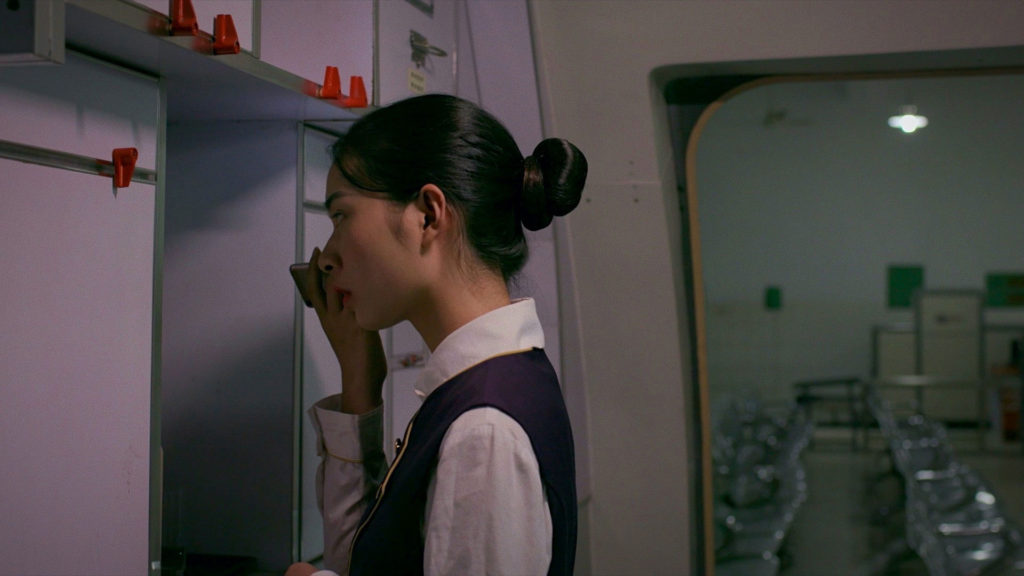
In an early scene from Stonewalling, co-directed by wife-husband duo Huang Ji & Otsuka Ryuji, the main character Lynn (Yao Honggui), who works in various modeling and hostess gigs while studying to become a flight attendant, recites the phrases “forty is forty,” “fourteen is fourteen,” “forty isn’t fourteen” to herself over and over. In Mandarin, these words (sì shí shì sì shí, shí sì shì shí sì, sì shí bú shì shí sì), while foundational in and of themselves, combine to form a rather potent tongue-twister, one that Lynn, who grew up speaking Hunanese, uses to improve her grasp of the dominant Mandarin dialect, any extra asset to assist in her hireability, though she declines to practice her English.

Stonewalling is suffused with such delicate balances of identity that reflect wider socioeconomic concerns. It is the third part of a trilogy with Egg and Stone (2012) and The Foolish Bird (2017) — the first directed by Huang solo, while all three are lensed by the Japanese-born Otsuka — a triptych following Yao’s character from the age of 14 to 20 and her parents (played by Huang’s own father and mother). I haven’t seen the first two films, whose narrative linkages seems fairly secondary to Stonewalling‘s concerns, but they all deal with the particular struggles faced by young women in a rapidly changing China. And those struggles are especially particular here: the film takes place over the course of Lynn’s unexpected pregnancy; first intending to get an abortion, she instead decides to carry her child to term so that her mother (who runs a woman’s clinic) can offer it as compensation to a patient who lost her own child.

This set-up gestures towards Stonewalling‘s most pressing interest: the commodification of the body, how one’s personal being is turned into just another item for the market, objectified in multiple senses of the word and evaluated according to strict parameters. Much of the film thus unfolds as almost a series of vignettes, as Lynn passes from gig to gig, crossing back and forth from her parents’ home in the suburbs of Changsha to the big city, continually trying to sustain herself amidst a climate of uncertainty and fraud, most clearly typified by her mother’s participation in a multi-level marketing scam involving a healing cream. The effect is in many ways akin to an ambitious cross-section of a certain aspect of the Chinese marketplace, continually finding new manifestations and outgrowths of a fundamental imbalance in society.

But what makes Huang and Otsuka’s approach much greater than a simple exposé of the dire state of modern China and/or capitalism in general is the middle ground they find. Mostly shooting in static long shots, the pace of their scenes unfurls with a great sense of consideration, refusing to lean into the outrageousness of any moments and instead letting it emanate from the material. This especially comes to pass during a crucial job that finds Lynn supervising a group of women potentially slated to donate their eggs to wealthy clients; all young, attractive, and told to behave in certain ways, their job interviews take place with exactly the level of discomfort one might expect without ever becoming overbearing. (It’s also worth noting that there are a few Uyghur women in this group, though it’s not a thread that is this film’s place to explore further).

Throughout this, Lynn’s sense of drift and displacement remains pronounced, not the least because of her fraught, distant relationship with her parents and her boyfriend, the latter of whom disappears for most of the film because of her concealment of her decision to carry her child. And this all reaches full tilt with a shockingly vivid recreation of the early days of the pandemic, something which is evoked as a disruption to the rhythms of life, a further elaboration on Stonewalling‘s interest in the body’s role amidst the masses blown up to national and then global scales. Without saying too much further, the ending suddenly hammers home the sadness and personal ties that bind, only hinted at before and which suddenly come home to roost. The elegance of its conceit, the suddenly bursting emotions that swell amidst immense loneliness, feels so attuned to its character’s journey, something which makes the quotidian rhythms all the more potent.

Preliminary Sight & Sound 2022 Thoughts

Initial thoughts on the 2022 Sight & Sound Poll initially written for Seattle Screen Scene.

For all the prattling I’ve done on Twitter about this iteration of The List, which I do agree is pleasingly vibrant, I find it hard to really get my thoughts settled about it. Part of the idiosyncrasy of such an endeavor is of course how arbitrary it can feel, a taste purposefully unrepresentative of all but whatever might be considered the “average” critic in the year 2022. But there’s also the way in which highly diverse films — directed by Keaton, Sembène, Apichatpong, Leone, Bresson, just to name the first names on the list alongside the incongruous Peele — are lumped together, a “baseline” of tradition that’s largely neglected in favor of the discussion of all the new films that have sprung to the surface and the old ones that have drowned.

This is of course how the discourse works; change is — ironically, given the new #1 — much more interesting than what’s already known. And despite everyone talking about how films made the list or not, we really only have about half of the most important data: not only the individual ballots, but also what lies just beyond the top 100. For some reason, I always thought that as long as something was in the top 250 it was roughly as prestigious as the top 100, whereas the current attitude of many seems to be that if a film is not in the top 100 then it’s been ejected from The Canon (as opposed to the canon). Certainly I’m guilty of this, and I have my own lamented favorites, stalwarts (The Mother and the Whore, The Magnificent Ambersons, Gertrud, the aforementioned Rio Bravo) and new combatants (Twin Peaks: The Return, Goodbye, Dragon Inn) alike that might have ended up in the top 150.

Sean, I like your phrasing about “established young critics” (I guess I’m one, though I don’t try to think of myself that way) having their own Wild Strawberries and Chinatown, even as I struggle to figure out what those might be. As I’ve made clear elsewhere, I do think the inclusion of Portrait of a Lady on Fire in the top 100, let alone at #30, is (despite being an okay film) a travesty, a kowtowing to mediocre middlebrow aesthetics dressed up in gestures to representation that do little to ameliorate its great faults. I do quite like the other 2010s films, especially Parasite, but it’s not so much their newness that troubles as it is the magnitude of hype that accompanies them, while vastly more totemic films in our circles (Twin Peaks, Toni Erdmann, Zama) get left in the dust; I agree (and hope) that none of them stay in the top 100. (Perhaps unfairly, I’d also lump in Daisies as a massively overinflated inclusion, and probably The Piano and Daughters of the Dust as well.)

None of these qualms really apply to some of the other enormous jumps: Wanda, Killer of Sheep, Do the Right Thing, all deserving and cemented in film history long before their breakthroughs here. They certainly don’t apply to Beau Travail and “Meshes of the Afternoon,” two films which I had no inkling would make it as high as they deservingly did, alongside my beloved Mulholland Dr. and In the Mood for Love. And most of all they don’t apply to Jeanne Dielman, as deserving a #1 as any film out there. On the one hand, I don’t think it’s absolutely sunk in for me how incredible a result this is, given its almost inevitable rise amid a general renewed love for Akerman’s work. Despite The Discourse that has resulted, it truly is a challenging film in all the best senses, one which demands an engagement rare for films that generally make it to the uppermost echelons of this kind of evaluation.

But it also has me weirdly reflecting back on Vertigo, and how weirdly out of place its 10-year reign was. The other three #1s — Jeanne Dielman, the perennial winner Citizen Kane, the one-time Bicycle Thieves — were all effectively nuclear bombs in the film landscape of their time, radical films which had an immense effect on the many films that followed in their footsteps. This has been obscured in large part by, as Jonathan Rosenbaum put it, his polemical (and to my mind true) reading of Citizen Kane as “the first feature of an independent, avant-garde filmmaker” being downplayed by the traditional reading as a flash-in-the-pan triumph of the Hollywood system by a director who never bettered it.

Vertigo, on the other hand, though it had a slow rise and seemed likely to best Kane in 2012, is in many ways the opposite of these other #1s, entirely befitting its status as a dark mirror. It is still likely cinema’s greatest nightmare, a reflection of all the forbidden pleasures we cinephiles indulge in. Of course none of the other three are exactly heartwarmers, but there is nothing of the plain humanism of Bicycle Thieves, the astonishing jubilation of Citizen Kane, the uncompromising feminism of Jeanne Dielman, only a swooning pain. Vertigo has many imitators to be sure, but it took much longer to reach that level of recognition. Maybe we can only appreciate how strange it is that it was ever at the very top in hindsight.