Rough and Rowdy Ways [THE FEELING THAT THE TIME FOR DOING SOMETHING HAS PASSED]

Courtesy of Magnolia Pictures.

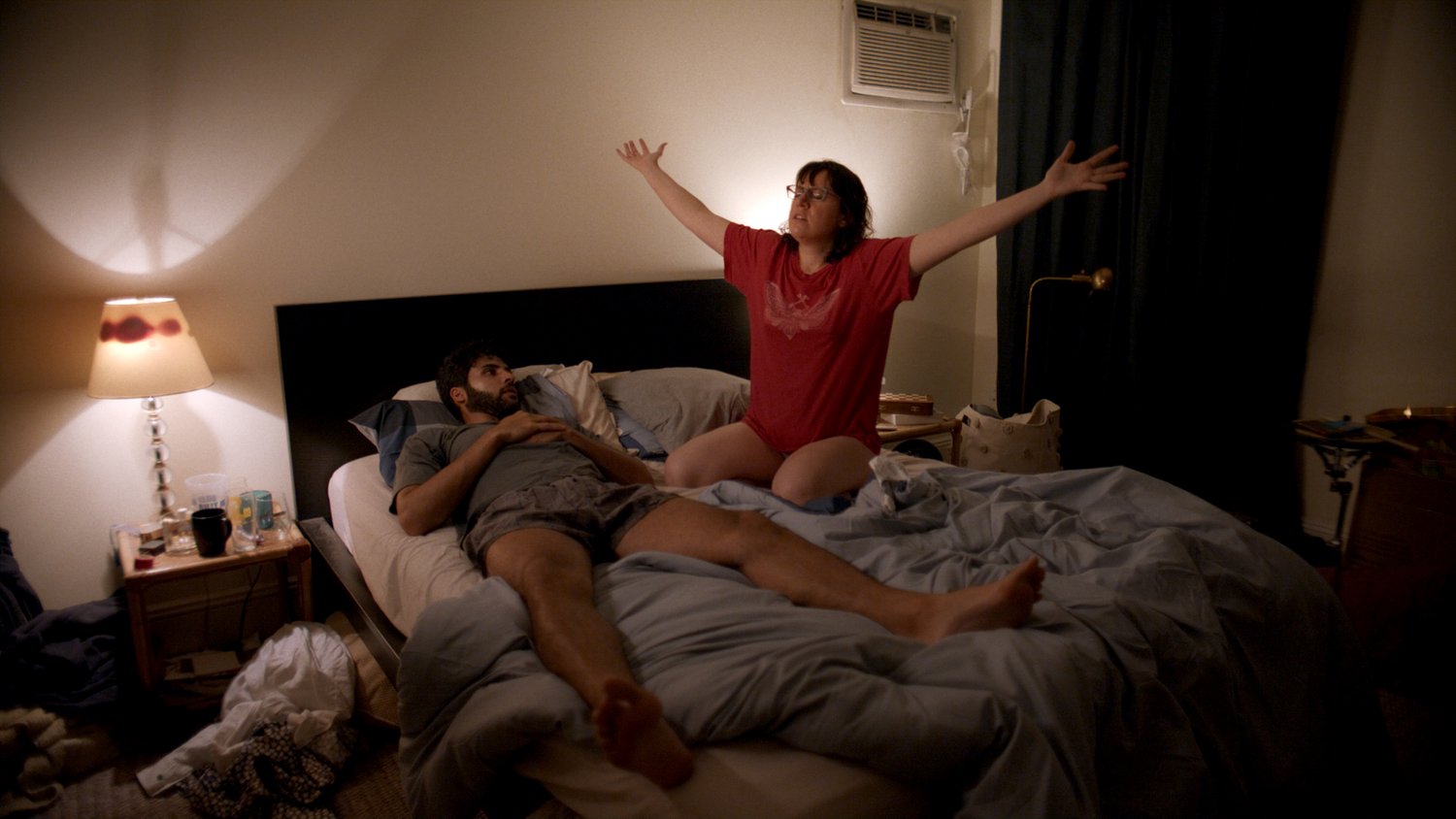
The Feeling That the Time for Doing Something Has Passed

Rating *** A must-see

Directed by Joanna Arnow

Over the course of a decade, Joanna Arnow has crafted a slender but vivid oeuvre of uncommonly personal filmmaking. Before last year, she had directed exactly three films: the 56-minute mid-length documentary i hate myself 🙂 (2013), the 11-minute black-and-white narrative short Bad at Dancing (2015), and the 6-minute narrative short Laying Out (2019). Each featured herself front and center, delving largely into issues and anxieties surrounding sexuality, social and familial relationships, and codes of behavior in New York City, poking and prodding at the boundaries with a disarming, self-conscious awkwardness. The concluding scenes of i hate myself 🙂, which feature Arnow showing the film she had made to her parents and her then-boyfriend, form a gauntlet throw of self-reflexivity and devil-may-care attitude that each of her films since then has explored.

Arnow’s narrative feature debut The Feeling That the Time for Doing Something Has Passed, despite running just 87 minutes, is longer than her entire previous body of work combined, correlating to a pronounced leap in scale and ambition. For the first time, Arnow plays a character not named after herself: Ann, a New Yorker in her thirties mired in a bland corporate job and, at the start of the film, in a long-term casual BDSM relationship with Allen (Scott Cohen), an older and more affluent man. Eventually, she begins exploring arrangements with other men as sign-posted by the five chapters of hilariously unequal length, each named after one or more men that she meets. The most notable newcomer is the sweet and caring Chris (Babak Tafti), though the film ultimately makes no feints at decisive change.

To convey all of this, The Feeling That the Time for Doing Something Has Passed (a title so fittingly melancholy yet ludicrously distended that typing it all out is its own pleasure) opts for an almost prismatic approach, drawing out Ann’s life of near-constant humiliation—desired in sexual encounters but dreaded in work and familial interactions—as a cyclical series of shards of time, often honed by Arnow herself down to a single isolated exchange that cuts away right before an anticipated punchline. The effect, to put it crudely, is almost a continual coitus interruptus, and indeed while the film does not shy away from the consensual harshness and even absurdity of the dominant/submissive arrangements that Ann enters into—she’s almost always fully nude when she’s with Allen, and dons a “fuckpig” costume when with Elliot (Parish Bradley)—she’s rarely (if ever) seen experiencing genuine sexual pleasure. The performativity, the satisfaction of a job well-done seems to be its own fulfillment.

While The Feeling That the Time for Doing Something Has Passed does contain plenty of mortifying humor in line with Arnow’s past work, the range afforded by a much longer runtime expands the opportunities for perpetual, low-key embarrassment. Where shorts like “Bad at Dancing” and “Laying Out” were hermetic in their focus on just two or three characters, and i hate myself 🙂 was entirely consumed by a few relationships, this new film is free to let its focus drift. Ann/Arnow is always retained as a center, but the comedy is allowed to drift out from her environs to a much greater degree than before: hackneyed business mantras a decade behind the times, the travails of dating apps, even an eerily prescient conversation about Zionism are evoked with ease. Each little scene has the capacity to suddenly evolve and take on a different intention, and the collision between the areas of Ann’s life without letting them overlap produces a synthesis towards understanding her desires and frustrations.

It’s well worth noting that Arnow, with this film especially, is operating within a very particular New York cineaste milieu. The Feeling That the Time for Doing Something Has Passed is co-produced by Graham Swon, the independent maven involved with such vital works as Dan Sallitt’s Fourteen, Ted Fendt’s Classical Period, and Matías Piñeiro’s Hermia & Helena; it’s shot in cool, no-fuss digital by Barton Cortright, who also lensed Swon’s The World Is Full of Secrets and Ricky D’Ambrose’s The Cathedral; and it features a bevy of familiar faces in its cast and extras: Keith Poulson, Bingham Bryant, C. Mason Wells, Maddie Whittle, and Charles Bramesco among countless others.

Ann is seen carrying a Film at Lincoln Center tote in several scenes, and a few very curious film artifacts crop up throughout. At one point, she mentions that her favorite song is the theme to the fictitious film In the Act of Wishing for Love, and the track that plays (by composer Robinson Senpauroca) is a clear parody of In the Mood for Love‘s use of “Yumeji’s Theme”; this scene is later counter-balanced by a truly odd moment where she sings a song that can only be described as Les Misérables starring Sirius Black. Additionally, there is a rather intriguing mention in the credits for Andrei Ujică’s cosmonaut documentary Out of the Present (whose use I sadly was unable to spot), and the prominent use of two films-within-films with a special “experimental film cinematographer” credit for Charlotte Hornsby. Those both come on dates with Chris: the first a split-screen landscape film focused on waves (which may takes place at Anthology Film Archives) and the second a digital black-and-white French musical featuring a female singer and a male guitarist. Of all things, the man’s countenance and the welcome low-budget stiltedness suggested to me Pierre Léon’s L’Idiot (2008), another film with brilliant use of limited means and space.

All of this is very funny, and contributes to a melting pot of interests that can be further extrapolated to influences (Pialat of course comes to mind). But The Feeling That the Time for Doing Something Has Passed is Arnow’s through and through, down to the casting of her own parents (something of a feat considering how upset they were at the end of i hate myself 🙂). Her long-shot frames, frequently at oblique angles, provide an ideal vantage point to observe a life slightly askew, and for all of its humor and self-conscious silliness, the aggregate is something more pensive. In the penultimate scene, Arnow’s father apologizes for overcooking the fish, ruefully commenting on how much there is of it. Both a (unconscious or not) riposte to Woody Allen’s opening Annie Hall monologue and a complete summation of her work thus far, Arnow’s choice is to keep going nevertheless, burrowing ever further into the strangeness of modern life.

On High in Blue Tomorrows [THE BEAST]


Courtesy of Sideshow/Janus Films.

The Beast/La Bête

Rating **** Masterpiece

Directed by Bertrand Bonello

In the past five years or so, at least two of the greatest films have also provided their own radical versions of adaptation. Christian Petzold’s Transit (2018) left the events of Anna Seghers’s novel mostly intact, but augmented its concerns through both image and word, deliberately obfuscating the time period in which the film is set and adding a discordant narration that reflects back on the nature of storytelling in times of immense crisis. Even more boldly, Hamaguchi Ryusuke’s Drive My Car (2021) drastically expanded Murakami Haruki’s short story, using disparate elements not only from the author’s body of work but also Anton Chekov’s Uncle Vanya to create an all-encompassing meditation on artistic creation and the strife and potential healing within relationships. 2023 also saw a surfeit of unconventional adaptations, with Martin Scorsese’s Killers of the Flower Moon, Jonathan Glazer’s The Zone of Interest, and Trần Anh Hùng’s The Taste of Things all zeroing in on one aspect of their sources or shifting their focal points, all to fascinating if not entirely successful ends.

But the greatest adaptation to premiere last year came from an unlikely source: Bertrand Bonello. Despite his palpable interest in inspirations both historical—Saint Laurent, Zombi Child—and mythical—Tiresia—his latest magnum opus, The Beast, is his first work of explicit adaptation, with the screenplay credited to himself in collaboration with Benjamin Charbit and Guillaume Bréaud, “freely inspired” by Henry James’s legendary 1903 novella The Beast in the Jungle. “Freely” is even perhaps pushing it: it is almost an impudent work of adaptation, spooling out James’s story of devastating melancholy between an Englishman anticipating a sudden catastrophic event and the woman who agrees to keep watch with him into a tripartite tale of thwarted connection across the ages. In 1910 Paris, on the eve of the Great Flood, concert pianist Gabrielle (Léa Seydoux) and Englishman Louis (George MacKay) reconnect over her premonition; in 2014 Los Angeles, aspiring actress Gabrielle is stalked by Louis, now an American incel; and in 2044 Paris, Gabrielle meets Louis while deciding whether to undergo an AI-recommended procedure to “cleanse” her DNA by reliving her past lives to purge her emotions.

Making the appearance of The Beast all the stranger is the existence another 2023 adaptation: Patric Chiha’s The Beast in the Jungle is a putatively more faithful reworking of James, retaining the original story’s names and tracking their interactions over the course of 25 years (beginning in 1979) in a Parisian nightclub. The differences are instructive, despite both directors’ entrancing focus on mood and texture. Chiha sticks close (but not entirely) to the letter of the novella: the outlines are the same, especially with the climactic scenes, and yet the tangents open up the hermetically sealed emotions of James’s characters. Numerous signposts are given, most of all the specter of AIDS which devastates the openly queer nightclub’s population, and the seemingly virginal James protagonists are swapped in for people with relationships of varying levels of success and intimacy.

For his part, Bonello plays with such expectations of fidelity from his first image: Seydoux in a green-screen studio (in what the viewer will later learn is her 2014 guise), taking off-screen directions from Bonello himself, as she performs actions of a woman in trouble, before her image and screen bleeds into a digitally artifacted blur that serves as the title card. The film then moves into the 1910 section, which recreates the first chapter of James’s novella to a T; immediately afterwards, the 2044 thread is introduced, and little after that is directly retained from James. The 1910 and 2014 sections play out over their respective halves of the film (only one shot from 2014 is intermingled with its predecessor), with the 2044 setting interspersed at unexpected intervals, a decision which, rather than deemphasizing futuristic speculation in favor of twinned tragic tales, explicitly casts the future as an inherently ethereal, inexplicable realm woven into our collective past and present, all the more vivid for its eerily quiet Paris, empty of cars and computer screens but always full of a certain menace.

Bonello’s never been shy about divulging his influences, and it’s easy to further extrapolate potential precedents for The Beast. There is of course Brian De Palma, whose self-casting in The Black Dahlia as a sleazy Hollywood director mirrors Bonello’s voice in the prologue. Of all people, Jia Zhangke seems to have made an impression with his two recent tripartite films, both of which bear a resemblance: Mountains May Depart with its past/present/near-future set-up (though the use of 4:3 is applied here to the future), and Ash Is Purest White in the use of past time periods to in effect revisit past works, with 1910 corresponding somewhat closely to House of Tolerance and 2014 to Nocturama. But while that latter film was equally indebted to Dawn of the Dead and Alan Clarke’s Elephant, and parts of Zombi Child are in conversation with I Walked With a Zombie, The Beast shares its clearest touchstone with its predecessor—filmed during a year-long delay in production—Coma: David Lynch. Paradoxically, the eighty-minute Coma feels closer to Inland Empire‘s complete dislocation, while the two-hour-and-forty-minute The Beast shares its own DNA primarily with Mulholland Dr., embracing the seductive Hollywood textures even as darkness rapidly approaches; even considering changing cultural preferences, Seydoux’s noticeably shorter hairstyle here compared to the other two sections suggests a kinship with Naomi Watts in Lynch’s 2001 masterpiece, as does her status as a woman staying in a residence not her own while trying to break into the industry. The extremely prominent use of Roy Orbison’s “Evergreen” only drives home the connection.

Bonello’s process for adaptation, like his proclivity towards inspiration, seems to be one of unique, discerning absorption, open to pulling from the unlikeliest of sources and repurposing them for his own uses. The boldest of these, of course, is the mass shooter Elliot Rodger, who killed six people at the University of California, Santa Barbara 2014 in a misogynist rage. Bonello intersperses recreations of several of his manifesto videos featuring Louis throughout Gabrielle’s 2014 narrative, and his fascination with the clear means of address that lay bare hatred and insecurity turns the first section’s tentative, repressed duet into a series of indecisive point/iron-willed counterpoint. In turn, the pronounced inequality in the span of years between the three time periods suggests a fracture in connections exacerbated by the events of this middle section, an acceleration towards oblivion.

There is too much contained in The Beast to even begin to encapsulate. For one, it’s still difficult to watch this film and MacKay’s brilliant, watchful performance without picturing how Gaspard Ulliel, a longtime Bonello collaborator originally cast in the part before the production delay and his untimely death in a skiing accident, would have played the part; on the other hand, the shifting identity and personality of Louis in relation to Gabrielle’s steady, tremulous presence is only enhanced by having a non-French actor assume these different forms. There’s also of course the sheer pleasure of watching Bonello shoot in Los Angeles (even catching a glimpse of a taco truck at one point), a mood consonant with yet distinct from his unrivaled work with Paris at night. Even the casting of three of the only significant characters besides the main duo bears mentioning: Guslagie Malanda from Saint Omer as an android in 2044; filmmaker and Red Scare podcaster Dasha Nekrasova as a model friend of Gabrielle in 2014; and producer Xavier Dolan as the voice of the AI guiding Gabrielle in 2044. These three oddly discordant choices, each seeming to represent entirely different strands of film culture, feel in line with Gabrielle’s computer in 2014 constantly contending with real-world events and online detritus that, taken together, form something genuinely unnerving: news coverage of the Ferguson uprising literally backgrounded, pop-up ads featuring a prescient description of a Trump presidency and promises of Kim Kardashian nudes, even some clips from Trash Humpers.

The general cacophony suggested by this hailstorm of information, however, does not truly describe the experience of The Beast, and how both Bonello and Seydoux contribute to the singular, overwhelming mood. Seydoux has been on one of the great acting runs of the twenty-first century, turning out what would conceivably be career-best work for anyone else in three consecutive years between France (2021), One Fine Morning (2022), and now this film; like in the former, so much power is derived from the shifting landscape that is Seydoux’s face, the terror, pleasure, and confusion that she vividly displays. Across the three parts united under Bonello’s implacable camera and alternately lush and cold surfaces, various motifs recur both within—most notably a nightclub in 2044 that is patterned at various times after the music and decor of 1972, 1980, and 1963—and across different parts: dolls (suggestively made out of celluloid in the 35mm-shot first part), shared musical pieces, psychics, and incongruously pigeons as a harbinger of death. What this all adds up to is something inexplicable, completely breaking from the letter of James but totally in line with the horrifyingly sad spirit: that when the final hammer blow comes, it will be in the most impossible of ways; that one life is not enough to contain the devastation that a single person will feel.

Welcome to the Working Week [DO NOT EXPECT TOO MUCH FROM THE END OF THE WORLD]


Courtesy of MUBI.

Do Not Expect Too Much From the End of the World/Nu aștepta prea mult de la sfârșitul lumii

Rating **** Masterpiece

Directed by Radu Jude

Few directors working today can claim to have had as protean an oeuvre in as a short time as Radu Jude. He first began somewhere in the realm of contemplative cinema, with his international breakthrough Afterim! (2015) and considerably lesser-seen Scarred Hearts (2016) essaying self-consciously “antiquated” visual schemes—black-and-white widescreen in the former, color Academy ratio in the latter, both on 35mm—to capture historical periods constantly under the shadow of colonial and fascist forces. Since his decisive turn (in the narrative realm) to satire, inaugurated with “I Do Not Care If We Go Down in History as Barbarians” (2018) and solidified with his Golden Bear-winning Bad Luck Banging or Loony Porn (2021), the same intellectual rigor which undergirded those earlier efforts has been turned towards outright comedy. The opening moments of Barbarians, where the lead actress (purportedly out of character) tells a boxing joke that invokes Kant’s Critique of Pure Reason, set the fast-and-loose, unpredictable tone and spiral of citations and references.

Jude’s latest and best film to date, Do Not Expect Too Much From the End of the World, at least somewhat continues in the same vein as those previous two narrative features. Like those, it is centered upon a woman dealing with issues related to work—a director attempting to mount a reenactment of a massacre in Barbarians, a schoolteacher caught in a porn scandal in Bad Luck Banging—and features a decisive switch from celluloid to digital cinematography more than halfway through the film. Here, the woman is Angela (Ilinca Manolache), an overworked production assistant driving around Bucharest to film injured workers auditioning to be in a factory safety video; like Bad Luck, where the third part of the film used digital cameras to delineate the rancorous parent-teacher meeting, the second and final part of Do Not Expect uses a digital single 35-minute long take to capture the filming of the video.

But where Barbarians maintained a consistent pattern of philosophical and historical debate, and Bad Luck Banging confined its own shape-shifting play between fiction and archival signification to three separate parts, Do Not Expect refuses such boundaries to bracing, illuminating effect. Such interplay begins immediately with the first part, running over two hours in this 163-minute film, situated as a conversation of two Angelas: our heroine and the protagonist of the 1981 film Angela Moves On by Lucian Bratu. Extensive clips are used from that preexisting film, presented in both Academy ratio and 1.85:1, with the pale colors making for a stark contrast with Jude’s hazy black-and-white 16mm. These are in turn interrupted by Angela’s way of blowing off steam: an online persona named Bobiță, with Angela using an absurd Andrew Tate-esque face filter to make various crude and misogynistic jokes; these sequences are presented as bright digital iPhone footage.

What the proto-feminist film and the foul-mouthed TikTok personality have in common is a certain “found” nature: Manolache had apparently been posting as Bobiță, and when Jude learned about it he wanted to incorporate it. In interviews, he has talked about both his mixed-to-low opinion of the film—whose footage is frequently slowed down and zoomed-in to reveal images/signifiers of life under Ceaușescu missed by the censors—and his fascination with TikTok, comparing it to early silent cinema in its promise and capacity for invention, but what’s fascinating is how Do Not Expect Too Much From the End of the World avoids such associations. For one, the film embraces a certain slowness that matches the grind of Angela’s quotidian work experience: much of the film just observes both Angelas driving, and despite the frequent unpleasant interactions with other cars and blasting of music to stay awake, there is a certain pensive, even hypnotic quality that emerges.

This isn’t to say that Do Not Expect isn’t incredibly funny, both with its vulgarity and barrage of references—a single scene manages to reference Antonioni, Warhol, Freaks, and Godard’s suicide—but Jude’s aim has never been more balanced or effective. In large part, this is derived from the unsubtle but detailed shared exploitation between Angela and the workers she is interviewing, and in turn her own complicity in carrying out the bidding of her production company. That company has itself been hired by the Austrian company operating the factories in Romania where the accidents occurred, from which a great many more economic connections and injustices across nations can be inferred. Even a visit to the set of Uwe Boll’s latest film and an ongoing issue with a graveyard set to be moved conjure up a sense of life under oppressive capitalism as a series of inexplicable, numbing events, a rhythm that Jude creates while still making each of these individual moments across disparate media surprising.

By the end of Do Not Expect Too Much From the End of the World, both Angelas are sidelined, and Ovidiu, the wheelchair-bound worker selected for the video whose mother appears to be 1981 Angela herself (played by the same actress Dorina Lazăr), takes center stage. He leads the second and final part, which is classified as “raw material,” a phrase which applies equally to the actual camera footage and the dehumanizing outsourced labor which led to his injury in the first place. Combining the Lumières and Bob Dylan, along with the hilariously inane repetition of the phrase “gold diffusion filter,” this last part is both denouement and vital encapsulation, a hyper-compressed, real-time recapitulation of the previously seen lived experience across a single day within the span of half an hour, where ultimately even fabricated language proves inadequate to capture the intentions of an unfeeling corporation. But Jude’s vision, crucially, is not one of unmitigated bleakness. Whether it be the frequent use of poetry, including interspersed through his handwritten credits, or a haunting silent sequence towards the end of the first part that silently films crosses along a road infamous for car accidents, Do Not Expect constantly demands and foregrounds the moments of contemplation. And in those many, many scenes of Angela focused on the road, trying to stay awake as she moves from place to place, he has found the perfect vehicle.

The People You’re Paying to Be in Cars [FERRARI]


Courtesy of NEON.

Ferrari

Rating *** A must-see

Directed by Michael Mann

Ferrari, Michael Mann’s first film in eight years, begins with a sequence that I’m fairly sure is without precedent in his oeuvre. It is a prologue that captures Enzo Ferrari (Adam Driver)’s lesser-known beginnings as a racecar driver, made to look akin to a silent film (within the confines of Mann’s usual Scope frames). At least some of these images appear to be archival from the early 1920s, as cars barrel down at great speed and sometimes smash into each other as spectators eagerly look on. But a few images stick out: those that distinctively have Driver within the frame. It isn’t just his status as the star of the film or the oft-commented-upon odd (and very modern) appearance of his visage that “take” the viewer out of the action of the film: it is the introduction of what may be green-screen or some other form of visual effects to emulate images taken likely a full century before. The result is something thoroughly uncanny, not unlike the emulated photographs of the era in Martin Scorsese’s Killers of the Flower Moon, but Mann’s heightened artifice (and lower budget) take things a step further: it becomes difficult to establish what belongs to then and what is inextricable from now.

Mann’s period films since the turn of the century and his switch to digital have often flirted with such concepts, from the startling insertions of digital footage of Will Smith as Ali jogging at night to the full-on, never not galvanizing HD cinematography in Public Enemies right at the cusp of its widespread adoption. But it’s worth enumerating the many ways Ferrari differs from virtually all of his past works, even as it remains to be seen whether this is a full-on creative reset for the octogenarian or simply a one-off moment of exploration. For one, this is the first film of his (with the exception of The Keep) that doesn’t take more than a quick stop in a major city. Set almost entirely within the city of Modena, Italy (population ~185,000), where Ferrari lived and made his work, it feels like a provincial town when stacked up against Chicago, Los Angeles, Hong Kong and the other metropolises that have populated his work, especially since Ferrari is such a dominant figure, either employing or begrudgingly enjoying notoriety from seemingly every person on screen.

For another, this is the first Mann film where the protagonist is not the main participant in the “action” of the film. Ferrari’s frequent moniker Il Commendatore (“The Commander”) cuts both ways: he wields an enormous amount of influence over how his men and cars behave, who’s in contention, and so on and so forth, but after the prologue—which pointedly comes before both the title card and intertitles explaining his situation at the beginning of the film—his driving is confined to the strictly quotidian, including most prominently his covert shuttling between his residences housing his wife Laura (Penélope Cruz) and his mistress Lina Lardi (Shailene Woodley) and son out of wedlock. For a Mann protagonist to no longer have access to the juice is a strange sensation, but one that is a) leavened by Driver and Mann’s customarily dynamic engagement with their material and b) in keeping with the different perspective that Mann adopts from his past work.

As scripted posthumously by Troy Kennedy Martin, Ferrari‘s narrative compression into a couple of weeks in 1957, as opposed to the grand sweep of past Mann biopics, applies doubly towards the juggling of his two home lives and his work stresses. As illustrated most vividly in an early scene where Ferrari and his employees time rival Maserati’s attempt at a record while across town at morning mass, the private and public things that must be done all flow into one continuous sense of drive, something which applies just as much to the commander as it does to his underlings. Ferrari, in explaining the competitive will to beat the other driver, utters the key quote of the film that “two objects cannot occupy the same point in space at the same moment of the time,” and indeed Mann’s films have always been a question of focus, of shutting out other considerations in any given moment to focus on the task at hand. Whether Ferrari is facing off against his wife for control of the company built together, or wrestling with Lina’s request for public acknowledgment of their child, he (and Mann) approaches it with the same level of hard-nosed negotiation and unerring pragmatism that he does a neck-and-neck race.

Ferrari ultimately builds to a cataclysmic bloodshed, putting a capstone on the death drive encapsulated by the media’s characterization of our Man as a “Saturn devouring his children,” and it’s oddly fitting that this film of constant motion just stops, recalling the deliberately incomplete All the President’s Men as strangely as its cemetery-set final scene is reminiscent of Elle. Other Mann films, most of all his most recent Blackhat, culminate with a certain transcendence, a triumphal act of physical and emotional boundary-pushing (Ali, Collateral) or an escape in life or death for at least one part of a coupling (Miami Vice, Heat, Public Enemies). But here, in a society and culture where everybody knows his name, Ferrari has no choice but to press on.

Sandra From A to Z [ANATOMY OF A FALL & THE ZONE OF INTEREST]


Courtesy of NEON.


Courtesy of A24.

Anatomy of a Fall/Anatomie d’une chute

Rating **** Masterpiece

Directed by Justine Triet

The Zone of Interest

Rating *** A must-see

Directed by Jonathan Glazer

Few actors in recent memory have had as vivid a year to showcase their particular strengths as Sandra Hüller in 2023. Aside from perhaps Léa Seydoux in both of the past two years, whose roles (for the better) generally resided in films with too divergent receptions/profiles to totally register as a unified statement, the last true occurrence of this was with Isabelle Huppert in 2016, with the perfectly contrasting Elle and Things to Come, and even she didn’t have her films taking the two top prizes at Cannes and getting big theatrical releases from the two most overtly influential US distributors right now.

If Elle acted as the archetypal ice queen role for Huppert and Things to Come as a relatively uncommon display of quotidian warmth for an actor decades into one of the most formidable oeuvres that a performer has ever assembled, Justine Triet’s Anatomy of a Fall and Jonathan Glazer’s The Zone of Interest operate less as tonal opposites than as distinctly different views of what it means to center a performance. Hüller, for her part, has less of a track record than either Huppert or the younger Seydoux — her hitherto most prominent performance in Maren Ade’s comic masterpiece Toni Erdmann — which makes her sudden return to the spotlight all the more gratifying.

Triet has been a director of great interest to me for a number of years, with both of her Virginie Efira vehicles — Victoria (2016) and Sibyl (2019), with the latter featuring Hüller in one of the great unsung supporting performances of the past five years — demonstrating a canny understanding of romantic woes and the way they can become enmeshed in the courtroom (in the former) and the film set (in the latter). For his part, Glazer is a filmmaker I’ve appreciated without ever truly embracing; my memories of Sexy Beast are mostly limited to its flashy style and flashier performances, while Under the Skin struck me as unnerving and confident without coming close to its consensus status as a transcendent journey into the unknown.

So my love for these films, likely the strongest of their respective director’s careers thus far, can’t (and shouldn’t) be entirely separated from Hüller and the disparate means by which she grounds them. But this isn’t to take away from each film’s considerable merits, and the sizable breaks from my previous conception of what their auteurs are capable of. Anatomy of a Fall lies closer to that view: like Victoria, it is principally a courtroom drama, with Hüller as an autofiction writer (suggestively also named Sandra) on trial for the murder by defenestration of her novelist husband at their chalet in the French Alps. The Zone of Interest, meanwhile, is Glazer’s first period piece, tackling a time and space which at first glance feels more well-trod than any from his past films: Auschwitz, or rather, the manicured estate of camp commandant Rudolf Höss (Christian Friedel), his wife Hedwig (Hüller), and their many children, with the Jewish victims out of sight and (to the residents) mostly out of mind.

One of the under-discussed aspects thus far of Anatomy of a Fall and The Zone of Interest lies in their structures, which when paired together almost form mirror images. The former shifts from the couple’s beautiful snowy mountain dwelling to a bland courtroom a third of the way through and rarely departs — not unlike Alice Diop’s more overtly rigorous Saint Omer, another French courtroom film about motivation, extended testimony, and cultural mores — while the latter somewhat unexpectedly moves from bucolic green Polish riversides to harsh wintry Berlin at roughly the three-quarters point, placing the barely glimpsed, often-heard genocide on the other side of Höss’s wall at a much greater, more blatantly statistical distance. This twinned series of departures alone complicates what might seem (and already has been construed) to be films easily reduced to their loglines, carrying little variation or depth after said premises are established. I bring up this last point not to criticize any of my fellow peers — indeed, while I love it considerably more than Triet’s film, Anatomy of a Fall strikes me in a good way as the greatest achievement in middlebrow filmmaking since Drive My Car, with all the possible attendant criticisms that such a filmmaking categorization attracts — but to convey something of the slipperiness of both films in both the execution and in any attempt to nail down exactly what each is doing. For both films are, at their core, about the fallout from committing to (and/or deluding oneself into believing) a narrative.

Like Triet’s most obvious antecedents, Basic Instinct and Anatomy of a Murder — though Luc Moullet and Antonietta Pizzorno’s Anatomy of a Relationship might be an even more fitting predecessor/title inspiration — Anatomy of a Fall courts this literary inclination explicitly. One of the chief points of contention in the battle that develops between Sandra’s friend and defense attorney Vincent (a terrifically blithe Swann Arlaud) and the prosecutor (Antoine Reinartz, as captivatingly needling as he was in 120 BPM with none of the earnestness) lies in the interpretation of various texts, given that the only beings in the vicinity of the chalet were the couple’s son Daniel (Milo Machado-Graner), blind from an accident that happened under his father Samuel’s (Samuel Theis) watch, and their adorable dog Snoop. Such texts run along a spectrum between personal and impersonal: a passage from one of Sandra’s novels which found its consensual genesis in one of Samuel’s many abandoned projects; the astonishingly catchy instrumental cover of 50 Cent’s “P.I.M.P.” that Samuel blasted to disrupt an impromptu interview Sandra was giving shortly before his demise, where the original’s “misogynistic” lyrics are dismissed as too remote from the recording that was actually deployed; and most crucially of all the surreptitious recording of Sandra and Samuel’s final fight, made by the latter a day before he plunged from his domicile, which is only partially visually dramatized before moving back to the “objectivity” of the courtroom, a process that Sandra characterizes as honing in on one isolated incident and using it to inaccurately characterize a much more complex relationship.

In this and many other instances, Triet and co-writer Arthur Harari (her partner and director of the great, similarly conventional Onoda) do lean into a certain obviousness with respect to the calculated ambiguity of these and other objects, placeholders for lack of direct proof. But the decisive moment arrives early on: Sandra claims to Vincent shortly after the incident that she believes Samuel’s death was truly accidental, not the product of a despondent suicide or a heated quarrel; Vincent bluntly tells her that neither he nor the court will seriously consider such a possibility. From then on, the idea is completely dropped, but its conspicuous absence remains in the viewer’s mind, even as Sandra is forced for self-preservation’s sake to abandon it. All her actions from that point on — whether she did it or not, whether she ever actually believed what she said — are necessarily driven by a commitment to a certain path. In the face of all the rigors of the trial process, with its distortions and equivocations on both sides, and the media — largely represented with some wonderfully garish camera footage also used to capture segments of the police investigation/reenactment of the day, a particularly deft way to hammer home the performative, mediated roles for detective and reporter alike — Sandra must stand firm; it’s only fitting that, after the conclusion of the trial, the film does not climax so much as fade out, a long exhale as the emotional detritus of the past few years floods back into view once again.

For The Zone of Interest, the commitment to a delusion happened long before the first image of a family picnic, before the black-screen overture set to Mica Levi’s droning score. It is historical, embedded in ideas of Aryan supremacy instilled in Höss and his family via both interior and exterior forces, something that presumably every viewer of this film will be aware of before it starts. Glazer’s project, then, is to explore the ramifications of that mindset, to depict the perverse normalcy involved in a daily existence next to one of the most infernal machines ever devised; it’s certainly not for nothing that one of the few scenes of Höss actually working comes in a meeting he has with two engineers who have traveled to present their ingenious new design for an incinerator with multiple chambers, so that the process of burning corpses and dumping their ashes can proceed that much more efficiently.

Such a ghastly mental image and the professional compliments accompanying it come to sum up much of The Zone of Interest, whose title — the film is adapted from Martin Amis’s novel, which I haven’t read, though reports seem to indicate that this largely eschews much of that book’s narrative — itself gestures at both bureaucratic detachment and an ominous foreboding. In turn, that describes the general form of the film: captured on a multitude of hidden cameras that captured continuous action, the images feel ever-so-slightly off, whether by dint of their angle, the slightly lower resolution than the norm for digital cinematography in 2023, or the sometimes jagged editing patterns. Signal moments do develop out of this aesthetic: upon returning from work one day, Höss orders a servant to take and wash his boots; the cameras stay outside of the house, observing the servant hard at work at an outdoor spigot, before abruptly cutting to an overhead view of the blood flowing from the boot for less than a second.

But the deliberate limits of The Zone of Interest‘s areas of observation largely lead Glazer to operate by allusion, which becomes Hüller’s key function; while the “character development,” such as it is, belongs to Höss, Hedwig is just as vital a figure for understanding Glazer’s ultimate aims. The house includes a tastefully kept garden ringed by barbed wire, and it can be understood that, since the film never ventures inside the concentration camp itself, the viewer’s perception of Hedwig’s work — inside and outside, dreadfully mundane and aesthetically pleasing alike — overlaps the work that her husband is doing right next door. Her means of cultivation is abetted by his toil towards destruction, a self-sustaining loop as logical and sickening as the revolving incinerator. The journey round-and-round is only interrupted by Höss’s relocation to Berlin and a series of interludes, shot on thermal cameras, which show a young Polish girl furtively leaving food around the camp and retrieving a song written by an inmate. That ghostly image is all the resistance that can be found, at least until a coda that brings the weight of history down upon Höss, alone in the halls of power.

Hüller is left out of that personal reckoning, just as the construction of Anatomy of a Fall‘s denouement forestalls the kind of catharsis that might be found in a different sort of courtroom drama. To return to the sterling linkage between these two films, Hüller in Anatomy is called upon to essentially carry the film; for all of the excellent performances and destabilizing, searching camera movements (sometimes appearing to emulate courtroom videography, crash zooms and quick pans included) and scene constructions, it likely could not hold together without her particular screen presence, a composure and confidence that always feels on the edge of breaking apart. The deft establishment of Sandra’s shaky command of French, frequently forcing her to switch to English (a lingua franca still removed from her native German), acts as yet another way in which she is situated as an outsider in this fight for her own life, and much of the pleasure of the film comes from watching a brilliant woman with everything to lose attempt to navigate the labyrinth of law and society, of judicious rejoinders and earnest appeals, constructed so that the underlying misgivings are never forgotten. Zone, on the other hand, takes all of that poise and removes the raw emotions undergirding them, leaving a surface without any depth, an automaton moving through her carefully practiced quotidian paces. Yet it is a surface that I am very familiar with; it’s potentially not too outlandish to call this a particularly odd form of a star vehicle, where seeing an actor I deeply admire cast “against type” as a thoroughly detestable character deepens the oddity and discomfort of the experience. Watching Hüller navigate a very different set of mazes — spatial and moral — making every right turn in the former and every wrong turn in the latter, lends its own strange charge to the proceedings. While one character’s judgment remains open and the other’s is hammered away, the lingering impacts of both, separately and together, still carry a tremendous force.

Road to Nowhere [ASTEROID CITY & SPIDER-MAN: ACROSS THE SPIDER-VERSE]

Asteroid City

Rating *** A must-see

Directed by Wes Anderson

Spider-Man: Across the Spider-Verse

Rating * Has redeeming facet

Directed by Joaquim Dos Santos & Kemp Powers & Justin K. Thompson

A few points of coincidence connecting these two films ruled in many ways by their creators’ tight, almost stifling grasps over the possibility of chance: both films opened in Taipei (where I’m staying for the next few months) on the same day and formed the first films I’ve seen overseas in many years over the course of a cross-town double feature, both films feature animation as a key component of their appeal, both films pinball between different aesthetic styles, and both films star Jason Schwartzman, though the one I saw at the SPOT cinema was *not* the one where he plays a character called The Spot.

The two films also find the particular “brands” to which they belong to at a certain point of crisis. On the one hand, Wes Anderson remains as alternatively beloved and derided as ever, seemingly having made a nigh-irrevocable advance/retreat into worlds of his own imagination, whether they be futuristic Tokyo, a provincial French town, or the eponymous Southwestern hamlet (population size: 87, filmed entirely on sets in the Spanish desert), piling on further structural and metafictional challenges for himself. In contrast to Anderson’s benevolent intractability, the forces on the other side are eager to cast their work as a superior, if not entirely separate entity from the sinking ship that appears to be the superhero mega-blockbusters that have very nearly swallowed Hollywood filmmaking whole. Where the MCU and DCEU appear to be faltering at last, Sony Pictures Animation, as marshaled by Phil Lord and Christopher Miller, aims to pick up the slack. Not only does the studio run with the conceit of super-powered beings aiming to prevent the end of the world for the umpteenth time, but also with the concept of the multiverse that has paid dividends both financial — making for boffo box office of the otherwise middling grosses of the MCU Spider-Man and Doctor Strange sub-franchises — and critical, with the Russo Brother-co-produced Everything Everywhere All at Once earning Oscar glory off of its own gussied-up multiverse riff.

The trends have remained steady with these latest entries. Asteroid City was fairly tepidly received at its premiere at Cannes, only to get a rapturous near-unanimous reappraisal upon its stateside release. Spider-Man: Across the Spider-Verse has been even more beloved than its predecessor Spider-Man: Into the Spider-Verse — reports of abominable crunch-time overwork notwithstanding — almost wholly escaping the sharp critical downturn in the wake of Avengers: Endgame and its (for better and worse) summative cap on a certain era of superhero filmmaking; while everything else is accurately seen as desperate flailing, the further extended adventures of Miles Morales and company continue to attract acclaim, including from many who swore off superhero films close to a decade ago.

It’s probably already clear where my sympathies lie; Anderson has been and remains one of my favorite American directors, even as my ardor for any given one of his films can vary wildly, while I remember quite liking Into but have since cooled on it, the extravagance of some of its images slipping away while the bad aftertaste of the gobsmackingly formulaic narrative became less and less obscured. It’s certainly worth noting that none of the three directors of that film returned to this one, at least in the same role; I never saw the Jump Streets or Clone High and barely remember anything of The Lego Movie, so I can’t speak to exactly how strong Lord and Miller’s voices are apart from these very linked films (though I still suspect that I’d prefer Ron Howard’s version of Solo to theirs).

With all that being said, it’s worth examining in conjunction why one aestheticized unreality works (to me) and the other ultimately doesn’t. After all, Anderson could reasonably be said to be working in, if not the multiverse, then in alternate planes of fiction in a similar way. The central conceit of Asteroid City (completely hidden in the trailers) rests on parallel tracks: a play about a group of civilians, juvenile scientific geniuses, residents, and military personnel who are quarantined in a tiny town in the Southwestern United States when they come into contact with an alien in a meteorite crater, shot in rather lovely 2.39:1 pastel color; and a television recreation of scenes from the mounting of that play in 1.37:1 black-and-white (all shot on Anderson’s customary 35mm by Robert Yeoman). While the film largely stays in that former realm, the boundaries are porous, even moreso than the storytelling devices that Anderson’s previous film The French Dispatch of the Liberty, Kansas Evening Sun used; where that film largely let the reminiscences of Swinton, McDormand, and Wright’s characters remain on that level (with Bill Murray’s editor one tier up and remaining at a slight remove from the action) and explicitly situate the “base” narrative as flashback, the inherent fictiveness of play and production alike — “Asteroid City is not real,” as Bryan Cranston’s Rod Serling-esque television host intones — displace the viewer, leaving them to reckon with the mystery of the relationships between play and production, which, if they do illuminate each other, often do so in oblique fashion.

Asteroid City, to a greater degree than any Anderson film, is about its filmmaker’s belief in the power of the performative gesture, of the ability of artifice to get at something contradictory and thus deeper in the heart of its character and setting. Perhaps it’s for this reason that I connected with it to a greater degree than any of his films since his 2014 masterpiece The Grand Budapest Hotel, whose situating of adventure and the beauty of personal storytelling against the sweep of history still feels leagues ahead of anything he has done before or since. The ambition of Asteroid City, necessarily, lies in smaller, more furtive gestures; Jason Schwartzman’s Augie Steenbeck is the closest thing to an anchoring presence like Hotel’s M. Gustave or Royal Tenenbaum, and the film (or at least the play) begins and ends with him, but it truly is, depending on how generous you want to be, a communal or an overstuffed film, and thus there is less room for the sort of reveries that Hotel was filled to bursting with.

Anderson’s directorial command can be taken for granted these days, such is the recognizability of his frames, albeit not just his frontal symmetrical close-ups: one look at the striking arrangement of faces at perpendicular angles in both Academy and Scope ratios reveals a still galvanizing eye that remains at all times his own while refusing to be pigeonholed. It’s not just enough that, in an emotional split-screen phone call, Schwartzman and (brilliant first-time Anderson player) Tom Hanks are placed as if they are looking at each other; little stripes at the top-left and the bottom-right (the former, if I’m remembering correctly, is from the edge of the phone booth) accentuate a visual symmetry that might be wholly unnecessary if it wasn’t immensely pleasurable to spot it and productive to speculate why it might be there. Similarly, the inclusion of a few shots of Academy ratio footage in the play scenes call attention to themselves; it can be easily surmised that these are meant to be from the camera on hand to film the ceremony during which these shots take place, but the perfect framing, at extreme angles that the camera couldn’t possibly find from its locked-down place in the back of the proceedings, emerges as artifice-within-artifice-within-artifice, with too many potential readings to explicate.

In a sense, such gestures, especially the second microphone that Jeffrey Wright’s military officer or Tilda Swinton’s scientist stride towards during their ceremonial speeches, demonstrate how much performance factors into all of these unfamiliar situations that the temporary denizens of Asteroid City find themselves in. The close encounter is more than anything a device, an Act 1 deus ex machina in the most existential of senses, where people locked into their routines suddenly find themselves confined with each other, having to confront how they relate to strangers in strange lands. This is not to say that the means by which this is achieved is at all secondary: the initial sighting, an extended, seemingly stop-motion UFO landing, is conducted with an awe that’s of a piece with the climax of The Life Aquatic With Steve Zissou or the wolf in Fantastic Mr. Fox. Redolent of Space Race/Cold War anxieties — the town is also periodically rocked by nuclear testing, with the distant mushroom clouds recalling the controversial atomic bomb invocations found in Isle of Dogs — the alien is a tangible representation of everything that is unknowable and ungraspable, love (familial and romantic) chief among them.

Lest that sound like a trite summation, Anderson’s metafictional structure constantly destabilizes, not least because of the opportunity for alternate characterizations, surface non-sequiturs (an acting workshop led by Willem Dafoe’s Method-espousing Saltzburg Keitel chief among them), and appearance changes it provides. One of the signal moments in the film comes at the tail end of an early scene between the play director Schubert Green (Adrien Brody) and his ex-wife Polly Green (Hong Chau), where, as she exits, she mentions that at the end of a specific scene in Act 3, Scarlett Johansson’s Midge Campbell should say a line after she leaves the room and not before; after Schubert takes that advice, Polly leaves the set where he currently resides and then says goodbye, a literal and figurative echoing across narrative levels. If that wasn’t enough, unless I’m forgetting, there is no moment when Campbell actually does that in the play; Act 3 is specified in the intertitles (heretofore regularly broken up into sections of scenes) to be played continuously without break, though at least one scene is likely omitted. One could even construe as this early “non-diegetic” scene as being essentially an airlifted substitute for the emotion of that scene, which is deliberately curtailed otherwise.

At the end of the day though, Anderson has never relied solely on his aesthetic to carry his films; it’s not for nothing that each of his films has had absolutely magnetic, screen-commanding performances, extending to the audio-only stylings of George Clooney in Fantastic Mr. Fox or Liev Schreiber in Isle of Dogs. Even amidst the parade of faces, plenty of people stand out, old and young, large roles and small; the shaken poise of Maya Hawke’s schoolteacher, the affability of Steve Carell’s motel manager, the ornery searching of Edward Norton’s Tennessee Williams-esque Conrad Earp, the playwright of Asteroid City. And Anderson’s greatest non-Murray or Wilson stalwart, Schwartzman, stands atop them all. His greatest moment comes during an already celebrated scene with Margot Robbie, his deceased wife in the play whose scene was cut. Heavily bearded in the play, he removes his fake facial hair and gets a close-up without encumbrance for the first time, and the effect is chilling: the defiance of Max Fisher is still there but wizened, even weathered, an almost wolfish, hollowed stare into the camera lens as his struggles with how to play his character reach across time. Not unlike Jean-Pierre Léaud with François Truffaut or even Lee Kang-sheng with Tsai Ming-liang, Schwartzman has been in roles small and large for Anderson, and the effect of that gaze as it has evolved over the years pierces the artifice.

It is true that Anderson’s films tend not to be tectonic shifts in style or in ultimate purpose, but that speaks to the enduring appeal of his concerns, and Asteroid City both makes that text and complicates it. The former comes in the play itself: after the quarantine is lifted, Augie and his family awake to find everyone, including Midge (who he had embarked on a tentative fling with), gone without another word. The nuclear tests resume, the charmingly absurd police-criminal gun-blazing car chases streak through town once more, and everyone picks up their routines which the span of a week did little to disrupt. The whole extraterrestrial event feels, if not completely hushed-up, then left on the backburner, something to marvel at for a few moments then abandoned in favor of more quotidian concerns. Asteroid City all but compares it to a fantasy: in the acting workshop, Earp wants the play to, among other things, get at the sensation of dreaming. In electrifying, unprecedented-for-Anderson canted angles, the actors spring up and begin reciting the line “You can’t wake up if you don’t go to sleep.” It is stated that this experience helped shape the formulation of the play, yet no such equivalent utterance appears. Rather, it is the concatenation of sensations and invocations that predominates: obscure yet haunting; lullaby-like yet foreboding (as accentuated by an unnerving Jarvis Cocker end-credits song); unrelated yet defiantly — by dint of an almost Hongian play with two narratives clanging off each other in often successful, always daring ways — vital.

Would that such complexity were afforded to the film that actually made narrative, and in particular the fungibility of superhero storytelling itself, the explicit subject. To its credit, Across initially switches up its focus: the first fifteen minutes or so take place in the dimension where Gwen Stacy (Hailee Steinfeld) resides, the single most visually bewitching realm in the film that seems to simulate watercolors dripping off the walls in deep blues and purples. These, like the rest of the film, can be inconsistent (some frames play much more with abstracted environments and people than others), but much of the charm of the Spider-Verse films, like Dash Shaw’s underrated My Entire High School Sinking Into the Sea, is their hodgepodge nature, giving different characters and environments a corresponding look that speaks to the mutability and creativity of the animated comic-book form.

But for the first of many, many times, the basic plot, always digging itself into holes then taking the easiest way out, comes to dominate the proceedings. While (at least initially) Across avoids the staid self-actualizing of Into, content to leave Miles and Gwen to deal with day-to-day life, the film quickly devolves into the ratcheting up of personal dramatic stakes between child and parent(s) that become numbing when played out for the umpteenth time. Across, across its numerous acts, withers amid its almost unceasing rising tension; fun and reasonably diverting when it allows itself little moments of Miles by himself or with Gwen, or his parents discussing their child together, but disastrous when it has to go through the motions of a teen unable to communicate with his parents. It certainly doesn’t help that Miles’s universe, and thus the dominant aesthetic of the film, is stultifyingly bland in comparison. Without engaging interpersonal relations, this large chunk of the film feels like a holding pattern until the multiverse hijinks ensue. Of course one could say this is meant to be the point, that, after experiencing universe-altering events, ordinary life must seem like even more of a slog than it already is, but it only partly ameliorates that issue.

This isn’t to say that Across isn’t pretty funny or engaging in this early section, which ends up being by default the post-opening highlight, not least because The Spot, one of the main villains of the film, is an inherently amusing idea whose ability to open inter-dimensional wormholes leads to some funny fight scenes, with limbs and bodies sprawled across a series of portals. The early glimpses at other worlds, encompassing, among other things, live-action and Lego stop-motion, are delightful in their media mixing. In general the Spider-Verses are best at bemused affability, at leaning into the comedy inherent in seeing people from different walks of life awkwardly interact, something which, for example, a scene where Miles-as-Spider-Man tries to talk with his father and convince him that Miles is a good son adroitly gets at. And the eagerness with which Miles and Gwen act upon reuniting, the ability to enjoy each other’s presences and feel like they have true companionship in the world, is quite touching.

But in the age of go-ahead hell-bent apocalyptic superhero filmmaking, nothing can “just” be frivolous, and a series of subterfuges ultimately lands Miles among the Spider-Society, a vast array of Spider-People dedicated to tracking down villains unstuck in spacetime and restoring them to their proper place, headed by Miguel O’Hara (Oscar Isaac). From here, all pretense of complexity or flexibility basically goes out the window, with every character too locked into their ways of thinking to budge, with typically destructive results. It’s basically impossible to see Miguel as anything other than a misguided villain, someone so obsessed with doing the right thing that our hapless, headstrong protagonist gets caught in the crossfire.

The main contention is the head-slappingly literal term “canon events,” those moments which come to define any Spider-Person’s life, centered almost always on death: that of an Uncle Ben-like figure, a cop relative of a loved one, and so on and so forth. These are displayed in a hologram simulation, with an array of Spider-People crouched solemnly over a dying corpse, including the live-action MCU-precursor Spider-Men. I won’t go into further plot detail than this, except to note that the ludicrously distended film (140 minutes, the longest mainstream American animated feature ever) takes what feels like 20 minutes after the climax to get to its final, offensively reductive twist, a lugubrious stretch well after I had soured on the film.

That sudden downturn is linked more than anything to those images of death, which in a charitable reading would be an indictment of this whole multiverse concept that numerous films have attempted to make a viable device to no success. It speaks to a fundamental issue with the supposed ambition of this idea, of having putatively unlimited options only to arrive at the same characters and scenarios, only done up with a palette swap. Sure, it’s funny when it’s a Spider-Horse or baby Spider-Girl or whatever, but such changes run only skin-deep, and the lack of imagination becomes grotesque and moribund when there’s an insistence on retaining the same tropes, where the same great powers can only lead to the same great responsibilities.

I could talk about many other things that bothered me: the vagueness with which each person’s powers and fighting ability are treated, the muddled representation, the roteness of some of its humor. But I’d like to mention my favorite part of Across: brief editorial explanation text boxes that appear a few times in the film, which almost reminded me of the “(Historical)” notes on the intertitles for Abel Gance’s Napoléon. Those text boxes, enmeshed as they are within all the action, can sometimes be difficult to read and quick to go away, yet they epitomize a certain spirit of fun and innovation that much of the rest of the film sorely needs, a clear nod at a comic book art tradition that nevertheless challenges the viewer to think and slow down in a way that the general slapdash shock-and-awe of the rest of the shifting aesthetics rarely allows for. Meanwhile, in Asteroid City, where even the beginnings of a freeway built in the air inspires thought, that sense of searching, resonant ambiguity lies everywhere.
I Contain Multitudes [SHOWING UP]

Showing Up

Rating **** Masterpiece

Directed by Kelly Reichardt

Inherent in the process of artmaking is the imperfection, the unexpected detour that can radically change the overall trajectory of the artist’s intent and execution. Mark Toscano once wrote about an occurrence in his restoration of Stan Brakhage’s films, where the legendary avant-garde filmmaker stated that, for a particular short, he had initially failed to spot the hair in the camera gate; upon doing so, he decided to orient his entire visual conceit around that unintended intrusion. Such an approach can be found across media and along the entire continuum of resources and styles: whether it be classical or experimental, a mega-blockbuster or a no-budget picture, a piece of music or a film or a play, the essential humanity of art means that nothing “perfect” exists, which is something to be cherished and upheld as indicative of a personality, or a coterie of personalities, behind pieces both imposing and modest.

The best films about art accept this idea on its own terms and incorporate it into their forms; the miracle of Kelly Reichardt’s Showing Up lies in its ability to do so while creating a vivid world of its own, filled with quotidian frustrations, mysteries, and liberations. In her portrait of Lizzy (Michelle Williams), a sculptor who does administrative work at a Portland art college for a living, Reichardt does this task almost literally: the film takes place at the Oregon College of Art and Craft, which closed just before the pandemic. Temporarily resurrected during filming, the space conjures an effect not so dissimilar from Tsai Ming-liang’s Goodbye Dragon Inn, though there is no looming closure that threatens to destroy an entire way of life.

Instead, Showing Up takes place over the course of a week, as Lizzy attempts to create enough pieces for her first solo show while dealing with sundry personal problems: her contentious relationship with her friend and landlord Jo (Hong Chau), who is dragging her heels on fixing her fellow artist’s hot water due to her own impending shows; her tedious days at the college under the watchful eye of her boss, who happens to be her mom (Maryann Plunkett); and her house calls to her eccentric father (Judd Hirsch) and troubled brother (John Magaro). An additional wrench is thrown into the proceedings when her cat mauls a pigeon, breaking its wing; almost by accident, she ends up taking care of it for large stretches of time, forcing her to alter her art-making routine. Crucially, however, Lizzy is not the sole protagonist. Jo takes center stage at numerous moments, with her relatively carefree nature — she is introduced excitedly rolling a tire down the street to a tree so she can swing from it — acting as a source of equal parts hilarity, resentment, and serenity, something which Chau inhabits with exquisite good grace. Even more importantly, the film is strewn with shots of students and teachers creating their own art in wildly different media — light installations, artifice-forward films, wool-work, dyeing, painting, and much more — usually without Lizzy or any named character in the shot, frequently featuring bold tracking shots to convey the scope of this institute.

While Showing Up is probably funnier than all of Reichardt’s previous films put together — the withering glares Williams flashes at certain points are especially choice — it generously refuses to look down on any of the art its characters make, not even a landscaping piece that Lizzy’s brother claims to be crafting near the climax of the film. Its view is humble yet expansive, often using uncharacteristic jerky small pans and zooms which could be called be called, not unlike the more apparent zooms of Hong Sang-soo — whose recent films, particularly The Novelist’s Film, feel like kindred spirits in their approach to the artist — amateurish.

Of course, the entire nature of what it means to be an amateur, especially in this milieu, where a relative star like Jo still has to deal with possibly not getting a catalogue for her work, has no bearing on the quality of art or its maker’s level of dedication. While plenty of artmaking is seen, including from Lizzy, the most extended view of her practice comes in a static long take, where she breaks off the arm of one of her sculptures so she can carefully attach a different, extended set of arms in its place. That concept, subtraction in the service of addition, can be found all over Showing Up, especially its climax at Lizzy’s opening, which evolves into a litany of anxiety and passive-aggression that then unspools into a fitting equanimity. The key in that modus operandi is the back-and-forth: the blindspots and irritation must exist alongside the camaraderie and rapprochement, often coming from the most unexpected of sources. In that balance, in her leads’ abilities to carry both emotions, Reichardt finds her brilliant muse.

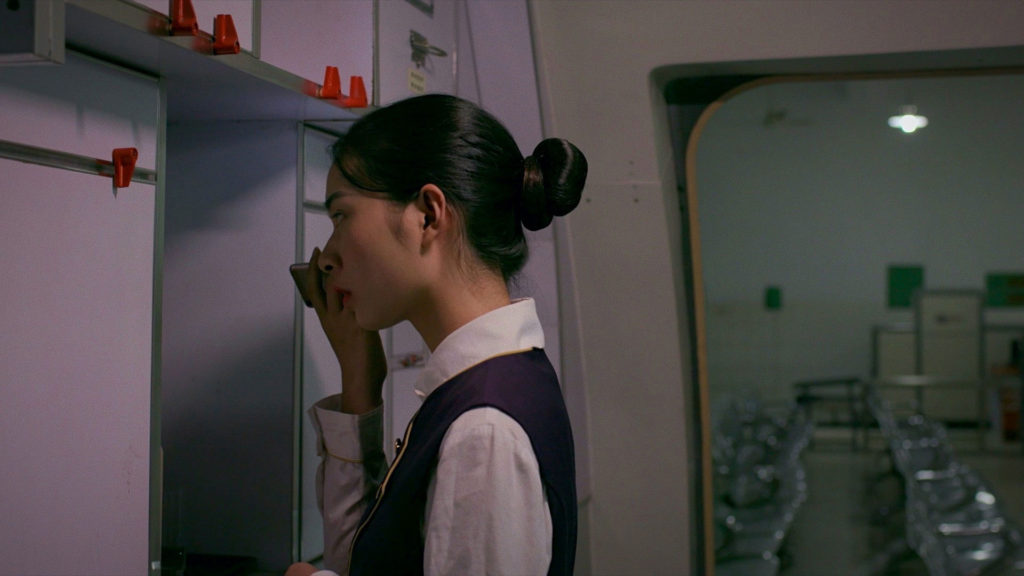
Before the Flood [STONEWALLING]

Stonewalling/石门/Shímén

Rating *** A must-see

Directed by Huang Ji & Otsuka Ryuji

In an early scene from Stonewalling, co-directed by wife-husband duo Huang Ji & Otsuka Ryuji, the main character Lynn (Yao Honggui), who works in various modeling and hostess gigs while studying to become a flight attendant, recites the phrases “forty is forty,” “fourteen is fourteen,” “forty isn’t fourteen” to herself over and over. In Mandarin, these words (sì shí shì sì shí, shí sì shì shí sì, sì shí bú shì shí sì), while foundational in and of themselves, combine to form a rather potent tongue-twister, one that Lynn, who grew up speaking Hunanese, uses to improve her grasp of the dominant Mandarin dialect, any extra asset to assist in her hireability, though she declines to practice her English.

Stonewalling is suffused with such delicate balances of identity that reflect wider socioeconomic concerns. It is the third part of a trilogy with Egg and Stone (2012) and The Foolish Bird (2017) — the first directed by Huang solo, while all three are lensed by the Japanese-born Otsuka — a triptych following Yao’s character from the age of 14 to 20 and her parents (played by Huang’s own father and mother). I haven’t seen the first two films, whose narrative linkages seems fairly secondary to Stonewalling‘s concerns, but they all deal with the particular struggles faced by young women in a rapidly changing China. And those struggles are especially particular here: the film takes place over the course of Lynn’s unexpected pregnancy; first intending to get an abortion, she instead decides to carry her child to term so that her mother (who runs a woman’s clinic) can offer it as compensation to a patient who lost her own child.

This set-up gestures towards Stonewalling‘s most pressing interest: the commodification of the body, how one’s personal being is turned into just another item for the market, objectified in multiple senses of the word and evaluated according to strict parameters. Much of the film thus unfolds as almost a series of vignettes, as Lynn passes from gig to gig, crossing back and forth from her parents’ home in the suburbs of Changsha to the big city, continually trying to sustain herself amidst a climate of uncertainty and fraud, most clearly typified by her mother’s participation in a multi-level marketing scam involving a healing cream. The effect is in many ways akin to an ambitious cross-section of a certain aspect of the Chinese marketplace, continually finding new manifestations and outgrowths of a fundamental imbalance in society.

But what makes Huang and Otsuka’s approach much greater than a simple exposé of the dire state of modern China and/or capitalism in general is the middle ground they find. Mostly shooting in static long shots, the pace of their scenes unfurls with a great sense of consideration, refusing to lean into the outrageousness of any moments and instead letting it emanate from the material. This especially comes to pass during a crucial job that finds Lynn supervising a group of women potentially slated to donate their eggs to wealthy clients; all young, attractive, and told to behave in certain ways, their job interviews take place with exactly the level of discomfort one might expect without ever becoming overbearing. (It’s also worth noting that there are a few Uyghur women in this group, though it’s not a thread that is this film’s place to explore further).

Throughout this, Lynn’s sense of drift and displacement remains pronounced, not the least because of her fraught, distant relationship with her parents and her boyfriend, the latter of whom disappears for most of the film because of her concealment of her decision to carry her child. And this all reaches full tilt with a shockingly vivid recreation of the early days of the pandemic, something which is evoked as a disruption to the rhythms of life, a further elaboration on Stonewalling‘s interest in the body’s role amidst the masses blown up to national and then global scales. Without saying too much further, the ending suddenly hammers home the sadness and personal ties that bind, only hinted at before and which suddenly come home to roost. The elegance of its conceit, the suddenly bursting emotions that swell amidst immense loneliness, feels so attuned to its character’s journey, something which makes the quotidian rhythms all the more potent.

Formalism Forever [THE GIRL AND THE SPIDER & LOS CONDUCTOS & IL BUCO]

The Girl and the Spider/Das Mädchen und die Spinne

Rating *** A must-see

Directed by Ramon and Silvan Zürcher

Los Conductos

Rating *** A must-see

Directed by Camilo Restrepo

Il buco

Rating **** Masterpiece

Directed by Michelangelo Frammartino

I’ll freely admit at the start of this review that the links between these three remarkable 2022 (release year) films are tenuous at best. Time gets in the way of even the most trivial of interests — the reviews I write on this website, which by definition aren’t on commission — and it’s too long since I’ve seen these to give them their own proper standalone reviews. But I want to write on these films: in part because I never commented on the former two, and moreso because I feel like they’ve gotten lost in the shuffle even more than the typical small-scale arthouse release, even as they rank among my favorites of the year thus far. Additionally, Rosenbaum’s penchant for tackling multiple films in a single review has always appealed to me — even as I’ve only emulated it once — and it came to mind as a solution to my lapses in memory and energy. If the purpose of my reviews on Taipei Mansions is to shed light on such works, then I’m compelled to write on them.

Shedding light of course is a unifying theme: The Girl and the Spider, Los Conductos, and Il buco feature among their many qualities a compelling approach to the difference between day and night, light and darkness, and how these extremes intermix. They are also all the works of directors with very few features, though the path each has taken to get there varies tremendously.* Additionally, in a landscape increasingly dominated by longer and longer films, they all run less than 100 minutes; if not necessarily models of concision, they still stand out as relatively fleet works that still maintain a languid, or at least contemplative, atmosphere.

It’s difficult in some ways for me to properly assess whether these films can be said to truly exist outside of the mainstream of the festival landscape. Il buco, after all, was in competition at Venice, where it won the Special Jury Prize; both Los Conductos and The Girl and the Spider were two of the highest profile films in Berlin’s secondary Encounters section in 2020 and 2021, respectively. Especially with the deservedly strong attention towards Encounters (and the strategic placing of more prominent films in it), the simple distillation of a film’s location to the festivals and sections it played at can lead to blithe dismissal of quietly — or not-so-quietly — groundbreaking work.

As is always the case, the barometer ought to be the films themselves, and in light of that they begin to extricate themselves from the norm. All of the films, in keeping with the deserved decades-long preference for minimalism in art film, could be distilled down to a single sentence. The Girl and the Spider tracks the odd interactions and relationships across two apartment buildings in Bern, Switzerland, during two days and one night. What little plot that Los Conductos possesses rests in the movement of an unhoused man around Medellín, Colombia, tracking his attempts to survive and his fraught relationship with the society surrounding him. Il buco is mostly about the 1961 excursion into the Bifurto Abyss in Italy, then considered the third-deepest cave on Earth, while also leaving ample time to chronicle a shepherd’s slow demise. Already there are the hints of the details and motifs that each director teases out: the sheer density and queer eroticism of The Girl and the Spider, the somnambulant drift of Los Conductos, the urban-rural dichotomies of Il Buco, which also stands out for its lack of dialogue, only utilizing subtitles for a tangentially crucial archival news broadcast of the construction of the Pirelli Tower in Milan.

But each adopts its own style, the likes of which I haven’t quite seen in the contemporary landscape. In keeping with their debut, the Zürchers opt for an even more concentrated form of the close-up, almost geographic shooting style, often approaching the camera subject with a frontality that simultaneously makes clear and obscures the apartments; the film even begins with a PDF of the new apartment, an object which gets altered and shifted by human activity. Breaking from the mostly portraiture style of his shorts, Restrepo retains his use of grainy 16mm in photographing a barrage of close-ups on objects, using great tactility to ground and make tangible the near-ephemerality of the film’s narrative. I haven’t seen Le Quattro Volte, but Frammartino appears to follow a similar durational style, albeit with substantially more complications: in order to shoot the film Frammartino and his non-actors actually made roughly thirty-five voyages into the abyss, shooting with no lighting save the period-accurate helmet lights and undergoing a four-hour journey each way in addition to the demands of shooting.

What these films all share, besides their awkward placement between the mainstream and the underground, is this attention to space. Two of them are shot on digital, one isn’t; two of them use rapid editing, one doesn’t; two have a legible sense of a narrative arc, one doesn’t. But all of them use space as a jumping off point, none of them content to simply showcase directorial style, and all seeking to transform a place while taking care not to rob it of its essential characteristics. In the case of Il buco, Frammartino even manages to engineer something with a greater sense of spectacle than any film of the past few years: it’s one thing to witness the spelunkers in a journey that only ends when they reach the literal end, it’s another thing entirely to see the results of something like their method of ascertaining the depth of a cavern by setting a magazine page aflame and dropping it, watching the light slowly disappear into the distance.

And the most notable connecting point of all is each film’s devotion to a certain form of impossibility, a slight inflection of the “real world” that makes it uncanny and even otherworldly. The bright colors and melancholy bitterness of The Girl and the Spider; the reflection of downtrodden, vengeful young Colombian men in Los Conductos; the purposeful anticlimax of two ends in Il buco that gets miraculously transformed into an almost Fordian elegy: all of these films utilize the viscerality of their styles to convey engrossing complexity which, in my eyes, few filmmakers today have tried to match.

*Ramon Zürcher made The Strange Little Cat in 2013, and is officially joined by his brother Silvan (who co-produced his debut) for The Girl and the Spider. After a string of well-received shorts, including “Cilaos” and “La bouche,” Camilo Restrepo makes his feature debut with Los Conductos; it remains to be seen whether he has a similarly lengthy amount of time between films as the other directors do. Michelangelo Frammartino has his third film, and his first since Le Quattro Volte from 2010.

Misguided Warriors [EVERYTHING EVERYWHERE ALL AT ONCE]

Everything Everywhere All at Once

Rating * Has redeeming facet

Directed by Daniel Kwan & Daniel Scheinert

I don’t usually like to make my life and background the focus of my reviews, since my general inclinations are to let my observations assume their personality from what I choose to write about and to not interfere with the text itself. But Daniel Kwan & Daniel Scheinert’s Everything Everywhere All at Once begs for me to consider it in light of this. There are certain aspects of myself that, for various reasons, I can’t bring into this piece, but suffice it to say that this film — in how eerily and perfectly it captures my relationships with my parents and my heritage, along with my present circumstances — should have absolutely destroyed me, serving as an absurdist funhouse mirror that nevertheless contained my recognizable visage at the center. That it doesn’t do so (leaving aside any likely emotional deficiencies that I possess) stems from, among other things, its utterly counterproductive ambitions and its ultimate shortsightedness with regards to a certain view of Chinese-American experiences, along with its misunderstanding of Michelle Yeoh; I should say here up front that my parents are from Taiwan while the Wangs are from Hong Kong, but as I’ll get into this slight difference might be even less significant than it originally appears, to the film’s detriment.

Before fully diving in, I do wonder how much of my response to Everything Everywhere All at Once is a direct reaction to the way it has been received as a landmark of Chinese/Chinese-American representation in United States film. It’s certainly something I’ve considered, and has been at least a small part of my negative feelings towards Crazy Rich Asians and The Farewell (and, much more tangentially, Minari for Asian-Americans generally). While the merits of these films vary wildly, it’s impossible not to notice that the main thing linking all these films together is that most common of narrative devices, especially with respect to Asians: family. I don’t mean to imply at all that filmmakers of Asian descent should avoid trying to make films explicitly about family; Edward Yang’s Yi Yi is my favorite Chinese-language film after all, and everyone from Fei Mu to Tsai Ming-liang has at one point or another explored what it means to be part of a family. But what comes across as a more quotidian or allegorical concern in those films is “elevated” to something of near-life-or-death consequences, the battle between the parent who wants to preserve the family unit at all costs versus the child who yearns to become more free, who implicitly wants to assimilate (or has) into the Western culture in which they live.

Such a conflict is ballooned, in the style of Everything Everywhere All at Once‘s co-producers and Marvel Cinematic Universe helmers Anthony & Joe Russo, so that Evelyn (Michelle Yeoh) must literally save not only the world or the universe, but also the entirety of existence across innumerable parallel universes. As self-consciously ludicrous and unwieldy as the film gets, this struggle is more-or-less construed as, in the film’s twisted logic, the reason everything bad that has ever happened. The various events, no matter when they take place and whether Evelyn and Joy (Stephanie Hsu) are in them, are unmoored and then knit together by the presence of these two people: a mother and a daughter.

I don’t plan to get too much into the head-spinning and likely totally confused weeds of the multiverse, but instead to concentrate on the family relationships plural: for much of the film, due to the apparently unbelievably dangerous force that Joy/Jobu Tupaki — is that meant to be a bastardization of something in Chinese? Doesn’t seem to resemble anything I can remember — possesses, Waymond (Quan Kế Huy) is Evelyn’s companion and mentor, and her father (James Hong) makes a number of appearances, though always presented at a remove. The opening of the film, before part 1’s title “Everything” appears, feels very much in the vein of a recent trend in films that people like the Safdies seem to have ushered in: a barrage of colliding work and family priorities as Evelyn navigates the hectic laundromat patrons, her muddled taxes subject to review by the IRS, her impending Chinese New Year celebration, and of course her ongoing disagreements with Joy over her desire to introduce Becky (the great Tallie Medel, for once flattened into standard bland independent film acting) as her girlfriend to her Gong Gong. If that wasn’t enough, the hapless Waymond is attempting to serve Evelyn divorce papers on that same day, never mind the fact that the spouse can’t actually serve the other spouse their divorce papers.

Of course, this fits Everything Everywhere All at Once‘s general “anything goes” approach, but in doing so it leaves no room to breathe or to consider how this family arrived in this situation. While the flashbacks and alternate branches attempt to fill in Evelyn’s backstory in particular, it’s implied by omission that nothing of importance happened at all during the twenty-some years between Evelyn and Waymond’s emigration to Simi Valley, a span of time only captured by wistful-then-caustic childhood memories captured in 4:3 — the film also follows the current trend of shifting aspect ratios, using 4:3 for flashbacks, 1.85:1 for “normal” scenes and various other pastiches, and 2.35:1 for the martial arts/action sequences, never mind the fact that Yeoh’s prime Hong Kong-era work was shot in 1.85:1.

Indeed, Hong Kong and its place within Everything Everywhere All at Once, especially in relation to Yeoh, forms a prime factor in my mistrust of it and its supposed Chinese-American bona fides. One of the most immediately glaring factors comes in language: the film takes great pains to show the fluid, almost subconscious nature of how immigrants switch between two languages, speaking a few words amid a sentence and/or an entire sentence in English, even when the thought is meant to be conveyed in Chinese. This is really pretty admirable, and very reflective of how I’ve observed my parents interact over the years. However, there’s a confusion that likely isn’t discernible to any viewer who doesn’t have knowledge of Chinese: Evelyn and Waymond, despite (seemingly) being from Hong Kong, speak in Mandarin; this wouldn’t necessarily be a problem, except that Evelyn and her father speak Cantonese to each other throughout, which isn’t reflected in the subtitles at all. Even in the flashback scenes, including the pivotal one where Evelyn and Waymond decide to leave together for America against her father’s wishes, the two of them are speaking Mandarin. The most cynical interpretation would be that the filmmakers deliberately chose Mandarin over Cantonese in an effort to further appeal to the mainland Chinese market; I wouldn’t necessarily go that far, but it’s carried out at such length that I wonder if it was the filmmakers’ unfamiliarity with the language or some other factor that led to this break with their characters’ place of birth.

This, however, isn’t as egregious as Everything Everywhere All at Once‘s near-total abandonment of Chinese for large sections of the film. It certainly can’t be a coincidence that the Alpha Waymond and Alpha Gong Gong, the two characters who have the brunt of the exposition that hurriedly explains the rules and quirks of the multiverse, exclusively speak English with Yeoh responding in kind, even in the scenes that are slower and more heartfelt. This could be maybe weakly explained away by the Alpha universe not utilizing Chinese anymore, though it *is* worth noting that the only other people seen in the technologically advanced Alpha universe are not Asian, which sticks out in a film mostly committed to casting as many Asians in speaking parts as possible. If I remember correctly, Chinese isn’t spoken in the climax at all save for Evelyn’s final acceptance of Joy, for me a very affecting scene that nevertheless speaks to many of the film’s ultimate problems, which I’ll get to in a moment.

First, I have to talk about Everything Everywhere All at Once‘s main draw: Michelle Yeoh, who eventually decidedly won out over my hatred of the wretched Swiss Army Man, Kwan and Scheinert’s previous directorial collaboration. The film is clearly in large part a tribute to and vehicle for Yeoh; while it’s patently false to claim this as Yeoh’s first starring role, it does aim to showcase her talents, though the action here generally doesn’t have anything near the weight of golden era Hong Kong cinema. I can’t be so contrarian to claim that, say, her recent supporting performance in Master Z: The Ip Man Legacy is better than this (though it’s close), and she is indeed very strong in both martial arts poses and emotional vigor alike. But the more this ventures into a meta-text, the more it fails to come close to the pathos of Yeoh’s actual career. The universe that gets the most screen time — the hot dog fingers one is likely a close second — is the one where Evelyn breaks up with Waymond stays in Hong Kong. After getting mugged, she decides to learn kung fu — her female master is played by Li Jing, best known for doing stunts in the awful live-action Mulan; in a film where Yeoh, Quan, Hong, and even the originally cast Awkwafina (in Hsu’s role) were likely all chosen at least in part for their metatextual resonances, this uninspired choice is one of countless missed opportunities in the film — and become essentially Michelle Yeoh. While she retains her Evelyn name, it’s genuinely kind of stunning when the film cuts to actual red carpet footage, a piercing of the thick veil that the film has wrapped around itself in order to fully cement its connection to reality — even if it is for the personally offensive Crazy Rich Asians.

But Yeoh, who was born in Malaysia to a Malaysian Chinese family, didn’t grow up in Hong Kong or learn kung fu in order to break into the entertainment industry. As laid out by Sean Gilman in his typically essential MUBI Notebook article, she, like Cheng Pei-pei and Zhang Ziyi, never learned kung fu, instead utilizing her ballet training to aid in her understanding of the moves, along with her daredevil approach to doing her own stunts. Additionally, she grew up speaking English and Malay, even deciding to go down the career path of action rather than comedy where she felt her still-burgeoning Cantonese wasn’t good enough; she had to learn her Mandarin lines in Crouching Tiger, Hidden Dragon — still the greatest performance of hers for me, and in a number of ways a vastly superior consideration of what it is to be a woman and mother (figure) in Chinese-centered society — phonetically. Quan’s history, while less storied, still remains complicated; he was born in Saigon to a Hoa family with Han Chinese ancestry. If I’m not mistaken, they were of Cantonese descent, and he resided briefly in Hong Kong before emigrating to the United States, thereafter bouncing back and forth between the two continents on film shoots during his hiatus from acting; endearingly, he still retains something of the squeakiness of his voice from his role as Short Round in Indiana Jones and the Temple of Doom.

Kwan & Scheinert, however, for all the supposed imagination they possess, can’t seem to bother with crafting anything close to the immensely complex and fascinating possibilities that Chinese heritage, across national and local borders, possesses. Their ideas of heritage in this lugubrious 139 minute film are simply reduced to “Hong Konger chooses to defy her parents and move to America.” Even a film that takes a decision to immigrate as a starting point, like Mabel Cheung’s lovely An Autumn’s Tale, or as a late-breaking plot point, like Peter Chan’s masterpiece Comrades: Almost a Love Story, knows that cities and places are realms to inhabit and to render as believable places full of genuine interactions, that there is a specific relationship that Chinese people have between their homeland and this strange new place they’ve come to.

When I was growing up in Irvine, where Asians formed a sizable proportion of the population, I was fairly blasé with my ethnicity, shrugging off attempts to learn Chinese and becoming rapidly bored with my family’s semi-frequent trips to Taiwan and China. As I started to live in a city where I habitually interacted with people of different heritages and became more obsessed with Chinese film, I found my love for my native country, experiencing a pronounced longing that still persists within me.

In Simi Valley, which is overwhelmingly White and where Chinese people make up 1.2% of the population, I’d expect there to be more of a desire to engage with what it means to leave a place. After all, in a multiverse that has room for a 2-D animated world, an admittedly very funny and well-executed Earth where no life developed and Evelyn and Joy are manifested as rocks, and a party where the two women are piñatas, it would seem that getting an idea of what a place means to a person, whether they live in it or apart from it, would be essential to ground the film. But there is apparently no room for such supposedly mundane considerations even in a film called Everything Everywhere All at Once, even in one where the mundane issue of not revealing a child’s sexual orientation to their grandfather — something immensely common in a Chinese-American culture where Evelyn’s very acceptance of Joy’s queerness isn’t the norm — lights the fuse for the near-collapse of existence.

Before going further, I should mention that Everything Everywhere All at Once isn’t all bad, and has some interesting and genuinely really good parts. Yeoh, Hsu, Quan, and Hong are all quite strong and do their best to sell the ludicrous sentimentality of the film; Hsu especially does well with the attitude and blithe disregard that her villainous incarnations have to play. And there’s a stretch of about thirty seconds when Yeoh entirely fractures the multiverse that, in its rapid editing using Yeoh (I think) as its focal point, plays like something close to Jodie Mack.

However, it’s easy to nitpick Everything Everywhere All at Once, given its sprawling canvas and refusal to let even the smallest gag be resolved in a non-happy ending — the implication of course being that this one declaration of love is enough to right the wrongs across all manifestations of space and time. I could point to my annoyance with the laundromat showing some British-Indian musical romance with dancing — even without probable colonialist intimations, why isn’t it a Chinese film? It could even have been an homage to Li Han-hsiang’s heartbreaking The Love Eterne, one of the most popular films in Hong Kong history and itself, via a simple but devastating conceit, a watershed queer film that might have played off well against the supposed central issue.

There’s even the issue of the Wong Kar-wai homage, which bafflingly deploys the green filter used on In the Mood for Love‘s Criterion reimagining. Quan’s suit certainly recalls Tony Leung’s, though I don’t think Yeoh is wearing a cheongsam; Quan was the assistant director on 2046, while Yeoh of course has never been in a Wong film. But aside from a few blurred/step-framed shots, the film is shot in the same bland digital as the rest of the film, with fixed frames and shots that are just-off-center, coming nowhere close to the hazy romanticism of Wong’s films. Like everything else in Everything Everywhere All at Once, and utterly unlike Wong, who even introduces complexity into his voiceovers, there’s no depth, no ambiguity as to what’s being depicted or discussed; it’s simply a near-monologue by Waymond recounting his abiding longing for Evelyn.

That very lack of depth is what makes the insufferably simple resolution ring so hollow, where “the everything everywhere all at once was love” is the message the viewer is *supposed* to take away from Everything Everywhere All at Once. While love is unconditional, the circumstances in which you see loved ones are not; love (at least between humans) can be in some ways strengthened by distance and should be seen as something that takes so many different forms. But Kwan and Scheinert see love as an unyielding thing that can be sealed by a single act; even Evelyn’s decision to let go is repaid by Joy coming back instead of going into the abyss. That it comes so close to getting it, so close to getting me and my situation, makes it bother me all the more.